Updated 16 Oct 2026 · 38 offers checked
Where to rent an RTX PRO 6000 at the cheapest price
We read every RTX PRO 6000 offer we could find on the provider's own page, worked out what each hour really includes and which edition of the card it gives you, and priced three real monthly workloads against buying the card.
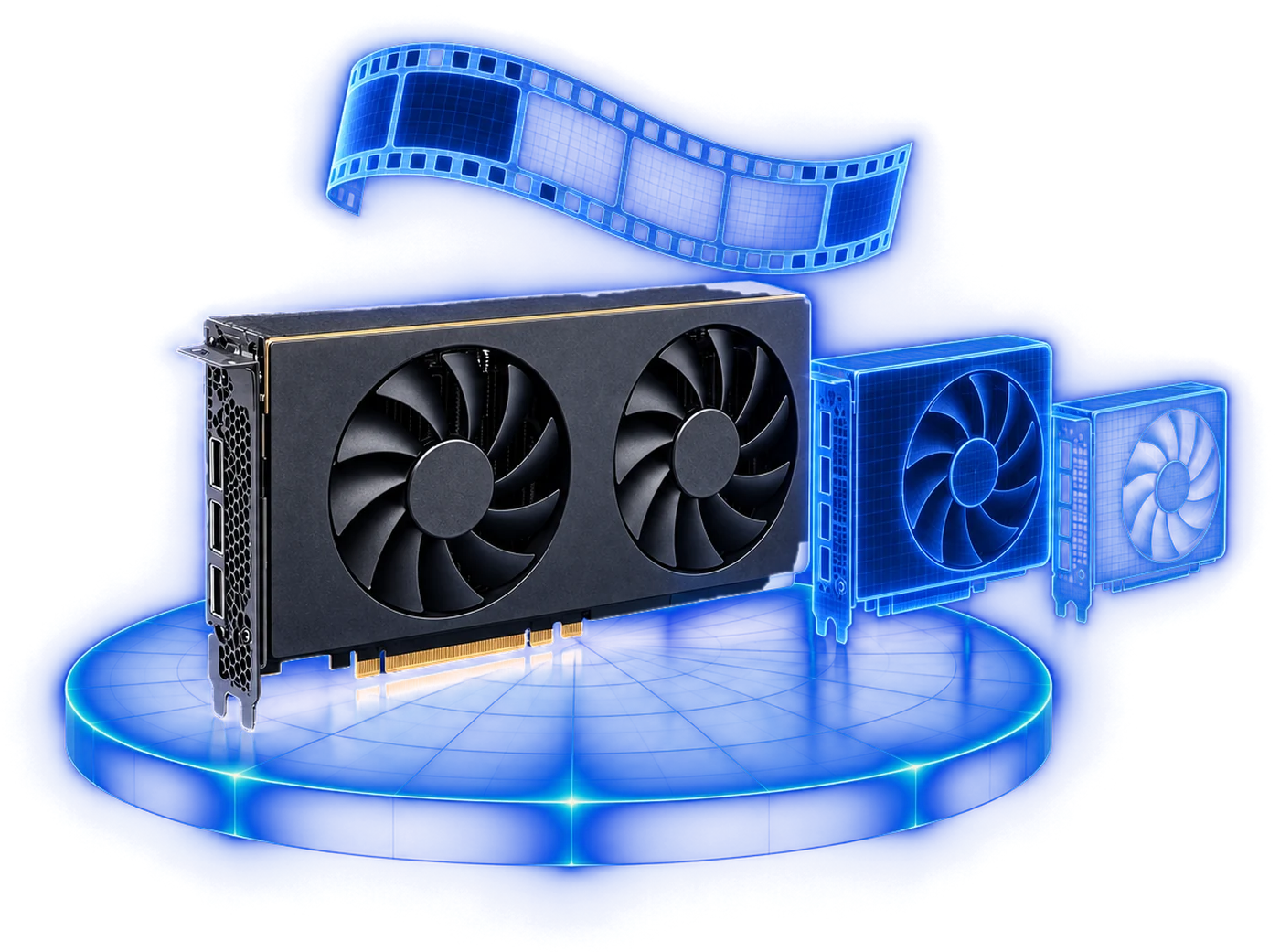
The short answer, 16 Oct 2026
- $0.33/hrCheapest hour you can get. A Vast.ai interruptible bid on a single 300 W Max-Q card, with the disk billed on top at $0.65 per GB-month and the card lost whenever a higher bid arrives1.
- $0.95/hrCheapest marketplace listing. A Max-Q card with 8 vCPU and 96 GB of RAM on a Vast.ai host in British Columbia, on PCIe Gen 4, disk and traffic extra; the cheapest full-power 600 W Workstation card started at $1.001.
- $1.09/hrCheapest dedicated machine at list price. Beam's RTX PRO 6000 machine from $1.09 with 16 vCPU, 128 GB of RAM, a 1 TB NVMe drive and no egress fees; Beam's plans start at $20 a month with $20 of credit2.
- $1.15/hrCheapest machine with everything included. GPUBank at $1.15, billed per second, with 16 vCPU, 188 GB of RAM, a 2 TB NVMe disk, an IPv4 address and all traffic; about $0.72 effective after the 60 percent bonus on a $1,000 top-up, $0.92 reserved and $0.69 interruptible3.
The RTX PRO 6000 is the professional Blackwell card that puts 96 GB of memory on a single PCIe board, and in October 2026 the hour sold under that name runs from a 33-cent interruptible bid to $5.50 per GPU on Azure, with GetDeploying's median across 165 on-demand configurations at $2.214. The spread is not noise. Each price buys a different machine, a different meter and a different promise about interruption, and it also buys one of three editions of the card that do not run at the same speed: a 600 W Workstation card, a 300 W Max-Q, or a passively cooled Server Edition with less memory bandwidth. A page that lines up those hours without saying which is which compares things that cannot be compared, so every row below says what the hour includes, how it is billed, the smallest unit you can rent and, where the provider says so, which edition you get.
We started from our own survey of 29 September 2026 and re-read every figure on 16 October 2026 on the provider's own page, or on Vast.ai's public offer search, which lists the live listings behind its marketplace. Figures we could only see on an aggregator are labelled as such with the aggregator named. More than one price in five had moved in two weeks: Runpod's Secure Cloud went from $2.09 to $2.49, Verda's on-demand hour from $1.96 to $2.30, Nebius switched its preemptible capacity to a floating spot price on 8 October, and Vast.ai's own pricing pages for all three editions showed no offers while its search returned 81 rentable listings56781. This page is published by GPUBank, a GPU cloud run by GPU Compute OÜ in Tallinn, so read our own entry with that in mind: it is measured on the same terms as every other offer, and the text says where a marketplace, a spot tier or another cloud beats it.
01 / Three editions, one name
Which RTX PRO 6000 you actually rent
Three cards share the RTX PRO 6000 name, the same chip and the same 96 GB, but not the same speed. The Workstation Edition runs at up to 600 W with 1,792 GB/s, the Max-Q keeps that bandwidth under a 300 W cap with a blower cooler made for four cards in one tower, and the Server Edition is passive, configurable from 400 to 600 W, and rated at 1,597 GB/s9111213. Two limits follow. Bandwidth sets the ceiling for single-stream token generation, so the Server Edition is up to about 11 percent slower than the other two on a one-user chat with a large model. Power sets the speed of compute-bound work such as diffusion, rendering and batched prefill, so the Max-Q gives up the most there: Puget Systems measured it 5 to 14 percent slower than the 600 W card in most content-creation tests, and 14 percent behind on Unreal Engine and DaVinci Resolve GPU effects47.
Edition 1 of 3
Workstation Edition9
- Memory
- 96 GB GDDR7 ECC
- Cooling
- Double flow-through, open-air cooler
- Price
- $16,000NVIDIA US marketplace, August 2026 (launch listing $8,565)43
1,792 GB/s and the full 600 W: the fastest of the three for both decoding and compute-bound work, but its cooler suits one or two cards per desktop rather than racks.
Edition 2 of 3
Max-Q Workstation Edition11
- Memory
- 96 GB GDDR7 ECC
- Cooling
- Blower, exhausts through the rear bracket
- Price
- $22,256GPU Poet, October 2026 average of the cheapest eBay listings (estimated MSRP $10,999)45
- Who rents it
- Vast.ai marketplace, 25 rentable listings from $0.95 on demand and $0.33 interruptible on 16 Oct 20261
Same 1,792 GB/s, so single-user token speed matches the 600 W card, but Puget measured it 5 to 14 percent slower on compute-bound work.
Edition 3 of 3
Server Edition12
- Memory
- 96 GB GDDR7 ECC
- Cooling
- Passive, cooled by the server chassis
- Price
- $23,288GPU Poet, October 2026 average of the cheapest eBay listings; NVIDIA publishes no MSRP46
1,597 GB/s, about 11 percent less bandwidth than the workstation cards; its speed on compute-bound work depends on the power limit the host sets.
Power gauges on one scale, 0 to 600 W; the hatched part of the Server Edition arc is the range a host can set. Prices are purchase prices of one card.
The power limit a host sets matters as much as the edition. HOSTKEY found its Server Edition running at about 300 W in its default mode and measured a Wan 2.2 14B generation 25 percent shorter, 30 minutes per clip instead of 40, after switching it to the 600 W mode38, and the Workstation card can be configured down to 150 W37. A cheap listing can therefore be a power-capped card, in which case each job costs more than the hourly rate suggests. Clouds that name the edition sell the Server Edition: AWS, CoreWeave, Verda, Hyperstack and Lium all say so1518241923. Vast.ai lists all three as separate filters, and on 16 October its cheapest on-demand Max-Q cost $0.95, its cheapest Workstation card $1.00 and its cheapest Server card $1.331. GPUBank lists 1.8 TB/s, which matches the Workstation and Max-Q datasheets, but does not state the edition or power limit3.

What fits in 96 GB
The table of fits shows why so many renters pick this card despite the edition question. Weights alone take about 2 bytes per parameter in 16-bit, 1.06 in 8-bit and 0.58 in 4-bit, and a model fits comfortably when they leave room for activations and cache. A 70B model fits in 8-bit with a modest cache and in 4-bit with room to spare, gpt-oss-120b fits in its native 4-bit form, Qwen3 32B, FLUX.1 dev and Wan 2.2's two 14B experts fit at any precision, and Mixtral 8x22B fits only in 4-bit, with about 14 GB left for context3132.
Weights of each model on one 96 GB card
Fits, room left for cacheTight, 85 to 96 GBDoes not fit on one card
Llama 3.3 70B70.6B parameters
Qwen3 32B32.8B parameters
gpt-oss-120b117B parameters
Mixtral 8x22B141B parameters
FLUX.1 dev12B parameters
Wan 2.2 A14B (two 14B experts)27B parameters
02 / The card
What the RTX PRO 6000 is and who rents it
NVIDIA's RTX PRO 6000 Blackwell carries 96 GB of GDDR7 with ECC, fifth-generation Tensor Cores that compute in FP4, and a PCIe Gen 5 host interface, and it has no NVLink bridge, so work spread over several cards talks over PCIe9. It is the GB202 die of the GeForce RTX 5090 with more of it switched on: 24,064 CUDA cores, 752 Tensor Cores, 188 RT cores and a 512-bit memory bus, with three times the memory10. Multi-Instance GPU can split one card into four 24 GB or two 48 GB slices, which is why Runpod also sells 48 GB and 24 GB slices at $1.29 and $0.69 an hour, and why a cheap listing is worth checking for being a whole card5. It launched in 2025 in three editions built around the same chip and the same memory. The Workstation Edition has a double flow-through cooler rated at 600 W and 1,792 GB/s of memory bandwidth, the Max-Q Workstation Edition keeps the bandwidth but is capped at 300 W, and the Server Edition, passively cooled for data-centre chassis, is configurable from 400 to 600 W and rated by NVIDIA at 1,597 GB/s and 4 PFLOPS of FP4111213. That one-ninth difference in bandwidth and the factor of two in power are why the edition matters, a point the section at the end of this page works through.
Being a professional card is what puts it in clouds at all. NVIDIA's GeForce licence rules out data-centre deployment of consumer cards such as the RTX 5090, while the RTX PRO line is built and licensed for it14, which is why AWS sells it in its G7e instances, Google in G4, Oracle in an 8-GPU bare-metal shape and CoreWeave in 8-GPU nodes, alongside specialised clouds and marketplaces15161718. The people renting it are mostly teams that want a 70B-class model or gpt-oss-120b on one card instead of two or four smaller ones, creators running Wan 2.2 video and large image models without offloading weights to system RAM, and fine-tuners who want 96 GB for LoRA or QLoRA on large models. The price range follows from that mix: the same card is sold as a shared slice, a marketplace listing, a bid, a reservation, a serverless worker and one-eighth of a hyperscaler server, and each of those carries a different price for reasons that have little to do with the silicon.
03 / The price ladder
How to read the RTX PRO 6000 market
A managed on-demand cloud sells a fixed machine, the GPU with its vCPUs, memory and local disk, at one hourly price, and the differences between clouds lie in what else that price covers. GPUBank includes the IPv4 address and all traffic and bills only a persistent disk on top3, Beam includes 16 vCPU, 128 GB of RAM and a 1 TB NVMe drive2, Hyperstack bills only the GPU line with CPU and RAM included up to its stated maxima19, and Runpod adds container and volume disk charges5. A cheaper managed hour can still produce a larger bill, so the cost section below prices whole months rather than hours. One offer does not fit any of the usual boxes: packet.ai's $0.66 Dynamic tier is a full card's memory on a card shared between tenants under scheduler isolation, a different product from a dedicated hour at the same price; its page includes up to 2 TB of local NVMe per node and charges no egress, but publishes no price for storage that outlives an instance20.
On a peer-to-peer marketplace independent hosts post their own GPU rate and add disk and bandwidth as separate lines, and the machine changes from one listing to the next. On Vast.ai on 16 October the cheapest listing was a 300 W Max-Q at $0.95 with 8 vCPU on a PCIe Gen 4 host1. Spot or interruptible capacity is cheaper because it can be taken back: Vast.ai bids start at $0.33, GPUBank's interruptible tier is $0.69 with five minutes of notice, and Nebius floats from $0.79137. Reserved capacity runs from week-long terms to three-year commitments and is often sold by the 2-GPU or 8-GPU server, serverless workers bill active seconds at two to three times a dedicated hour, and the hyperscalers price the card at $3.36 to $5.50 per GPU, usually as part of a larger machine.
Managed on demandA fixed machine at one hourly price.
MarketplaceHosts set their own price; machines vary.
Spot and interruptibleCheaper hours that can be taken back.
ReservedCommitted for a term, paid either way.
ServerlessBilled by active seconds.
04 / Provider by provider
What each price buys, and what it leaves out.
The captures below were taken on 16 Oct 2026 from each provider's own RTX PRO 6000 or pricing page, so every figure can be read next to the conditions printed beside it.
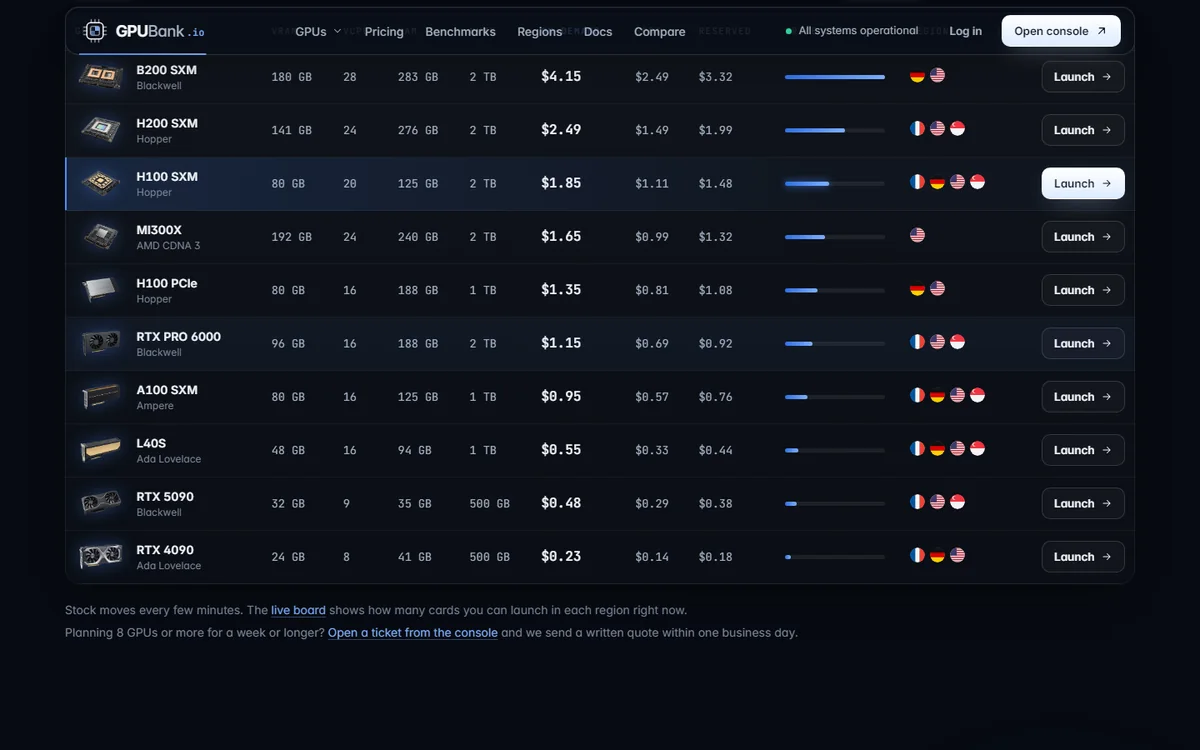
GPUBankAll-in
$1.15/hr
Managed cloud · 1 to 8 GPUs
16 vCPU188 GB RAM2 TB NVMeIPv4 and all trafficPersistent disk $0.03/GB-month$0.72 effective from a $1,000 top-up
GPUBank sells the RTX PRO 6000 at $1.15 an hour with 16 vCPU, 188 GB of RAM, a 2 TB local NVMe disk, an IPv4 address and all traffic, billed per second from the moment the machine passes its health check, with no minimum3. The same card costs $0.69 interruptible, with five minutes of notice and a stop rather than a deletion, and $0.92 reserved for a week or a month. A top-up bonus of up to 60 percent brings the effective on-demand hour to $0.72, but payment is in crypto only and cards are not accepted for now. The pricing page gives 1.8 TB/s but not the edition or power limit, which is worth asking before a long reservation.3
Checked 16 Oct 2026
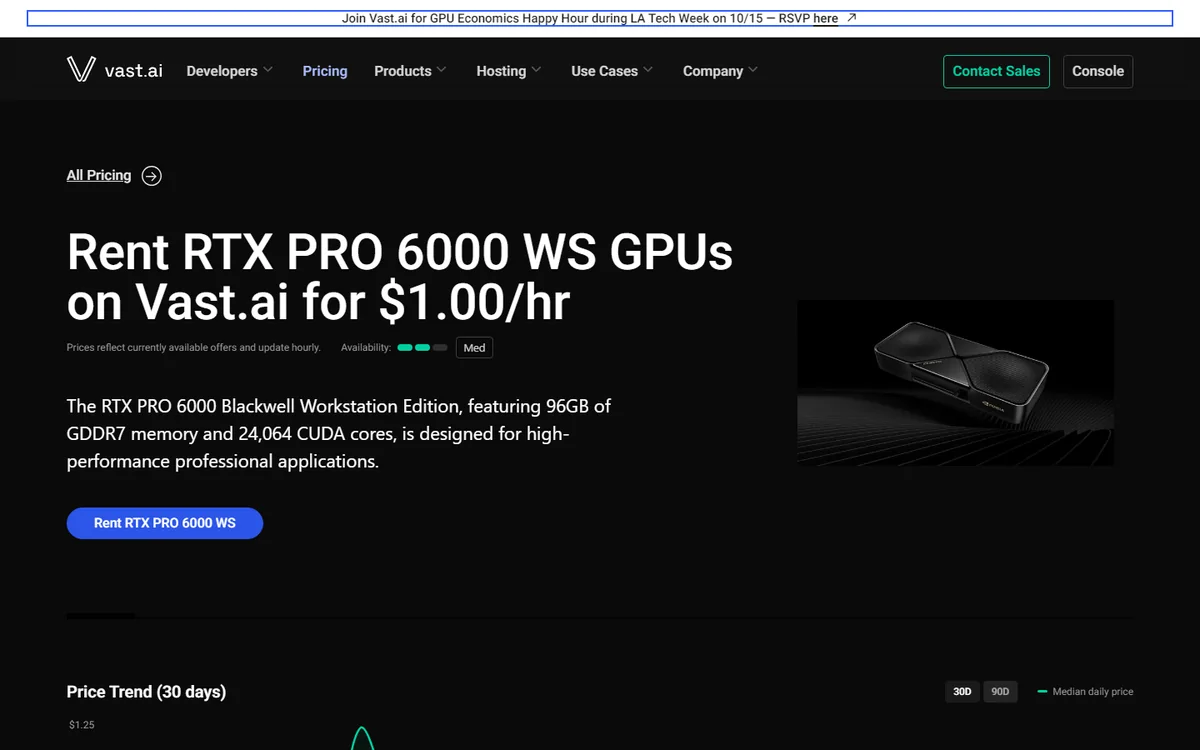
 Vast.ai
from $0.95/hr
Marketplace · all three editions
GPU rate set by the hostvCPU and RAM vary by listingDisk $0.13 to $0.87/GB-monthTraffic up to $0.04/GBBids from $0.33
Vast.ai is the one marketplace that sells all three editions under separate names, and its public offer search returned 81 rentable RTX PRO 6000 listings on 16 October 2026 even though its own pricing pages read "No current offers"18. The cheapest on-demand listing was a 300 W Max-Q at $0.95 with 8 vCPU and 96 GB of RAM in British Columbia on PCIe Gen 4, the cheapest Workstation card $1.00 and the cheapest Server card $1.33 on hosts of two to eight GPUs. Interruptible bids started at $0.33 for one Max-Q. Each host adds its own disk rate, between $0.13 and $0.87 per GB-month on these listings, and a bandwidth charge, and storage keeps billing while an instance is stopped30. Billing is per second. The price is the lowest on the market; the machine, the edition and the host's reliability are yours to check.1
Checked 16 Oct 2026
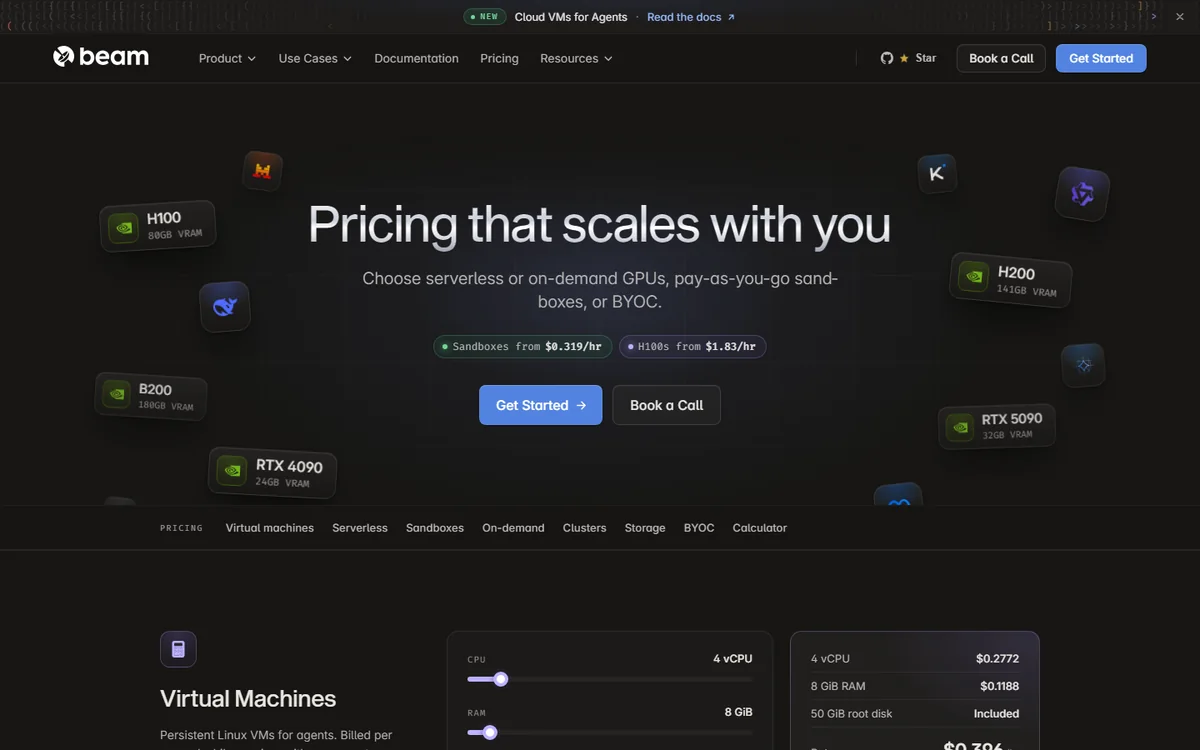
 Beam
$1.09/hr
Managed cloud · single-GPU machines
16 vCPU128 GB RAM1 TB NVMePlans from $20/month with $20 credit
Beam's pricing page lists an RTX PRO 6000 machine from $1.09 an hour with 16 vCPU, 128 GB of RAM and a 1 TB NVMe drive, and its own pricing article of 29 September 2026 gives the same rate with vCPU, RAM and NVMe included248. That is the cheapest dedicated full machine we could read on a provider's own page, six cents below GPUBank's list price, with 60 GB less system memory. The page does not say whether $1.09 is the exact rate or a starting price, nor which edition the PCIe card is. Beam's plans start with a $20 Developer plan that includes $20 of credit each month, and its Team plan costs $89 a month plus usage, so a light user should count the plan in the hour. Card payment is the norm, which makes Beam the simplest alternative for a buyer who cannot pay in crypto.2
Checked 16 Oct 2026
 Nebius
$1.80/hr
Managed cloud · 1 or 8 GPUs
24 vCPU218 GB RAMPreemptible from $0.79, floatingStorage extra
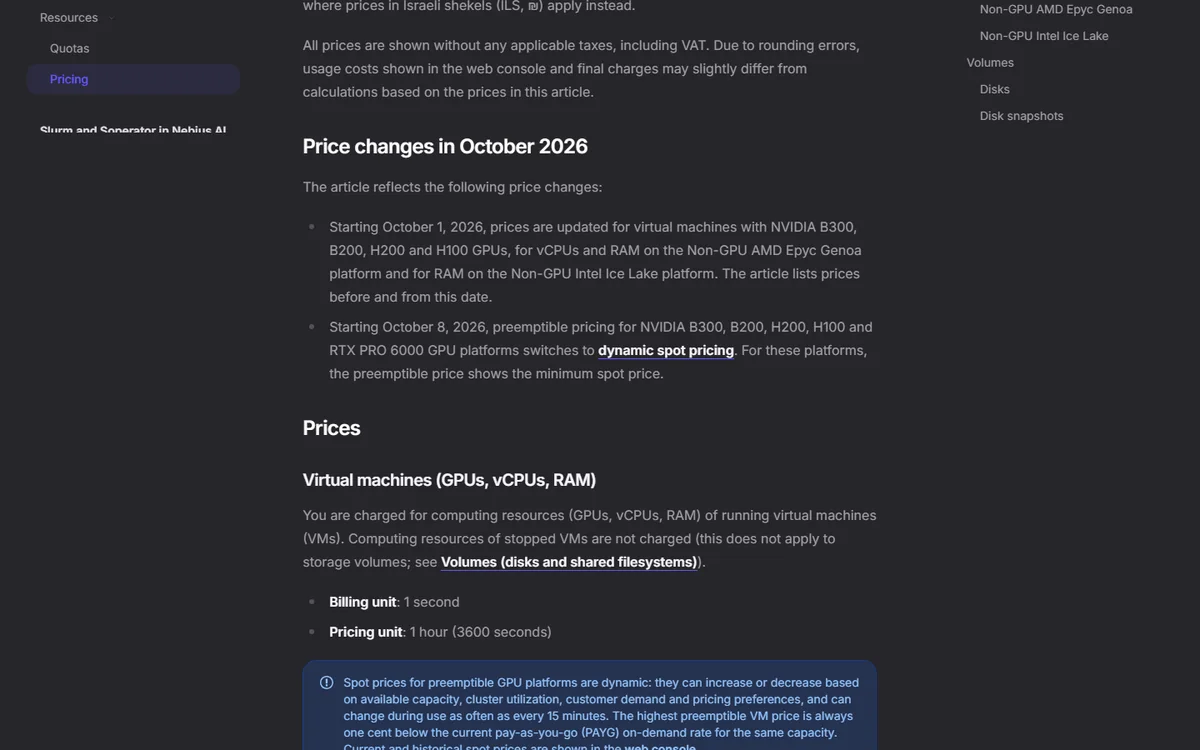
Nebius lists the RTX PRO 6000 at $1.80 per GPU-hour on demand in us-central1, unchanged by its October price increases on data-centre cards7. Its preemptible price moved on 8 October 2026 from a fixed $0.95 to dynamic spot pricing that starts at $0.79, can rise or fall with available capacity, and is capped one cent below the on-demand rate, with the current and past prices shown in the console. GetDeploying lists the instances at 24 vCPU and 218 GB of RAM per GPU in 1-GPU and 8-GPU presets4. Storage and network are billed separately. Nebius is a reasonable choice for a team that already runs there, and its spot floor sits close to GPUBank's $0.69 interruptible hour, but for a single card bought on demand it costs 65 cents an hour more than GPUBank's all-in price.7
Checked 16 Oct 2026
 Hyperstack
$1.85/hr
Managed cloud · Server Edition
Up to 31 pCPUUp to 180 GB RAMRoot and ephemeral NVMeSpot $1.48Reserved from $1.30Volumes $0.07/GB-month
Hyperstack's pricing page lists the RTX PRO 6000 SE, the Server Edition, at $1.85 an hour on demand, $1.48 on spot and from $1.30 reserved, with up to 31 pCPU and 180 GB of RAM per GPU and only the GPU billed19. Shared volumes cost $0.000096774 per GB-hour, about $0.07 per GB-month, so a 500 GB volume adds $35.32 to a month. GetDeploying saw both the on-demand and spot flavours out of stock on 15 October4, which leaves the reserved price as the main reason to look here: from $1.30 it undercuts most European and US clouds, though it remains above GPUBank's $0.92 week or month and well above the aggregator-only reservations of HyperAI and Leaseweb. The Server Edition label also tells you exactly which card you get.19
Checked 16 Oct 2026
 Runpod
$2.49/hr
Managed cloud and community · per second
16 vCPU188 GB RAMCommunity Cloud $1.69Serverless $3.49Volume disk $0.20/GB-month idle
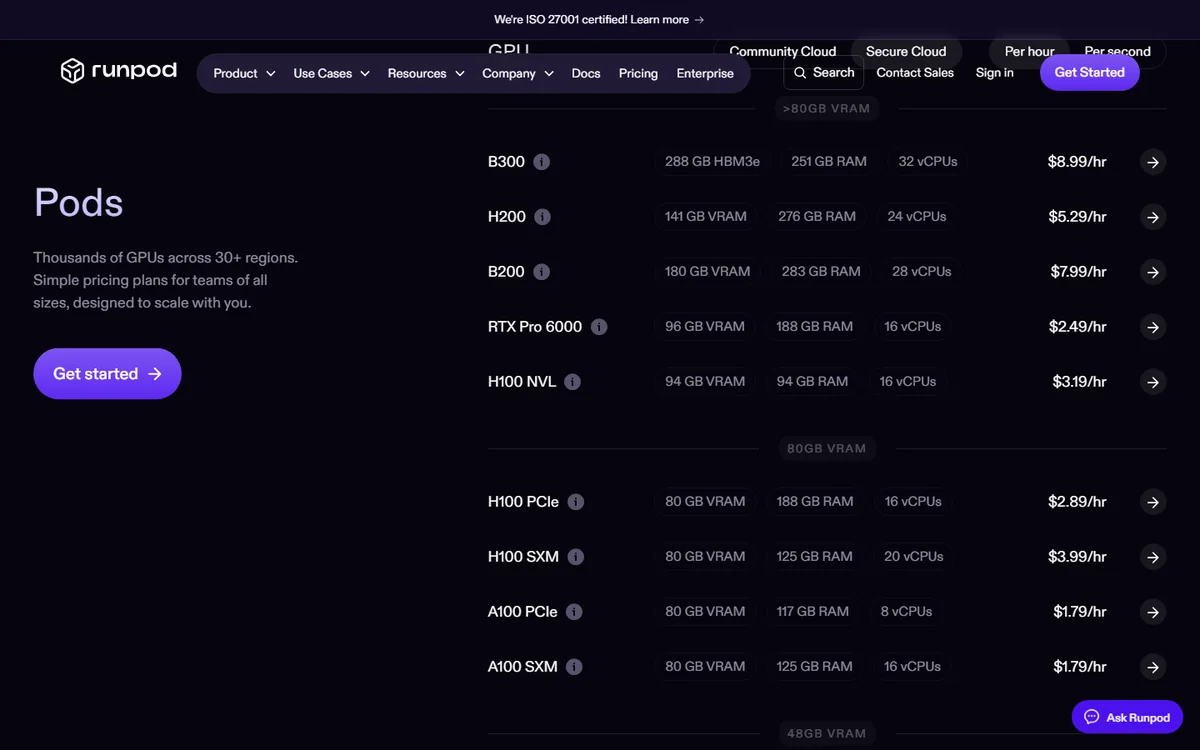
Runpod's pricing page lists the RTX Pro 6000 at $2.49 an hour in its Secure Cloud with 16 vCPU and 188 GB of RAM, up from $2.09 on 29 September, at $1.69 in its Community Cloud, where independent hosts supply the machines, and at $3.49 for a 96 GB serverless worker5. Billing is per second. Disk is where Runpod gets expensive for this card: a container disk costs $0.10 per GB-month, a volume disk $0.10 while the pod runs and $0.20 while it is idle, and network storage $0.07 under 1 TB. Kept for a month with the pod mostly stopped, a 500 GB volume costs close to $96, more than six times GPUBank's $15. Runpod's case is its tooling and template ecosystem, and its Community tier is the cheaper entry point when stock is there.5
Checked 16 Oct 2026
Where GPUBank wins, and where it does not
GPUBank rents the RTX PRO 6000 at $1.15 per GPU-hour on demand, $0.69 interruptible and $0.92 reserved for a week or a month, each with 16 vCPU, 188 GB of RAM, a 2 TB NVMe disk, one IPv4 address and all inbound and outbound traffic, in machines of 1, 2, 4 or 8 GPUs3. Billing is per second with no minimum, the meter starts after the health check, a failed launch is not billed, and the only extra line is a persistent disk at $0.03 per GB-month. Payment is a prepaid balance topped up in crypto from $25, and the top-up bonus brings the on-demand hour to about $0.96 from $25, $0.85 from $100 and $0.72 from $1,0003. It is listed in Paris, Ashburn and Singapore, and the median launch to a machine that has passed its health check takes 48 seconds29. Where it wins is the all-in month: no egress, no IP line and a cheap stopped disk made it the cheapest dedicated option in all three scenarios below, beaten on paper only by a shared card or a floating spot floor before their storage is counted, or by a marketplace bid whose disk is deleted between runs.
Where it loses is the headline hour. Vast.ai bids at $0.33 and Max-Q listings at $0.95, packet.ai's shared $0.66, HyperAI's $0.80 and Beam's $1.09 dedicated machine are all below its $1.15 list price, and its interruptible tier at $0.69 is twice the cheapest Vast.ai bid120212. Its reservation at $0.92 needs only a week but is prepaid and cannot be refunded once it starts. It takes no cards for now, which rules it out for a buyer who can only pay by card. And its pricing page lists 96 GB GDDR7 ECC at 1.8 TB/s without naming the edition or power limit behind the rental, so a buyer whose job depends on sustained power should ask before reserving3.
The rest of the market
Several offers below GPUBank's $1.15 list price could only be partly checked. packet.ai's $0.66 is on its own page but sits on a shared card, with the dedicated tier listed as launching soon20. HyperAI's pricing page lists the card at $0.80 an hour without stating the vCPU, RAM or disk that come with it, and GetDeploying shows a one-month reservation at $0.48 that we could not find on HyperAI's site214. Hostinger at $0.65 and GPUhub at $1.10 appear only on GetDeploying, which saw GPUhub in stock with 22 vCPU and 110 GB of RAM on 15 October4. Clore.ai's own documentation carries a dated snapshot of 24 August 2026 that put the card at $0.92 to $1.38 with a median of $1.21, from only four free servers, and no live price could be read since22. Lium's Server Edition pods were asking $1.60 to $1.99 per GPU on 8-GPU machines, billed per second23.
Above GPUBank's list price a group of European and US clouds sells dedicated single cards between $1.74 and $2.41: Nova Cloud at $1.74, UpCloud at $1.88, EcoHash at $1.89, Cloudzy at $1.93, Lyceum at $1.99, JarvisLabs at $2.19, Koyeb at $2.20 and Sesterce at $2.41, all from GetDeploying's crawl of 15 October, and Verda at $2.30 on its own page with 30 CPU threads and 90 GB of RAM per GPU4624. Massed Compute's own page lists the card at $2.19 with 16 vCPU, 144 GB of RAM and 725 GB of storage, and Exoscale sells it at $2.00 per GPU only as an eight-card node254. Their case rests on something other than price: a specific European jurisdiction, card payment, or an existing account. On the spot side, Verda's interruptible instances cost $1.15 and its serverless containers $2.53, or $1.27 on spot, while CoreWeave sells 8-GPU Server Edition spot nodes at $9.56 an hour, $1.195 per GPU618. CloudRift's own page quotes the card only reserved, $1.16 for a month and $1.10 for three, with on-demand capacity on request26. The long-term reservations seen on aggregators, Leaseweb at $0.88 per GPU on a 2-GPU server for a month, Database Mart at $0.90 on a 24-month term and Utho at $1.18 on 36 months, need a quote before anyone plans around them4.
The large clouds, per GPU
AWS and CoreWeave name the Server Edition in their offers, and the large clouds cost two to five times a specialised cloud at list price. AWS sells it in G7e instances from the g7e.2xlarge, one GPU with 8 vCPU and 64 GiB, at $3.363 an hour on demand and about $2.56 on spot, up to the 8-GPU g7e.48xlarge with 192 vCPU and 2 TiB at $33.14, or $4.14 per GPU, with EBS storage and egress billed on top152728. Google's g4-standard-48 gives one GPU with 48 vCPU and 180 GB for $4.50 an hour in us-central1, $3.105 on a one-year commitment, $1.98 on three years and about $1.71 on spot16. GetDeploying lists Azure's full-GPU size at $5.50 per GPU and Oracle's BM.GPU.RTXPRO.8 at $4.50 per GPU, the Oracle shape being a bare-metal server with 8 cards, 144 OCPU and 3 TB of RAM417.
CoreWeave's 8-GPU Server Edition node with 128 vCPU, 1,024 GB of RAM and 7.68 TB of local storage costs $20.00 an hour on its own page, which is $2.50 per GPU, the cheapest of this group but only by the whole node18. These clouds make sense when the rest of a stack already runs there, when enterprise discounts bring the effective rate down, or when compliance demands a particular provider. For a team that only needs the card, the hyperscaler premium buys nothing the card itself does faster, and the per-GPU price of an 8-GPU instance is only reachable by renting all eight.
05 / Every offer
The whole comparison, sorted by kind and price.
| Provider | USD / GPU-hr | Kind | Unit | What the price includes | Billing | Stock | Basis |
|---|---|---|---|---|---|---|---|
| HHostinger | $0.65 | Managed on demand | 1 GPU | Inclusions not stated | Hourly | Not stated | Aggregator4 |
| ppacket.ai | $0.66 | Managed on demand | 1 GPU | Shared card (multi-tenant), no egress fees | Hourly | In stock | Provider page20 |
| HHyperAI | $0.80 | Managed on demand | 1 GPU | Machine not stated on the pricing page | Not stated | Not stated | Provider page21 |
| Beam | $1.09 | Managed on demand | 1 GPU | 16 vCPU, 128 GB RAM, 1 TB NVMe | Not stated | Not stated | Provider page2 |
| GGPUhub | $1.10 | Managed on demand | 1 GPU | 22 vCPU, 110 GB RAM | Not stated | In stock | Aggregator4 |
| GPUBank | $1.15 | Managed on demand | 1 GPU | 16 vCPU, 188 GB RAM, 2 TB NVMe, IPv4, all traffic | Per second | In stock | Provider page3 |
| Nebius | $1.80 | Managed on demand | 1 GPU | 24 vCPU, 218 GB RAM; storage extra | Per hour | Not stated | Provider page7 |
| Hyperstack | $1.85 | Managed on demand | 1 GPU | Up to 31 pCPU, 180 GB RAM; Server Edition | Per minute | Sold out | Provider page19 |
 Massed Compute | $2.19 | Managed on demand | 1 GPU | 16 vCPU, 144 GB RAM, 725 GB storage | Not stated | Not stated | Provider page25 |
 Verda | $2.30 | Managed on demand | 1 GPU | 30 CPU threads, 90 GB RAM; Server Edition | Not stated | In stock | Provider page6 |
| Runpod | $2.49 | Managed on demand | 1 GPU | 16 vCPU, 188 GB RAM; disks extra | Per second | In stock | Provider page5 |
 Clore.ai | $0.92 | Marketplace | 1 GPU | Range $0.92 to $1.38, median $1.21 (24 Aug 2026) | Per minute | Not stated | Provider snapshot22 |
| Vast.ai | $0.95 | Marketplace | 1 GPU | Max-Q 300 W, 8 vCPU, 96 GB RAM; disk $0.13/GB-month | Per second | In stock | Provider page1 |
| Vast.ai | $1.00 | Marketplace | 1 GPU | Workstation 600 W, 16 vCPU; disk $0.20/GB-month | Per second | In stock | Provider page1 |
| Vast.ai | $1.33 | Marketplace | 1 GPU | Server Edition on 2 to 8-GPU hosts | Per second | In stock | Provider page1 |
 Lium | $1.60 | Marketplace | 8-GPU node | Server Edition pods, asks $1.60 to $1.99 | Per second | In stock | Provider page23 |
| Runpod | $1.69 | Marketplace | 1 GPU | Community Cloud, 16 vCPU, 188 GB RAM | Per second | In stock | Provider page5 |
| Vast.ai | $0.33 | Spot and interruptible | 1 GPU | Minimum bid, Max-Q; disk $0.65/GB-month | Per second | In stock | Provider page1 |
| NNova Cloud | $0.66 | Spot and interruptible | 1 GPU | 22 vCPU, 82 GB RAM | Not stated | In stock | Aggregator4 |
| GPUBank | $0.69 | Spot and interruptible | 1 GPU | As on demand, 5 min notice, stop not delete | Per second | In stock | Provider page3 |
| Nebius | $0.79 | Spot and interruptible | 1 GPU | Floating price, floor shown | Per hour | Not stated | Provider page7 |
 Azure | $1.02 | Spot and interruptible | 1 GPU | 128 vCPU, 256 GB RAM | Per second | Not stated | Aggregator4 |
| Verda | $1.15 | Spot and interruptible | 1 GPU | 30 CPU threads, 90 GB RAM | Not stated | In stock | Provider page6 |
 CoreWeave | $1.20 | Spot and interruptible | 8-GPU node | 128 vCPU, 512 GB RAM, 7.68 TB | Per hour | Not stated | Provider page18 |
| HHyperAI | $0.48 | Reserved | 1 GPU | One month, 32 vCPU, 90 GB RAM | Per term | In stock | Aggregator4 |
| LLeaseweb | $0.88 | Reserved | 2-GPU server | 2-GPU dedicated server, one month | Per term | Not stated | Aggregator4 |
| DDatabase Mart | $0.90 | Reserved | 1 GPU | 24-month term, 32 vCPU, 84 GB RAM | Per term | Not stated | Aggregator4 |
| GPUBank | $0.92 | Reserved | 1 GPU | Week or month, prepaid | Per term | In stock | Provider page3 |
 CloudRift | $1.10 | Reserved | 1 GPU | Three months | Per term | Not stated | Provider page26 |
| CloudRift | $1.16 | Reserved | 1 GPU | One month; on demand on request | Per term | Not stated | Provider page26 |
| Hyperstack | $1.30 | Reserved | 1 GPU | Starting price, terms on request | Per term | Not stated | Provider page19 |
| CoreWeave | $2.50 | Large clouds | 8-GPU node | 128 vCPU, 1,024 GB RAM, 7.68 TB | Per hour | Not stated | Provider page18 |
 AWS | $3.36 | Large clouds | 1 GPU | g7e.2xlarge, 8 vCPU, 64 GiB; EBS, egress extra | Per second | Not stated | Aggregator27 |
 Google Cloud | $4.50 | Large clouds | 1 GPU | g4-standard-48, 48 vCPU, 180 GB | Per second | Not stated | Aggregator16 |
 Oracle Cloud | $4.50 | Large clouds | 8-GPU node | Bare metal, 144 OCPU, 3 TB RAM | Per hour | Not stated | Aggregator4 |
| Azure | $5.50 | Large clouds | 1 GPU | 128 vCPU, 256 GB RAM | Per second | Not stated | Aggregator4 |
| Verda | $2.53 | Serverless | 1 GPU | Containers, $1.27 on spot | Per second | Not stated | Provider page6 |
| Runpod | $3.49 | Serverless | 1 GPU | 96 GB worker; storage extra | Per second | Not stated | Provider page5 |
"Aggregator" rows could not be read on the provider's own page that day; "Provider snapshot" rows come from a page dated by the provider.
06 / The real monthly bill
The real cost beyond the hourly rate
Storage is the line that most often overturns an hourly comparison, because model weights for this card are large and live on disk between sessions. A 500 GB persistent disk costs $15.00 a month on GPUBank and nothing else is billed while the machine is stopped3. The same 500 GB costs about $35.32 a month on Hyperstack at $0.000096774 per GB-hour19, and on Runpod a volume disk costs $0.10 per GB-month while the pod runs and $0.20 while it is idle, so a mostly idle 500 GB volume approaches $100 a month5. Vast.ai hosts set their own rate, from $0.13 to $0.87 per GB-month on the RTX PRO 6000 listings we read, and storage keeps billing while an instance is stopped130. Traffic is the second line: AWS bills egress at about $0.09 per GB, so a video service sending 5 TB a month would pay roughly $441 for it after the free first 100 GB, more than half the card's own month on GPUBank20. Google bills it too and Vast.ai hosts charge up to $0.04 per GB, while GPUBank, packet.ai and CoreWeave state none3201.
Billing granularity decides the price of short work. A 61-minute job, 3,660 seconds at $0.000319, costs $1.17 on GPUBank, while the same rate billed per started hour costs $2.30 because the sixty-first minute buys a second hour. packet.ai bills hourly20, Runpod and Vast.ai per second51, and the hyperscalers per second after a one-minute minimum. Deposits and credit matter too: GPUBank's minimum top-up is $25 and its balance never expires, Beam's cheapest plan is $20 a month with $20 of credit2, and a top-up bonus is a real discount only on money you will spend. The last cost is lost time. GPUBank restarts a failed host's machine on a healthy one and credits the interrupted session, and a missed spot notice credits 30 minutes3. On a marketplace the hours lost to a host that drops offline, or to a Max-Q sold as a generic card, are usually yours. The scenarios below keep the disk all month, and where a storage price could not be read it is set to zero, which favours that provider.
Three workloads, priced for a month
GPUBank
730 h GPU$839.50
Storage$6.00
OtherNone
Month$845.50
On demand, traffic included
All-inGPUBank
730 h GPU$671.60
Storage$6.00
OtherNone
Month$677.60
Reserved by the month, prepaid
All-inppacket.ai
730 h GPU$481.80
Storage$0.00
OtherStorage price not published
Month$481.80
Shared card, no egress fee
Vast.ai
730 h GPU$691.31
Storage$26.66
Other$7.81 traffic
Month$725.78
Max-Q listing at $0.947/hr exact, 2 TB out at $0.0039/GB
Hyperstack
730 h GPU$949.00
Storage$14.13
OtherNone
Month$963.13
Reserved starting price
Runpod
730 h GPU$1,817.70
Storage$20.00
OtherNone
Month$1,837.70
Secure Cloud, volume disk
GPUBank's month reservation is the cheapest dedicated card here: $671.60 for the GPU and $6.00 for 200 GB of disk make $677.60, against $725.78 for a Vast.ai Max-Q listing once its $26.66 of disk and $7.81 of traffic are added, $963.13 at Hyperstack's reserved starting price and $1,837.70 on Runpod's Secure Cloud. At on-demand list price GPUBank's $845.50 loses to the Vast.ai listing, and paid from $1,000 top-ups the same on-demand month costs $528.44 in cash. Only packet.ai's shared card undercuts the reservation, at $481.80 before a storage price it does not publish, and only if a card shared with other tenants gives the latency the API needs. The answer changes for a buyer who can only pay by card, for whom packet.ai or Vast.ai lead, and for anyone who accepts a 300 W Max-Q on a PCIe Gen 4 host, which runs a 4-bit 70B model at the same bandwidth but loses on prefill.
GPUBank
88.9 h GPU$102.22
Storage$9.00
OtherNone
Month$111.22
On demand
All-inGPUBank
88.9 h GPU$61.33
Storage$9.00
OtherNone
Month$70.33
Interruptible, clips re-run if reclaimed
All-inNebius
88.9 h GPU$70.22
Storage$0.00
OtherStorage not counted
Month$70.22
Preemptible at its floor
Verda
88.9 h GPU$102.22
Storage$0.00
OtherStorage not counted
Month$102.22
Spot
Vast.ai
88.9 h GPU$35.56
Storage$60.00
OtherNone
Month$95.56
Max-Q bid in Virginia, disk kept all month
At HOSTKEY's 160 seconds per five-second clip, 2,000 clips need 320,000 seconds, or 88.9 hours. GPUBank's interruptible tier does it for $61.33 plus $9.00 of disk, $70.33 in all, and since each clip is independent a reclaimed card only costs the clip in progress. Nebius's preemptible floor of $0.79 gives $70.22 before storage, a tie at best and only if the floating price stays at its floor, while Verda's spot at $1.15 costs $102.22. A Vast.ai Max-Q bid at $0.40 costs $35.56 of GPU time, but its host charges $0.20 per GB-month, so keeping 300 GB of weights all month adds $60.00 and the total reaches $95.56; deleting the instance after a four-day run would cut that to about $43, the cheapest result if you accept rebuilding the disk each month and a 300 W card. On the 14B model at 720p the job grows to about 1,000 GPU-hours and a reserved month becomes the right tool.
GPUBank
61 h GPU$70.15
Storage$15.00
OtherNone
Month$85.15
Per second, stopped between sessions
All-inppacket.ai
61 h GPU$79.20
Storage$0.00
OtherStorage price not published
Month$79.20
Hourly: each 61-minute session bills 2 hours
Vast.ai
61 h GPU$61.00
Storage$100.00
OtherNone
Month$161.00
Workstation listing, disk billed while stopped
Hyperstack
61 h GPU$112.85
Storage$35.32
OtherNone
Month$148.17
Per minute, if in stock
Runpod
61 h GPU$151.89
Storage$95.82
OtherNone
Month$247.71
Volume disk $0.20/GB-month idle
Sixty sessions of 61 minutes are 61 hours of work. GPUBank bills them by the second for $70.15 and adds $15.00 for the stopped 500 GB disk, $85.15 in all, or $63.07 in cash from $100 top-ups. packet.ai's lower $0.66 rate ends up at $79.20 before storage because hourly billing turns each session into two hours, and a Vast.ai Workstation listing at $1.00 costs $61.00 of GPU time but $100.00 of disk at its host's $0.20 per GB-month. Hyperstack comes to $148.17 if stock is there, and Runpod to $247.71, of which $95.82 is the volume disk. GPUBank is the cheapest dedicated card here through per-second billing and a cheap stopped disk rather than its hourly rate. packet.ai's shared card stays $5.95 cheaper only while its storage costs less than that, which it does not publish, and it pulls further ahead if sessions are exact multiples of an hour; from a $100 top-up GPUBank is cheaper either way.
07 / Measured speed
What it is fast at, measured
The card's place follows from two numbers, 96 GB of memory and 1.6 to 1.8 TB/s of bandwidth. The memory holds a 70B model in 4-bit with tens of gigabytes left for KV cache, the same model in FP8 with a short cache, gpt-oss-120b in its native MXFP4, and Wan 2.2's 14B video experts without offloading3132. The bandwidth is roughly that of an RTX 5090 and about half of an H100 SXM, so single-user generation on a large model is modest: Hardware Corner measured Llama 3.3 70B in Q4_K with llama.cpp at 32.0 tokens per second at 4K of context, 28.2 at 16K and 16.6 at 128K33. Batched serving is where the card pays: CloudRift's vLLM runs with 1,000-token prompts and answers at a concurrency of 400 gave one RTX PRO 6000 1,031 output tokens per second on Llama 3.3 70B AWQ, against 1,230 for two RTX 5090s and 467 for two RTX 4090s, and 8,425 on Qwen3-Coder-30B AWQ34. Engine and precision move these figures a long way: NVIDIA's own TensorRT-LLM table, as reported by Eurokommerz, gives 1,724 output tokens per second per Server Edition on Llama 3.3 70B in FP4 with 1,000-token prompts and 296 with 8,192-token prompts, and StorageReview measured 163.1 tokens per second for one request on gpt-oss-120b in LM Studio on a Workstation card3536.
On images, Naveen Kulandaivelu measured FLUX.1 dev at 1024 x 1024 at 3.10 iterations per second over 50 steps on a 600 W Workstation card, about 16.1 seconds per image37. On video, HOSTKEY's tests of the Server Edition in ComfyUI put Wan 2.2 TI2V-5B at 160 seconds for a five-second 720p clip, and the 14B text-to-video model at about 40 minutes per clip in the card's default mode and 30 minutes after switching it to 600 W; HOSTKEY did not publish steps or precision38. At GPUBank's $0.000319 per second that is $0.31 per million output tokens for batched 70B serving ($0.19 at the effective $0.72 hour), $11.33 per million for one user at 28 tokens per second, $0.05 per 5B clip, $0.58 to $0.77 per 14B clip and $5.15 per thousand FLUX images. The card stops being the right tool for multi-GPU training, which wants NVLink, for latency-critical 70B serving, where an H100 or H200 is faster per user, and for any model that fits in 32 GB.

CloudRift, 9 October 2025, one GPU per run on its own hosts.34
CloudRift, 9 October 2025. The 70B model does not fit on one 32 GB or 24 GB card.34
Hardware Corner, RTX PRO 6000 Blackwell; build, OS and power settings not published.33
CHEAPEST HOUR
$0.33
Vast.ai interruptible bid on a Max-Q card
GPUBANK ALL-IN
$1.15
$0.72 effective after a $1,000 top-up
BREAK-EVEN
523 h
a month of use before a $16,000 card beats renting
08 / Per job, not per hour
The RTX PRO 6000 against the other cards, per job
On a model that fits in 32 GB, the RTX 5090 wins per job. CloudRift's Qwen3-Coder-30B AWQ run gave 4,570 tokens per second on one RTX 5090 against 8,425 on the RTX PRO 600034; at GPUBank's $0.48 and $1.15 an hour that is $0.029 per million tokens on the 5090 and $0.038 on the RTX PRO 60003. Trooper.ai's automated runs tell the same story on images, 8.3 seconds per SD3.5 Large image against 12 on the 5090, which is $0.0027 against $0.0016 per image at the same prices39. The larger card earns its price only when the model would otherwise be offloaded, quantised harder or split across cards. Llama 3.3 70B in 4-bit, about 41 GB of weights, does not fit on one 5090, and CloudRift's two-5090 setup at $0.96 an hour on GPUBank produced 1,230 tokens per second against 1,031 for one RTX PRO 6000 at $1.15: close to a tie per token, with the single card keeping 50 GB free for cache and avoiding pipeline parallelism. The L40S at $0.55 has 48 GB and 864 GB/s, enough for a 4-bit 70B model with almost no room for context, and the only shared test we found is Runpod's single-user vLLM run, where the L40S decoded 48 tokens a second against 89 on the RTX PRO 600040.
Against the 80 GB datacenter cards the measurements are few, and they split by workload. CloudRift ran GLM-4.5-Air at 4-bit under heavy batched load and measured 3,140 tokens a second on one RTX PRO 6000 against 2,987 on one H100, so at high concurrency the cheaper card holds its own41. One user at a time is a different matter: Runpod's vLLM test at one request per second gave 89 tokens a second on the RTX PRO 6000, 96 on the A100 SXM, 109 on the H100 PCIe and 165 on the H100 SXM, which at GPUBank's prices is $3.59 per million tokens against $2.75, $3.44 and $3.11403. Spread over several cards the lack of NVLink shows: in the same CloudRift study four H100s served Qwen3-Coder-480B about 31 percent faster than four RTX PRO 6000s, and eight H100s ran GLM-4.6 in FP8 nearly three times as fast as eight of them41. For a team serving one large model to many users, or generating video, the RTX PRO 6000's 16 extra gigabytes and lower price usually decide it; for multi-GPU work or one-user latency on a 70B model, the H100 SXM at $1.85 is the better hour.
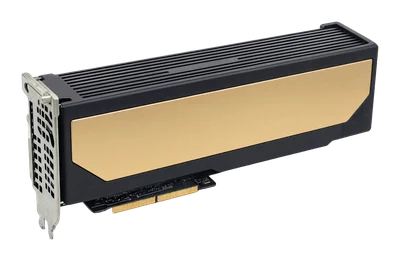
RTX 5090
32 GB GDDR7 · 1.8 TB/s
$0.48/hr
FLUX, SDXL, AI video and small language models
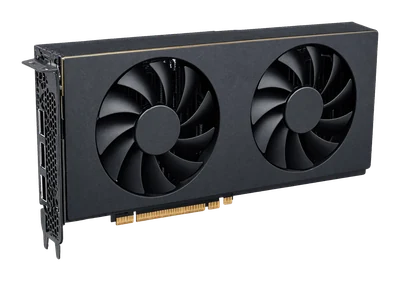
L40S
48 GB GDDR6 ECC · 864 GB/s
$0.55/hr
Stable Diffusion, video, Whisper transcription and embeddings
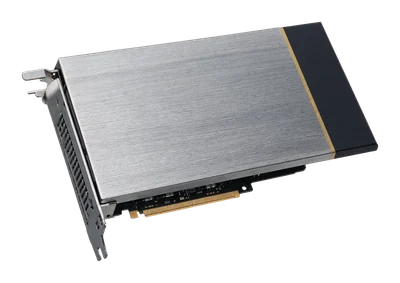
RTX PRO 6000
96 GB GDDR7 ECC · 1.8 TB/s
$1.15/hr
Serving 70B models in 4-bit and AI video generation
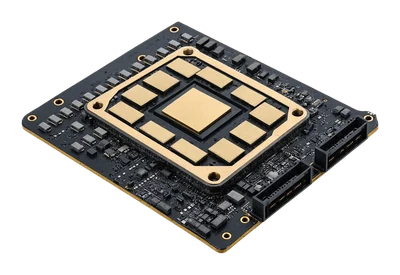
H100 PCIe
80 GB HBM2e · 2.0 TB/s
$1.35/hr
Single-GPU training and inference on a budget
H100 SXM
80 GB HBM3 · 3.35 TB/s
$1.85/hr
AI training, fine-tuning and production LLM inference
GPUBank on-demand prices, all-in. Memory bar scaled to 96 GB.
09 / Rent or buy
Rent or buy one card
Buying has become expensive. The Workstation Edition was listed at $8,565 at launch, NVIDIA's own US marketplace raised it from $13,250 to $16,000 in August 2026, against street prices in mid-2026 of $12,099.99 at Newegg for the Workstation Edition, $14,999 for the Server Edition and $13,999 at B&H for the Max-Q42, and GPU Poet's October average of the three cheapest eBay listings each day was $16,963; Max-Q and Server Edition cards were trading higher still, at $22,256 and $23,288 on the same tracker843444546. We take one Workstation card at $16,000 in a $4,000 workstation, drawing 0.8 kW at the wall under load, at $0.1819 per kWh, with no hosting fee and a resale value after 24 months of $6,400 for the card and $1,000 for the host. The host, power and resale figures are our assumptions, editable in the calculator. On those terms owning costs $12,600 of net capital over 24 months, $525 a month before use, plus $0.146 per loaded hour.
Against GPUBank's $1.15 on-demand hour the two meet at $525 divided by $1.004, about 523 hours a month, a card busy 72 percent of the time for two years. Against the $0.72 effective hour from $1,000 top-ups the break-even would be 914 hours, more than a month holds, so renting is cheaper at any utilisation. At 730 hours owning costs about $631, below the $839.50 on-demand month and the $671.60 reserved month at list, but above the $525.60 bonus-funded on-demand month. At the old $8,565 price the capital falls to about $339 a month and the on-demand break-even to about 338 hours. Buying makes sense for someone who will keep the card busy most of the day for two years and cannot prepay, who needs the card on site, or who can still buy near launch price; everyone else pays less by renting.
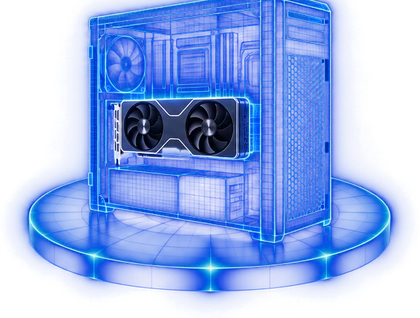
| Hours a month | Rent at $1.15 | Rent at $0.72 effective | Own | Cheaper |
|---|---|---|---|---|
| 100 | $115.00 | $72.00 | $539.55 | Rent |
| 200 | $230.00 | $144.00 | $554.10 | Rent |
| 400 | $460.00 | $288.00 | $583.21 | Rent |
| 523 | $601.45 | $376.56 | $601.11 | Even |
| 730 | $839.50 | $525.60 | $631.23 | Own, unless rent uses the bonus |
NVIDIA US marketplace price since August 2026, per Igor's Lab (14 Aug 2026); GPU Poet's October 2026 eBay average was $16,963
10 / What to choose
The cheapest RTX PRO 6000 depends on the job.

Serving a 70B model or gpt-oss-120b to many users
RTX PRO 6000, reserved by the month
One card holds the 4-bit weights with 50 GB left for cache, and batched vLLM reached 1,031 tokens per second on Llama 3.3 70B; at $0.92 reserved that is the cheapest dedicated month we could confirm.

Generating video with Wan 2.2
RTX PRO 6000, interruptible
Clips are independent, so a reclaimed card costs one clip; 2,000 five-second 5B clips came to $70.33 a month on GPUBank's $0.69 tier, and the 14B experts fit without offloading.

Images, LoRA and models under 32 GB
RTX 5090
When the model fits in 32 GB the RTX 5090 at $0.48 does the job for less per output: $0.029 per million tokens against $0.038 on the 30B test.

Training across several GPUs
H100 SXM
The RTX PRO 6000 has no NVLink and about half the H100 SXM's bandwidth; for multi-GPU training and one-user latency on large models the $1.85 H100 SXM is the better hour.
11 / Questions
What people ask before renting one.
The cheapest RTX PRO 6000 hour on 16 October 2026 was an interruptible Vast.ai bid at $0.33 on a single 300 W Max-Q card, which can be taken back whenever a higher bid arrives and carries its own disk charge1. The cheapest non-interruptible marketplace listing was a Max-Q on Vast.ai at $0.95, with the cheapest full-power Workstation card at $1.00. packet.ai sells a shared card at $0.66 and HyperAI lists $0.80 without stating the machine2021. The cheapest dedicated card with a full machine on a provider's own page was Beam at $1.09, followed by GPUBank at $1.15 with traffic and IPv4 included, or $0.72 effective after the bonus on a $1,000 top-up23. Which is cheapest for you depends on whether you accept interruption, a shared card or a 300 W edition, and whether you prepay.
A dedicated RTX PRO 6000 costs from about $0.95 to $2.50 per hour on demand at marketplaces and specialised clouds, and $3.36 to $5.50 per GPU at the hyperscalers. GetDeploying's crawl of 15 October 2026 put the median on-demand price at $2.21 across 165 configurations, with spot at $1.35 and reserved at $1.904. GPUBank's $1.15 all-in hour is about half that median3. Spot capacity runs from Vast.ai's $0.33 bids to about $2.56 for AWS spot, and reservations from aggregator listings near $0.48 to $2.42 for Azure on three years. Always check what the hour includes: a GPU-only marketplace rate and an all-in machine price can differ by more than $0.30 an hour once disk and traffic are added, and a per-GPU figure taken from an 8-GPU node is only available if you rent all eight.
RTX PRO 6000 spot prices ran from $0.33 to about $2.56 per GPU-hour on 16 October 2026, depending on the provider and the unit rented. Vast.ai's interruptible minimum bids started at $0.33 on a Max-Q card, and an outbid instance is paused1. GPUBank's interruptible tier costs $0.69 per GPU with five minutes of notice through the metadata endpoint, a webhook and the console, and a stop rather than a deletion3. Nebius moved to dynamic spot pricing on 8 October with a floor of $0.79 that can change with capacity7. Verda's spot instances cost $1.15, CoreWeave's 8-GPU Server Edition spot nodes work out to $1.195 or $1.386 per GPU, Google's g4-standard-48 about $1.71 and AWS's g7e.2xlarge about $2.566181627. Spot suits batch work such as video generation or checkpointed fine-tuning, not a production API.
Most clouds rent the Server Edition, while marketplaces also carry the Workstation and Max-Q cards. AWS describes its G7e instances as using the RTX PRO 6000 Blackwell Server Edition, and CoreWeave, Verda, Hyperstack and Lium name the same edition on their pages1518241923. The Server Edition is passively cooled, configurable from 400 to 600 W and rated at 1,597 GB/s, against 1,792 GB/s for the two workstation cards1213. Vast.ai lists all three editions separately, and on 16 October its offer search held 24 Server, 32 Workstation and 25 Max-Q listings1. GPUBank lists 1.8 TB/s, which matches the workstation datasheets, but does not name the edition3. If your job depends on sustained power or bandwidth, ask before reserving.
The Max-Q is a little slower on compute-bound work and about the same on memory-bound work. It has the same 96 GB and 1,792 GB/s as the 600 W Workstation Edition but half the power119, so single-user token generation, which is limited by bandwidth, runs at much the same speed. Puget Systems measured the Max-Q 5 to 14 percent slower than the 600 W card in most content-creation tests, with the largest gaps of 13 to 14 percent on Topaz Video AI, Unreal Engine and DaVinci Resolve GPU effects47. Long diffusion jobs, rendering and batched prefill sit at the compute-bound end. A Max-Q listing at $0.95 against a Workstation card at $1.00 is therefore a fair trade for LLM serving and a slightly worse one for video, and the host's power limit can matter as much as the edition38.
One RTX PRO 6000 runs a 70B model comfortably in 4-bit and tightly in 8-bit. In 4-bit Llama 3.3 70B's weights take about 41 GB, leaving around 50 GB for KV cache and long contexts; in 8-bit they take about 75 GB, which leaves only a modest cache. CloudRift measured 1,031 output tokens per second in aggregate on Llama 3.3 70B AWQ-INT4 with vLLM at a concurrency of 40034, about $0.31 per million tokens at GPUBank's $1.15 hour. For a single user, Hardware Corner measured 32.0 tokens per second with llama.cpp at 4K of context, falling to 16.6 at 128K33, which costs about $11 per million tokens. The card is therefore a good 70B server for many concurrent users and a modest one for a single chat session, where an H100 SXM's higher bandwidth would answer faster.
Yes, gpt-oss-120b runs on one RTX PRO 6000 in its native format. OpenAI released the model with 117 billion parameters, 5.1 billion of them active per token, and MoE weights post-trained in MXFP4, and says it runs on a single 80 GB GPU31. That leaves the RTX PRO 6000's 96 GB with roughly 30 GB beyond the weights for cache and batching. Because only 5.1 billion parameters are active, generation is much faster than on a dense 70B model: Hardware Corner measured 221.3 tokens per second with llama.cpp on a Q8_0 build at 4K of context and 123.3 at 128K33. Running the model in 16-bit or 8-bit would need more than one card. For a team that wants a capable open model on one rented GPU, this is one of the strongest reasons to choose the card over two smaller ones.
Wan 2.2 takes from under three minutes to about 40 minutes per clip on an RTX PRO 6000, depending on the model, the resolution and the power limit. HOSTKEY measured the TI2V-5B model at 160 seconds for a five-second clip at 720p on a Server Edition, about $0.05 per clip at GPUBank's rate38. The 14B text-to-video model at 720p and 24 fps took about 40 minutes per clip in the card's default mode and about 30 minutes after switching to 600 W, or $0.58 to $0.77 per clip. HOSTKEY did not publish the step count or precision, so your times will move with the workflow, the sampler and speed-up LoRAs. The 14B model's two experts total 27 billion parameters, and Wan's own single-GPU command expects a card of at least 80 GB, which the RTX PRO 6000 satisfies32.
The RTX PRO 6000 is better only when your model needs more than 32 GB, or more than 48 GB in the L40S's case. On CloudRift's Qwen3-Coder-30B AWQ test it produced 8,425 tokens per second against 4,570 on an RTX 509034; priced at GPUBank's $1.15 and $0.48, that is $0.038 per million tokens against $0.029, so the cheaper card wins per job3. On Llama 3.3 70B in 4-bit, which does not fit on one 5090, one RTX PRO 6000 gave 1,031 tokens per second against 1,230 for two 5090s, close to a tie at $1.15 against $0.96 an hour, with the single card keeping more room for context. The L40S at $0.55 has 48 GB and 864 GB/s, enough for 30B models and image work but too tight for a 70B model with any useful context.
The RTX PRO 6000 has more memory and costs less per hour than an H100, but the H100 is faster per user on large models and better for training. It has 96 GB against 80 GB, which lets a 4-bit or tight 8-bit 70B model fit on one card with cache room. The H100 SXM's 3.35 TB/s of HBM3 is about 1.9 times the bandwidth, and it has NVLink for multi-GPU training, which the RTX PRO 6000 lacks. On GPUBank the RTX PRO 6000 costs $1.15 against $1.35 for the H100 PCIe and $1.85 for the H100 SXM3. The measurements split by load: CloudRift's batched GLM-4.5-Air test gave 3,140 tokens a second on one RTX PRO 6000 against 2,987 on one H100, while Runpod's single-user vLLM test gave 89 against 109 on the H100 PCIe and 165 on the H100 SXM4140. Choose the RTX PRO 6000 for single-card inference, video generation and graphics, and the H100 SXM for training across GPUs and latency-sensitive serving.
Renting is cheaper than buying for most users at 2026 card prices. NVIDIA's US marketplace raised the Workstation Edition to $16,000 in August 2026, nearly double its $8,565 launch listing, and GPU Poet's October average of the cheapest eBay listings was $16,96343448. With a $4,000 host, resale after two years of $7,400 and power at $0.1819 per kWh, owning costs about $525 a month plus $0.146 per loaded hour. That breaks even with GPUBank's $1.15 on-demand price at about 523 hours a month. Against the $0.72 effective hour from $1,000 top-ups there is no break-even within a 730-hour month. Buying makes sense if you will keep the card busy most of the day for two years, need it on your own premises, or can find one near the launch price.
GPUBank charges only for an optional persistent disk on top of the GPU price. The $1.15 hourly price includes 16 vCPU, 188 GB of RAM, the 2 TB local NVMe scratch disk, one public IPv4 address and all inbound and outbound traffic3. The persistent disk costs $0.03 per GB-month, prorated over a 730-hour month, so 200 GB costs $6.00 for a full month and 500 GB costs $15.00. A stopped machine costs only that disk, a launch or health check that fails is not billed, and there is no minimum billing period. By comparison, Runpod bills $0.20 per GB-month for an idle pod's volume disk, Hyperstack about $0.07 per GB-month for volumes, and Vast.ai hosts between $0.13 and $0.87 per GB-month plus a traffic charge on the RTX PRO 6000 listings we read5191.
On GPUBank a host failure during a job restarts the machine on a healthy host with the same disk and credits the interrupted session in full, and a failed launch is never billed because the meter starts only after the health check3. Interruptible machines get five minutes of notice through the metadata endpoint, a webhook and the console, run your checkpoint hook and are stopped rather than deleted, and if the notice is missed the last 30 minutes are credited. Elsewhere the rules differ: an outbid Vast.ai instance is paused while its storage keeps billing30, Nebius's spot price can move every 15 minutes up to one cent below its on-demand rate7, and on a marketplace the hours lost to a host that drops offline are usually the renter's. For video batches, where each clip stands alone, a reclaim costs one clip; for a long fine-tune, checkpoint every few minutes whatever the provider.
Yes, the top-up bonus lowers the effective hourly price, but only on money you will spend. GPUBank takes payment in crypto from $25 into a prepaid US dollar balance that never expires, and cards are not accepted for now3. The bonus is 20 percent from $25, 30 percent from $50, 35 percent from $100, 40 percent from $250, 50 percent from $500 and 60 percent from $1,000, which turns the $1.15 on-demand hour into about $0.96, $0.85 and $0.72 at the $25, $100 and $1,000 levels. At $0.72 the RTX PRO 6000 is cheaper than any dedicated all-in hour we could read on a provider's own page, though still above Vast.ai's bids and packet.ai's shared card. Monthly spend caps can be set per account and per team member, which keeps a large prepaid balance under control.
Aggregator prices disagree with provider pages because they crawl at different times, pick different configurations and sometimes mix fractional or 8-GPU listings with single cards. On 16 October 2026 Vast.ai's own pricing pages for all three editions read "No current offers" while its offer search returned 81 rentable listings from $0.9581. Runpod's page showed $2.49 for a card that a survey two weeks earlier had at $2.095, and Clore.ai's latest own figure is a snapshot from 24 August22. Some rows, such as Hostinger at $0.65 or HyperAI's $0.48 reservation, exist only on aggregators4. Treat every aggregator figure as a lead: read the provider's page or console on the day, and check whether the price is for one GPU, a MIG slice, a shared card or one-eighth of a node.
Sources
Sources
- 01Vast.ai public offer search, RTX PRO 6000 S, WS and Max-QLive rentable offers per edition, prices, minimum bids, disk and bandwidth rates (read 02:00 EEST) · read 16 Oct 2026
- 02Beam pricingRTX PRO 6000 machine from $1.09/hr with 16 vCPU, 128 GB RAM, 1 TB NVMe; plans · read 16 Oct 2026
- 03GPUBank pricingGPUBank RTX PRO 6000 rates in three modes, inclusions, disk price, billing rules, top-up bonuses, other cards · read 16 Oct 2026
- 04GetDeploying, Nvidia RTX PRO 6000 rental pricesAggregator rows crawled 15 Oct 2026, median $2.21 across 165 on-demand configs · read 16 Oct 2026
- 05Runpod pricingRTX Pro 6000 $2.49 Secure Cloud, $1.69 Community Cloud, $3.49 serverless; disk rates · read 16 Oct 2026
- 06Verda pricingRTX PRO 6000 $2.30 on demand, $1.15 spot, $2.53 serverless · read 16 Oct 2026
- 07Nebius AI Cloud, compute pricing$1.80 on demand, preemptible from $0.79 under dynamic spot pricing since 8 Oct 2026 · read 16 Oct 2026
- 08Vast.ai, Rent RTX PRO 6000 WS GPUsPricing page showing no current offers; launch price 8,565 USD in the specs · read 16 Oct 2026
- 09NVIDIA RTX PRO 6000 Blackwell Workstation Edition96 GB GDDR7 ECC, 1,792 GB/s, 600 W, double flow-through cooler, PCIe Gen 5 · read 16 Oct 2026
- 10PNY, NVIDIA RTX PRO 6000 Blackwell Workstation EditionCUDA, Tensor and RT core counts, 512-bit bus, MIG slices · read 16 Oct 2026
- 11NVIDIA RTX PRO 6000 Blackwell Max-Q Workstation Edition96 GB GDDR7 ECC, 1,792 GB/s, 300 W, dual slot · read 16 Oct 2026
- 12NVIDIA RTX PRO 6000 Blackwell Server Edition96 GB GDDR7 ECC, 1,597 GB/s, up to 600 W configurable, 4 PFLOPS FP4 · read 16 Oct 2026
- 13ServeTheHome, NVIDIA RTX PRO 6000 Blackwell family for workstations and serversCoolers of the three editions, Server Edition configurable from 400 to 600 W · read 16 Oct 2026
- 14NVIDIA GeForce software licenceNo datacenter deployment of GeForce cards · read 15 Oct 2026
- 15AWS, Amazon EC2 G7e instancesG7e sizes with RTX PRO 6000 Blackwell Server Edition · read 16 Oct 2026
- 16Economize, GCP g4-standard-48 pricingus-central1: $4.50 on demand, $3.105 1-year, $1.979 3-year, $1.715 spot · read 16 Oct 2026
- 17Oracle Cloud Infrastructure, compute shapesBM.GPU.RTXPRO.8: 8 GPUs, 144 OCPU, 3,072 GB RAM, 8 x 7.68 TB NVMe · read 16 Oct 2026
- 18CoreWeave pricing8-GPU RTX PRO 6000 Server Edition at $20.00/h on demand, $9.56 and $11.09 spot · read 16 Oct 2026
- 19Hyperstack GPU pricingRTX PRO 6000 SE $1.85 on demand, $1.48 spot, from $1.30 reserved; volume storage rate · read 16 Oct 2026
- 20packet.ai pricingRTX 6000 Pro at $0.66/hr on the multi-tenant Dynamic tier, hourly billing, no egress fees · read 16 Oct 2026
- 21HyperAI pricingRTX PRO 6000 at $0.80/h · read 16 Oct 2026
- 22Clore.ai documentation, GPU pricing and availabilitySnapshot of 24 Aug 2026: $0.92 to $1.38, median $1.21, 4 free servers · read 16 Oct 2026
- 23Lium, RTX PRO 6000 Blackwell Server EditionLive asks $1.60 to $1.99, 2 pods, billed per second · read 16 Oct 2026
- 24Verda, NVIDIA RTX PRO 6000Server Edition, 30 CPU threads and 90 GB RAM per GPU · read 16 Oct 2026
- 25Massed Compute pricingRTX PRO 6000 Blackwell at $2.19 with 16 vCPU, 144 GB RAM, 725 GB · read 16 Oct 2026
- 26CloudRift pricingRTX PRO 6000 at $1.16 for one month and $1.10 for three months · read 16 Oct 2026
- 27Vantage, g7e.2xlarge pricing$3.363/h on demand, $2.557/h spot · read 16 Oct 2026
- 28Vantage, g7e.48xlarge pricing$33.144/h on demand for 8 GPUs · read 16 Oct 2026
- 29GPUBank home pageRegions listing the RTX PRO 6000, median launch time, templates · read 16 Oct 2026
- 30Vast.ai documentation, BillingStorage billed while an instance is stopped, bandwidth billed per byte · read 15 Oct 2026
- 31OpenAI, gpt-oss-120b model card117B parameters, MXFP4 MoE weights, fits one 80 GB GPU · read 16 Oct 2026
- 32Wan-AI, Wan2.2-T2V-A14B model card27B total parameters, 14B active, 80 GB single-GPU command · read 16 Oct 2026
- 33Hardware Corner, RTX PRO 6000 Blackwell LLM benchmarksllama.cpp generation and prompt speeds by context length · read 16 Oct 2026
- 34CloudRift, RTX 4090 vs 5090 vs PRO 6000 LLM inference benchmarkvLLM batched throughput on Qwen3-Coder-30B AWQ and Llama 3.3 70B AWQ (9 Oct 2025) · read 16 Oct 2026
- 35Eurokommerz, RTX PRO 6000 Blackwell benchmarks and MLPerf resultsNVIDIA TensorRT-LLM table: 1,724 and 296 tok/s on Llama 3.3 70B FP4 (24 Sep 2026) · read 16 Oct 2026
- 36StorageReview, NVIDIA RTX PRO 6000 Workstation GPU review163.1 tok/s on gpt-oss-120b, one request, LM Studio · read 16 Oct 2026
- 37Naveen Kulandaivelu, Benchmarking Nvidia's RTX PRO 6000FLUX.1 dev 3.10 it/s at 1024 x 1024, power configurable down to 150 W (7 Aug 2025) · read 16 Oct 2026
- 38HOSTKEY, RTX 6000 Blackwell Server Edition tests and benchmarksWan 2.2 14B and TI2V-5B times, 25 percent gain in 600 W mode (28 Aug 2025) · read 16 Oct 2026
- 39Trooper.ai, RTX Pro 6000 Blackwell vs RTX 5090 benchmarkSD3.5 Large 8.3 s against 12 s per image · read 16 Oct 2026
- 40Runpod, Best GPU for LLM inference: what the benchmarks show in 2026vLLM single-user decode: RTX PRO 6000 89, L40S 48, A100 SXM 96, H100 PCIe 109, H100 SXM 165 tok/s (measured 15 Sep 2026) · read 16 Oct 2026
- 41CloudRift, RTX PRO 6000 vs H100, H200 and L40S: LLM inferenceGLM-4.5-Air AWQ 3,140 against 2,987 tok/s; multi-GPU gaps on Qwen3-Coder-480B and GLM-4.6 (27 Nov 2025) · read 16 Oct 2026
- 42Tom's Hardware, Nvidia raises RTX Pro 6000 Blackwell pricing to $13,250Mid-2026 street prices at Newegg and B&H for the three editions · read 16 Oct 2026
- 43Igor's Lab, RTX PRO 6000 Blackwell now costs 16,000 US dollarsWorkstation Edition at $16,000 on NVIDIA's US marketplace, up from $13,250 (14 Aug 2026) · read 16 Oct 2026
- 44GPU Poet, RTX PRO 6000 Workstation Edition price, October 2026Lowest average of the three cheapest eBay listings: $16,963 ($16,325 to $17,860) · read 16 Oct 2026
- 45GPU Poet, RTX PRO 6000 Max-Q price, October 2026Lowest average $22,256, estimated MSRP $10,999 · read 16 Oct 2026
- 46GPU Poet, RTX PRO 6000 Server Edition price, October 2026Lowest average $23,288, cheapest listing $22,999, no official MSRP · read 16 Oct 2026
- 47Puget Systems, RTX PRO 6000 Blackwell Max-Q vs Workstation for content creationMax-Q 5 to 14 percent slower than the 600 W card in most tests (July 2025) · read 16 Oct 2026
- 48Beam, NVIDIA RTX PRO 6000 Pricing$1.09/hr with vCPU, RAM and NVMe included (29 Sep 2026) · read 16 Oct 2026
What we could not confirm
We could not read Hostinger's, GPUhub's, Nova Cloud's, UpCloud's, Leaseweb's, Database Mart's, Utho's, Azure's or Oracle's RTX PRO 6000 prices on their own pages, so those rows come from GetDeploying's crawl of 15 October 2026, and the AWS and Google prices come from Vantage and Economize because the providers' price pages did not render. HyperAI's pricing page shows $0.80 but not the machine behind it, and its $0.48 one-month reservation appears only on GetDeploying. Clore.ai's latest own figure is its snapshot of 24 August 2026. Vast.ai's prices come from its public offer search at about 02:00 Tallinn time on 16 October, because its pricing pages showed no offers; bids and listings change by the hour. Beam does not say whether $1.09 is an exact or starting rate, nor which edition it rents. GPUBank's pricing page does not name the edition or power limit behind its RTX PRO 6000 rentals. Aurora's widely quoted 33 percent Max-Q gap on Wan 2.2 could not be read and was left out in favour of Puget Systems' measurements. We found no measured HunyuanVideo or LTX-Video times on this card, no single-user benchmark beyond Runpod's that puts an RTX PRO 6000 and an H100 or L40S on the same test, NVIDIA's TensorRT-LLM table only as Eurokommerz reports it, and no dated price for a complete 8-GPU server. The host price, power draw and resale values in the rent-or-buy arithmetic are assumptions.
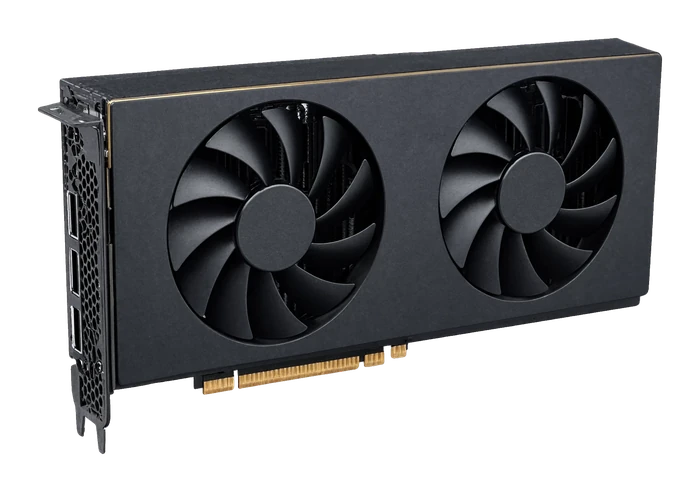
RTX PRO 6000 on GPUBank
96 GB on one card, with the whole machine included.
- 16 vCPU, 188 GB RAM, 2 TB NVMe, IPv4 and traffic in $1.15/hr
- Billed by the second after the health check
- Interruptible $0.69, reserved $0.92
 16 vCPU, 188 GB RAM, 2 TB NVMe, IPv4 and traffic in $1.15/hr
More GPU price guides
Where to rent the other cards at the cheapest price.
 B200 SXM180 GB HBM3eFrom $2.49 spot · $4.15 all-in
 H200 SXM141 GB HBM3eFrom $1.49 spot · $2.49 all-inH100 SXM80 GB HBM3From $1.11 spot · $1.85 all-inH100 PCIe80 GB HBM2eFrom $0.81 spot · $1.35 all-in
 MI300X192 GB HBM3From $0.99 spot · $1.65 all-in
 A100 SXM80 GB HBM2eFrom $0.57 spot · $0.95 all-inL40S48 GB GDDR6 ECCFrom $0.33 spot · $0.55 all-inRTX 509032 GB GDDR7From $0.29 spot · $0.48 all-in
 RTX 409024 GB GDDR6XFrom $0.14 spot · $0.23 all-in