Updated 16 Oct 2026 · 35 offers checked
Where to rent a B200 SXM at the cheapest price
We read every B200 offer we could find on the provider's own page, separated single GPUs from whole nodes, spot from reserved and shared from dedicated, then priced the monthly bill, the cost per job against the H200 and H100, and the point where buying an HGX server pays.
The short answer, 16 Oct 2026
- $0.99/hrLowest price listed. Nebius lists its preemptible B200 from $0.99 per GPU-hour, but that is the floor of a dynamic spot price that can change every 15 minutes, rise to one cent under the $8.50 on-demand rate and stop the VM with 60 seconds of notice, and its default B200 quota is zero, so most accounts cannot book it today123.
- $5.94/hrCheapest marketplace listing. Lium's marketplace listed B200 pods from $5.94 per GPU-hour, the cheapest an 8-GPU pod in Helsinki, with the host's CPU, RAM and disk in the price and billing by the second; no marketplace undercut the cheapest managed single GPU4.
- $4.15/hrWhole machine, traffic included. GPUBank's $4.15 covers 28 vCPU, 283 GB of RAM, 2 TB of NVMe, an IPv4 address and all traffic, billed per second, and falls to about $2.59 with a $1,000 top-up; on list price Deep Infra's $3.69 single-GPU container with 16 vCPU and 250 GB of RAM is lower56.
The same B200 silicon is listed this month at anything from 99 cents to more than $14 per GPU-hour, and almost none of that spread comes from the GPU. It comes from what is sold around it: one card or a mandatory eight, a machine with CPU, memory and disk or a bare GPU line, an hour that can be taken back with a minute's notice, a meter that runs per second or per started hour, a contract of a week or of four years, and stock that may or may not exist on the day you want to start. Two offers with the same headline number can be different products, and the cheapest line on an aggregator is often one you cannot book.
We read the prices on 16 October 2026 on each provider's own pricing page, documentation or public price API wherever we could, and we name the aggregator and its date where we could not. Several figures had moved since our previous survey on 29 September: Nebius raised its on-demand B200 from $7.15 to $8.50 on 1 October and turned its preemptible tier into a dynamic spot price on 8 October1, Verda's single GPU went from $6.85 to $7.877, and fal's list price rose to $7.998. Read every table on this page as a dated snapshot rather than a standing quote.
This page is published by GPUBank, a GPU cloud run by GPU Compute OÜ in Tallinn that rents the B200 SXM itself, so read our own entry with that in mind. It is measured on the same terms as every other offer, and the text says where a spot tier, a marketplace, a long contract or a cheaper single-GPU container beats it, and what the buyer gives up or gains in each case.
01 / One hour, six products
Why a B200 hour is not one product
Price per GPU-hour by buying unit, from one card to a rack
One GPU in the unitGPUBank
011 GPU on demand
DDeep Infra
$3.69/GPU-hr
CommitmentNone
16 vCPU, 250 GB RAM, billed per minute6
021 GPU reserved
GPUBank
$3.32/GPU-hr
Commitment1 week
Prepaid, GPUs held for you, $4.15 on demand5
038-GPU node on demand
 CoreWeave
$8.60/GPU-hr
CommitmentNone
$68.80 per node-hour, 2,048 GB RAM27
0516-GPU cluster reserved
 Lambda
$9.86/GPU-hr
Commitment2 weeks
InfiniBand; $8.87 from 256 GPUs11
06GB200 NVL72 rack
 AWS
$10.58/GPU-hr
CommitmentCapacity Block
$761.90 per rack-hour, Dallas Local Zone36
With most cards the unit of purchase is one GPU and the only variable is the rate. With the B200 the unit itself changes the price, and the table above shows the main ones side by side. A single GPU on demand is the newest and most flexible unit, sold by a handful of clouds from $3.69 with no commitment6. An 8-GPU node on demand, the classic neocloud unit, costs $6.69 to $8.60 per GPU and makes you pay for eight cards even when your job needs one1127. An 8-GPU node on a contract of one to three years falls to $3.79 to $4.49 per GPU at Civo, and Vultr quoted $2.99 on 48 months1650. Clusters with InfiniBand start at 16 GPUs and two weeks on Lambda at $9.86, falling to $8.87 at 256 GPUs, and a full GB200 NVL72 rack on an AWS Capacity Block costs $761.90 an hour for 72 GPUs, or $10.58 per GPU1136.
The prices run backwards from intuition: the long contract is the cheapest hour and the short cluster the dearest, because the cluster price pays for the fabric, the guaranteed placement and the provider's risk of idle racks, while the multi-year contract transfers that risk to you. The right unit follows from the job. A model that fits in 180 GB and a workload that comes and goes point to a single GPU billed by the second; tensor-parallel serving or a fine-tune of a 70B model points to one node; pre-training or mixture-of-experts training at scale points to a cluster or an NVL72 rack, where NVLink across 72 GPUs does what InfiniBand between nodes cannot. Buying the bigger unit for a small job is the most common way to overpay for a B200.

Three generations on the same benchmark rules
The chart below uses one MLPerf round, Inference v5.0, so that the B200, H200 and H100 rows were measured on the same benchmark rules and the same TensorRT release41. The language-model rows compare each card as you would deploy it, FP4 on the B200 against FP8 on Hopper, so they show the platform's gap rather than the silicon's alone, while the Stable Diffusion XL row, at FP8 on all three, is the like-for-like test and its 1.6 times the realistic floor of what a B200 hour buys over an H100 hour.
MLPerf Inference v5.0, 8-GPU systems, each row scaled to its own best result
B200 SXMH200 SXMH100 SXM
02 / The card
What the B200 SXM is and who rents it
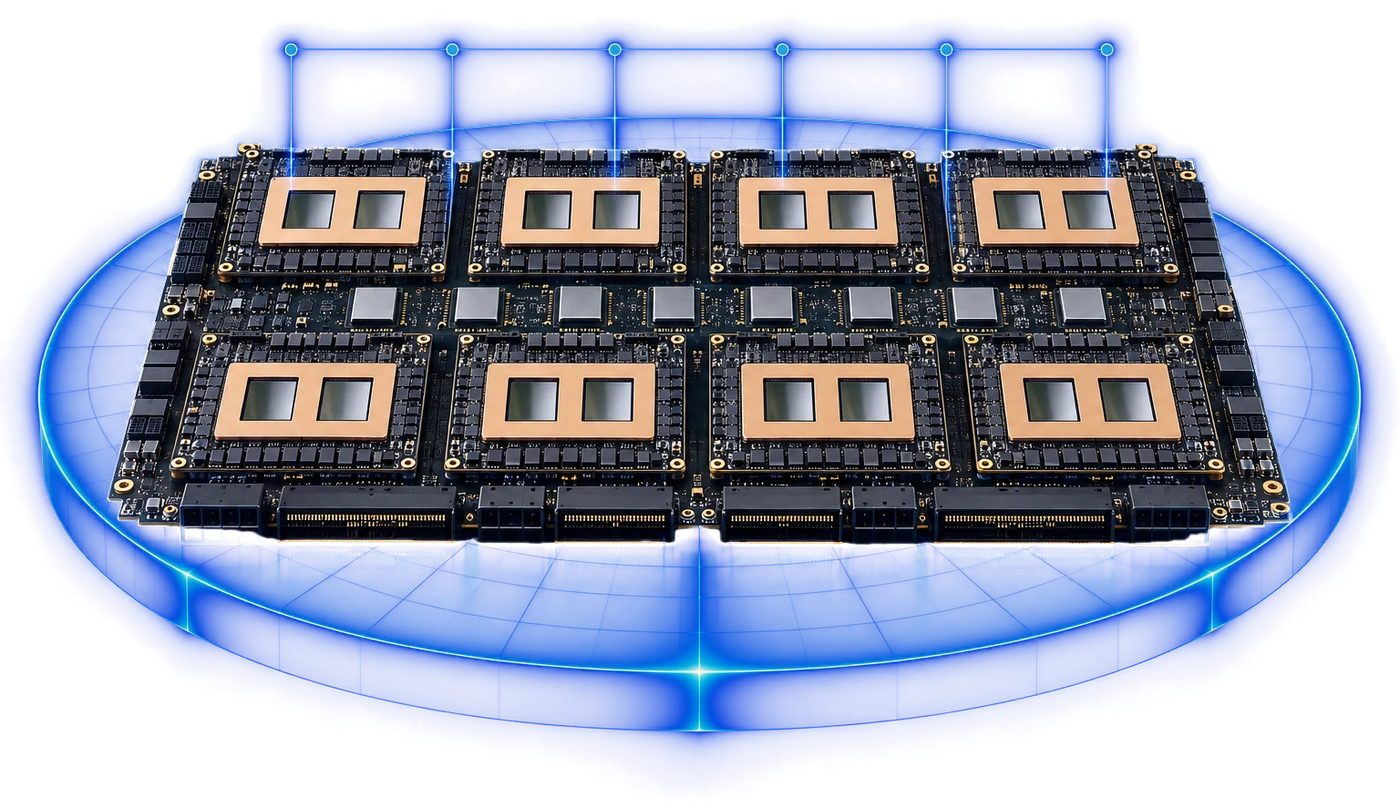
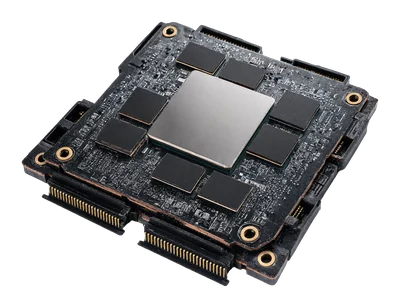
The B200 is NVIDIA's first Blackwell datacenter GPU, and in its SXM form it is not a card you can slot into a server: it ships on the 8-GPU HGX B200 baseboard that goes into NVIDIA's DGX B200 and into OEM servers from Supermicro, Dell, HPE, Lenovo and others. NVIDIA's DGX B200 page gives 1,440 GB of HBM3e and 64 TB/s of memory bandwidth for the eight GPUs, which is 180 GB and 8 TB/s per GPU, 14.4 TB/s of aggregate NVLink bandwidth (1.8 TB/s per GPU over fifth-generation NVLink), two Xeon Platinum 8570 processors, 2 TB of system memory and a maximum draw of about 14.3 kW9. Its FP4 figure of 144 petaFLOPS and FP8 figure of 72 petaFLOPS for the whole system are sparse numbers, and dense throughput is half of each. NVIDIA's MLPerf write-up describes each GPU running at a 1,000 W thermal design power10.
You will see both 180 GB and 192 GB quoted. The 192 GB figure comes from early HGX B200 material that some providers still reproduce, including packet.ai, Hyperstack and Spheron on their pricing pages, while shipping DGX systems and every cloud that states the usable memory, from Lambda and Verda to Deep Infra and Oracle, expose 180 GB to software9117612. Size models, KV caches and batches on 180 GB per GPU. The renters fall into three groups: training teams that want whole nodes or multi-node clusters with InfiniBand for weeks or months, inference operators who serve large models in FP8 or FP4 on one to eight GPUs, and engineers who want one card for a few hours to test or fine-tune a model that does not fit on an H100. For years the market served only the first group, which is why so many B200 offers still start at eight GPUs, and the single-GPU on-demand offers that appeared in 2026 are where the cheapest entry prices now sit.
03 / The price ladder
How to read the B200 market
Every price on this page is in US dollars per GPU-hour excluding VAT, and where a provider sells only an 8-GPU node we divide the node price by eight. That gives a fair per-GPU number, but you still pay for eight, so the minimum unit matters as much as the rate. A managed cloud sells a fixed machine at one hourly price, and the question is what that price leaves out: Nebius bills disks separately, Northflank bills CPU and memory as their own lines, and AWS bills EBS volumes and egress on top, while GPUBank, Beam and Deep Infra put the CPU, memory, local disk and traffic inside the hour1135146. A marketplace lets independent hosts set their own price on machines that vary from listing to listing, and on the B200 the marketplaces were not cheaper than the cheapest managed offers in mid-October, which reverses the pattern seen on consumer cards.
The other three kinds of offer trade something for the price. Spot or preemptible capacity is the cheapest hour on the market, from Nebius's dynamic floor of $0.99 to published fixed tiers between $2.49 and the $5.25 Spheron showed on GetDeploying, and the terms that matter are the notice period and whether the disk survives1515. Reserved capacity brings the B200 to between $2.99 and $4.49 when the contract runs one to four years, and to $6.79 to $9.86 on the short cluster reservations of Together AI and Lambda161711. Serverless platforms bill by the second of work from $5.50 to about $10 and suit bursty inference rather than long jobs1819. Stock is the last filter: on 15 October GetDeploying marked Lambda, Massed Compute, Hyperstack's on-demand flavour, Sesterce and Runpod Community out of stock, and Nebius's default B200 quota for VMs without a reservation is zero153.
Managed on demandA fixed machine at one hourly price.
MarketplaceHosts set their own price; machines vary.
Spot and interruptibleCheaper hours that can be taken back.
ReservedCommitted for a term, paid either way.
ServerlessBilled by active seconds.
04 / Provider by provider
What each price buys, and what it leaves out.
The captures below were taken on 16 Oct 2026 from each provider's own B200 or pricing page, so every figure can be read next to the conditions printed beside it.
GPUBankAll-in
$4.15/hr
Managed · 1 to 8 GPUs · per second
28 vCPU283 GB RAM2 TB NVMeIPv4 and all trafficSpot $2.49, reserved $3.32Frankfurt and Ashburn
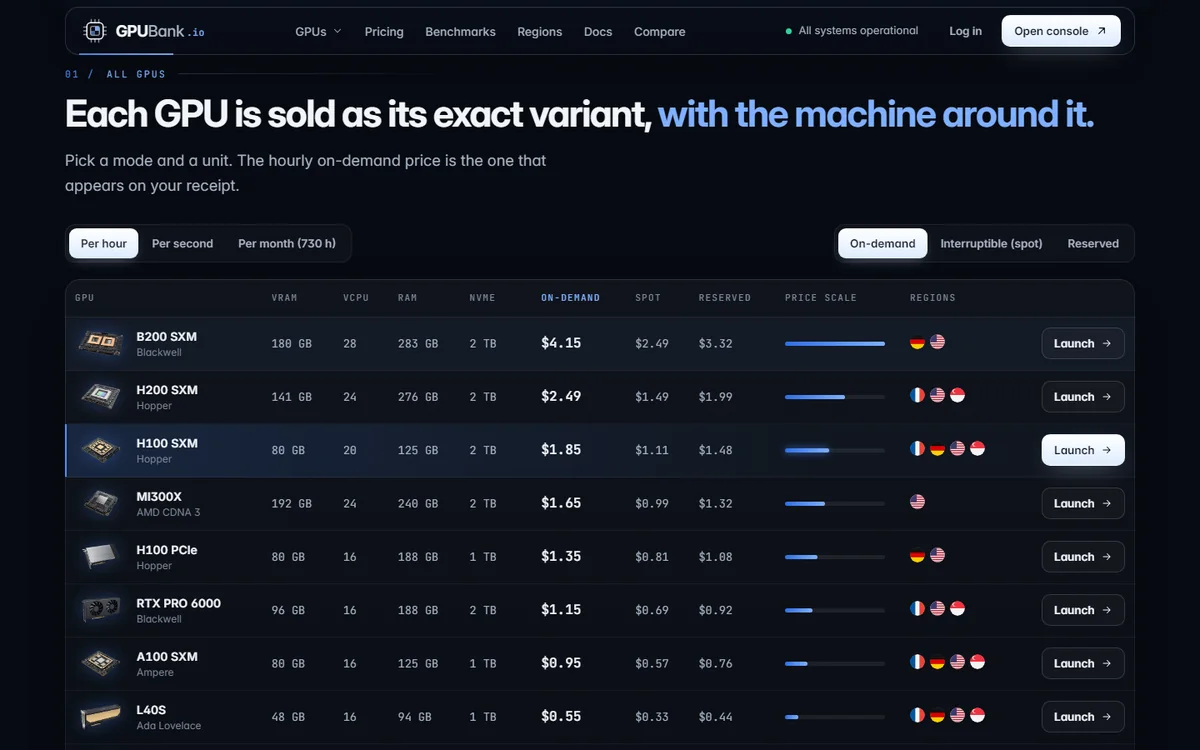
GPUBank sells the B200 SXM at $4.15 per GPU-hour on demand in machines of one to eight GPUs, and the hour already includes 28 vCPU, 283 GB of RAM and a 2 TB local NVMe disk per GPU, a public IPv4 address and all inbound and outbound traffic, with a persistent disk at $0.03 per GB-month as the only other line5. Billing is per second from the moment the machine passes its health check, and a failed launch costs nothing. The interruptible tier at $2.49 gives five minutes of notice and stops rather than deletes the machine, and a week or a month reserved costs $3.32. Payment is a prepaid crypto balance from $25 that never expires, with a bonus that brings the effective on-demand hour to about $2.59 at $1,000. The B200 is offered in Frankfurt and Ashburn only, and machines stop at eight GPUs, so jobs that need several nodes belong with a cluster provider.5
Checked 16 Oct 2026
?Deep Infra
$3.69/hr
Managed container · 1 to 8 GPUs · per minute
16 vCPU250 GB RAM2 TB SSDNo egress feesSSH into a containerStock not shown
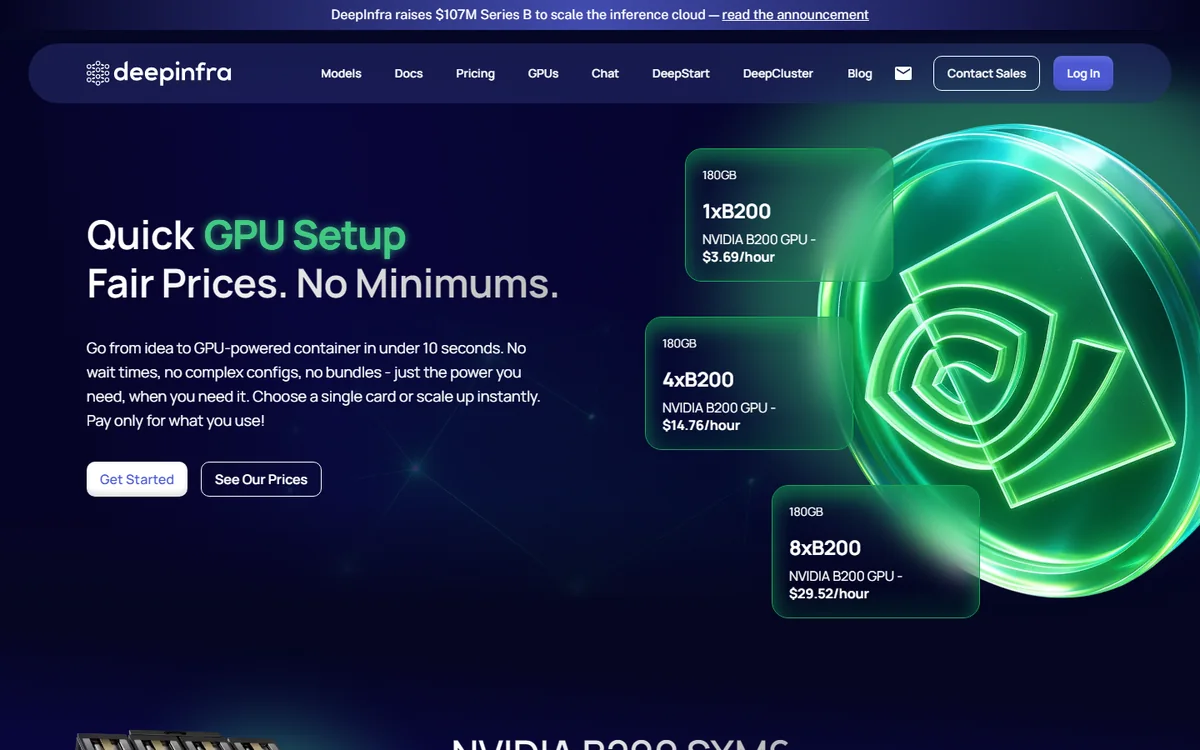
Deep Infra, better known for its inference API, rents B200 GPU instances at $3.69 an hour for one GPU, $14.76 for four and $29.52 for eight, the lowest dedicated single-GPU list price we found on a provider's own page6. Each GPU comes with 16 vCPU, 250 GB of RAM and 2 TB of SSD, billing is per minute and the page says there are no egress fees. What you get is a container reached over SSH with a choice of base images rather than a full virtual machine, and the page does not say whether the disk persists after a container is deleted, so keep weights in object storage. The machine is lighter than GPUBank's 28 vCPU and 283 GB per GPU, which matters for CPU-heavy data loading. At $3.69 it is 46 cents an hour cheaper than GPUBank's list price and more expensive than GPUBank's effective price after any top-up, which starts at about $3.46 with $25.6
Checked 16 Oct 2026
 Beam
$4.11/hr
Managed machine · bare metal or VM
28 vCPU256 GB RAM2 TB NVMeNo egress feesPersistent volumes to 1 TB includedClusters on request
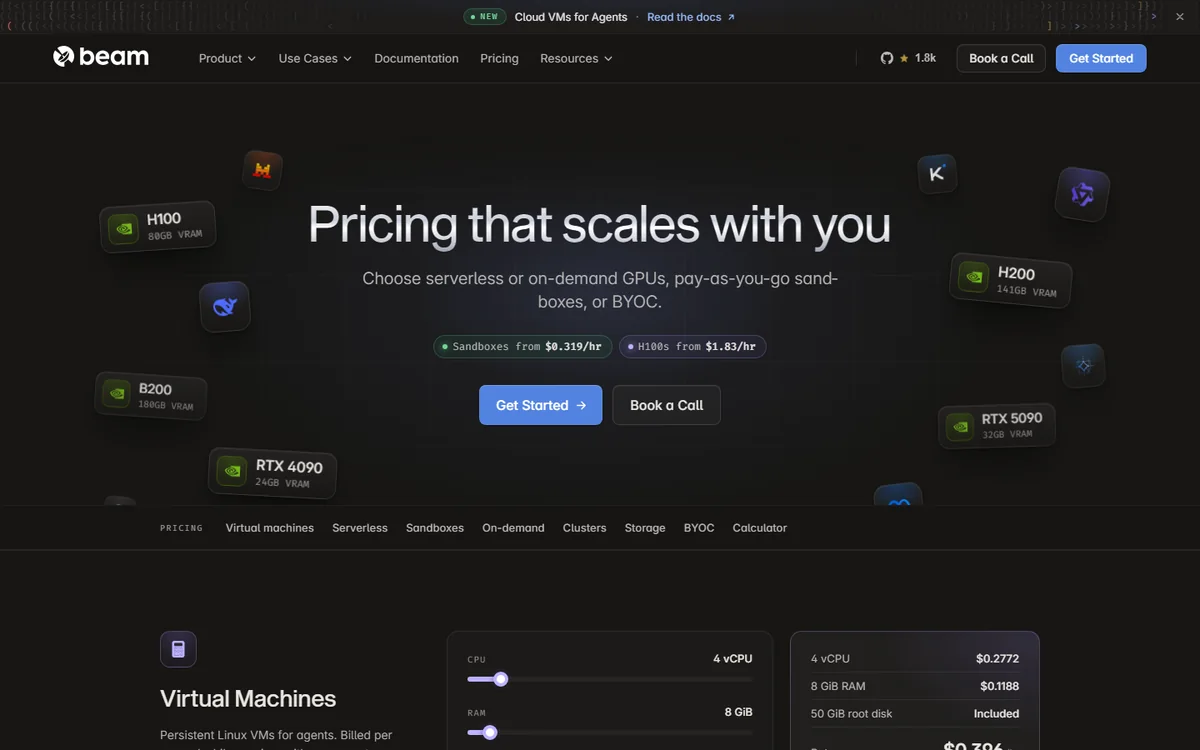
Beam's on-demand B200 SXM6 machine starts at $4.11 an hour with 28 vCPU, 256 GB of RAM and 2 TB of NVMe, sold as one flat price per machine on bare metal or a VM14. Beam includes persistent volumes up to 1 TB and charges $0.021 per GB-month above that, and its FAQ says there are no egress or bandwidth fees on any plan, which makes this the closest like-for-like offer to GPUBank's on the market at four cents less per hour. GetDeploying did not report its stock on 15 October, so check availability in the console before planning around it15. For multi-node work Beam lists 8-GPU B200 nodes with InfiniBand on request, without a published price. The page lists the machine as "from" $4.11, so larger configurations or other regions may cost more.14
Checked 16 Oct 2026
 Nebius
from $0.99/hr spot
Managed VMs · 1 or 8 GPUs · per second
20 vCPU224 GB RAMOn demand $8.50Default B200 quota 0
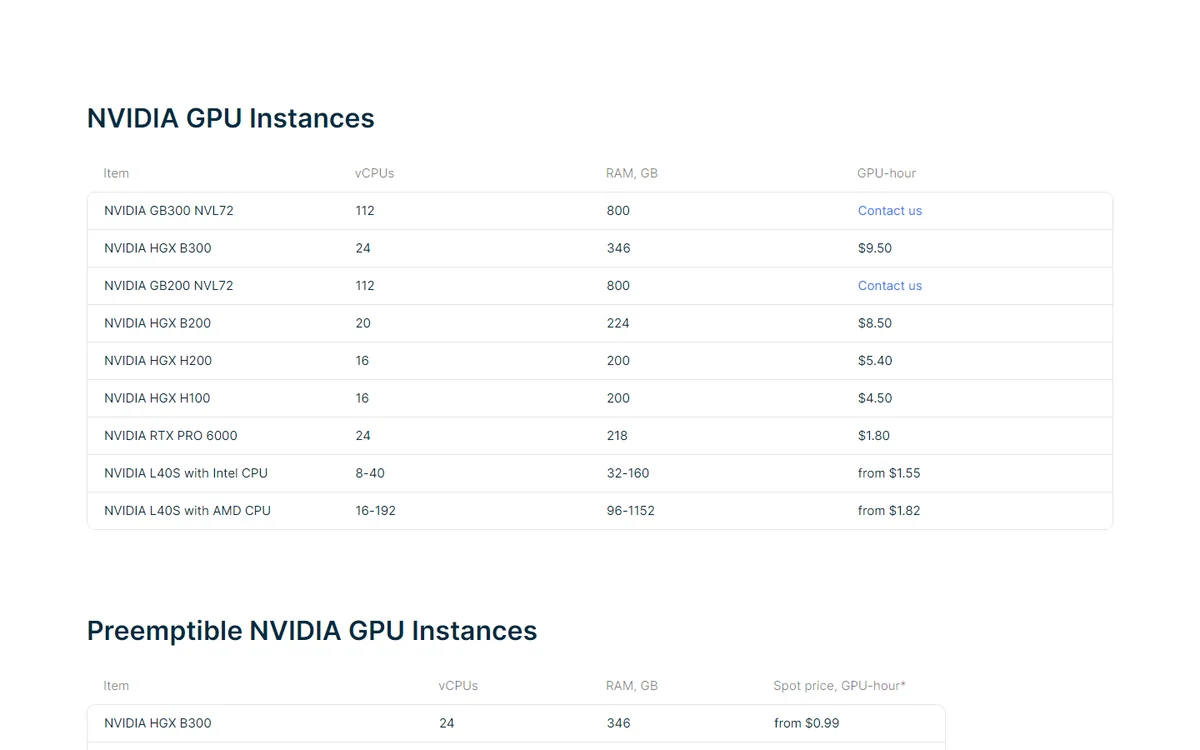
Nebius has the lowest B200 figure on any provider's page, a preemptible price "from $0.99" per GPU-hour since 8 October, but it is a floor, not a quote: the spot price changes with capacity and demand as often as every 15 minutes and can rise to one cent below the on-demand rate, which went from $7.15 to $8.50 on 1 October1. Each GPU comes with 20 vCPU and 224 GB of RAM, billing is per second, and disks are billed separately at $0.071 per GiB-month for a network SSD. A preempted VM gets 60 seconds of notice through SIGTERM, keeps its attached volumes and loses dynamic public IPs2. The default quota for B200 VMs without a reservation is zero in both us-central1 and me-west1, so you need a quota increase or a reservation before either price can be booked3.1
Checked 16 Oct 2026
 Lium
from $5.94/hr
Marketplace · per listing · per second
Host CPU, RAM and diskHelsinki, Ashburn, SydneyHeadline moves daily
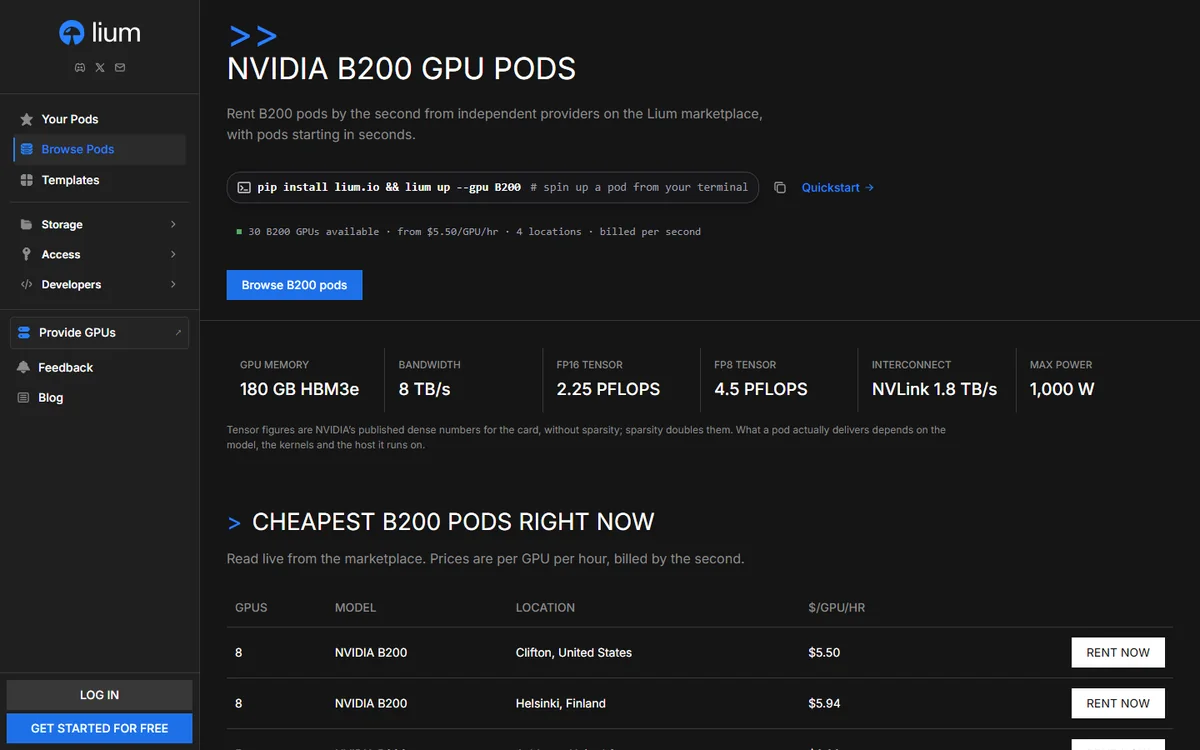
Lium is the marketplace with the clearest live B200 page: on 16 October it listed B200 pods in Helsinki, Ashburn and Sydney from $5.94 per GPU-hour, billed per second4. The cheapest pod was eight GPUs in Helsinki at $5.94 each, followed by five GPUs in Ashburn and a single GPU in Sydney at $6.00, and an 8-GPU Sydney pod at $6.38. The price covers the whole pod, including the host's CPU, RAM and local disk, but those vary from one host to the next, so read each listing's machine before comparing it with a managed instance. The headline had read $5.49 and $5.93 on the previous day according to our research pass, which shows how fast marketplace B200 listings change hands. At $5.94 Lium is above every single-GPU managed offer in the $3.69 to $4.15 range, so its use is a whole node when the managed clouds are sold out.4
Checked 16 Oct 2026
 Verda
$7.87/hr
Managed · 1 to 8 GPUs · Finland
30 vCPU170 GB RAMSpot $3.942-year term 25 % off
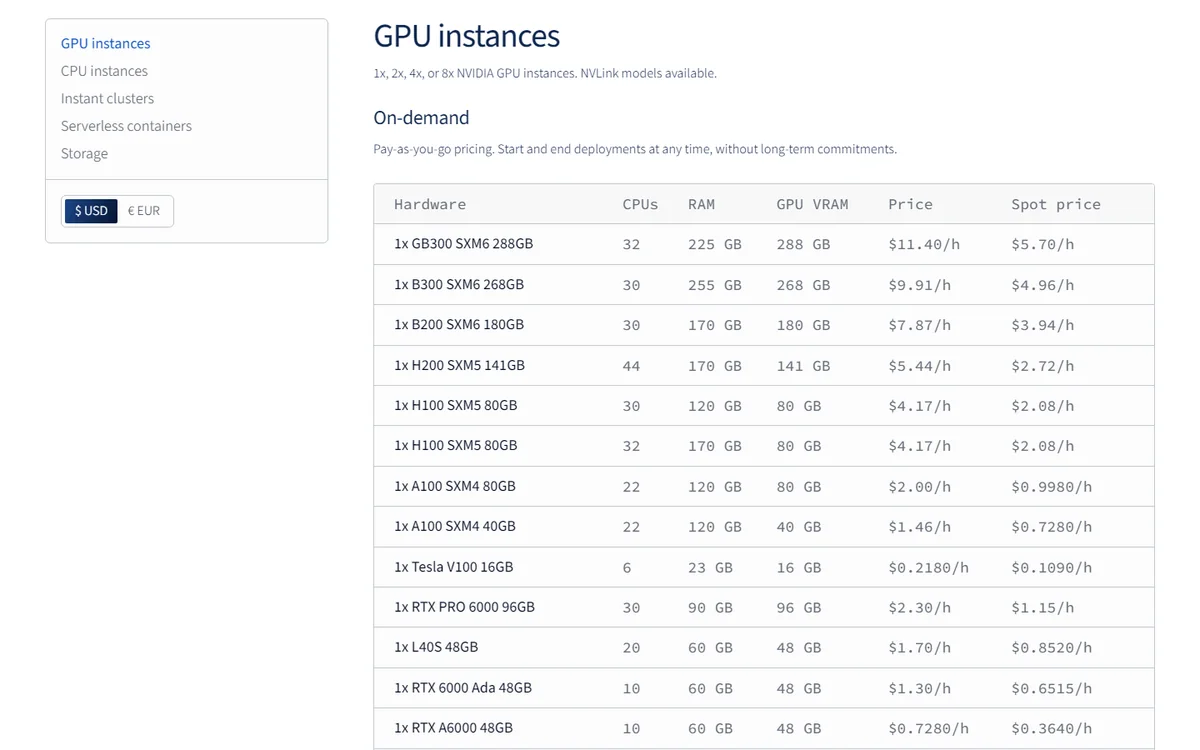
Verda, the former DataCrunch, lists a 1x B200 SXM6 180GB instance at $7.87 an hour on demand, up from $6.85 in our September survey, and $3.94 on spot, with 30 CPUs and 170 GB of RAM per GPU7. It also sells the B200 as serverless containers at $8.66, or $4.33 on spot, and as instant clusters at $7.87 per GPU. Long-term discounts on self-service instances run from 2 percent for one month to 8 percent for a year and 25 percent for two years, which puts a two-year B200 at about $5.90 per GPU-hour. Verda's spot tier is one of the few fixed B200 spot prices below $4 that were actually in stock, according to GetDeploying, which makes it the main alternative to GPUBank's $2.49 interruptible hour for European workloads that can live with interruption15.7
Checked 16 Oct 2026
Where GPUBank wins, and where it does not
The provider card above gives GPUBank's rates; what matters beside them is how the hour behaves. The meter starts only once a machine has passed its health check, which GPUBank gives as a median of 48 seconds from launch, a failed launch is never billed, and a stopped machine costs only its persistent disk at $0.03 per GB-month5. Machines come with 1, 2, 4 or 8 GPUs and the vCPU, RAM and NVMe scale by the same multiple, any Docker image can be launched, and ready-made templates cover vLLM, SGLang, Ollama, Open WebUI, llama.cpp, Unsloth, Axolotl, JupyterLab and PyTorch 2.8 with CUDA 12.8, the stacks most B200 renters reach for first. Every account and every team member can be given a monthly spend cap, which is the simplest guard against an 8-GPU machine left running over a weekend at $33.20 an hour.
Where GPUBank wins: its $2.49 is the lowest fixed spot price with published terms we found, its $3.32 week or month is lower than every short reservation we could read, and on demand only Deep Infra's $3.69 container and packet.ai's shared $3.75 tier undercut it at list, with Beam close at $4.1162014. Payment is a prepaid balance topped up in crypto from $25 to $5,000, and the top-up bonus of 20 to 60 percent brings the effective on-demand hour to about $3.46 with $25, $3.07 with $100 and $2.59 with $1,0005. Where it loses: Nebius's dynamic spot can be far cheaper when capacity is idle, Vultr's and Civo's multi-year contracts are lower per hour, Deep Infra is cheaper at list for one GPU, there are only two regions, machines stop at eight GPUs so multi-node training needs a cluster provider, and card payments are not accepted for now, which rules GPUBank out for some companies whatever the price.
The rest of the market
Below GPUBank's list price, packet.ai sells a B200 Dynamic tier at $3.75 in US East, which its own pricing page describes as shared GPU pods on scheduler-isolated infrastructure where the physical GPU may be shared with other tenants, and a Dedicated pod at $6.9920. Sesterce appeared at $4.11 for an 8-GPU node and Hostinger at $4.50 for one GPU on GetDeploying, the first out of stock and the second with stock not reported, and neither price could be read on the provider's own page15. The same aggregator listed Lyceum's single B200 at $6.49 and its spot tier at $3.29, both out of stock, Daytona at $3.59 for the GPU alone on a waitlist, and Spheron and EmpirioLabs in stock but at $11.06 and $11.90 per GPU, close to the hyperscaler rate15. GMI Cloud now lists the B200 from $5.00 with limited availability through sales, up from $4.00 in September21. Massed Compute sells an 8-GPU node at $43.46 an hour, or $5.43 per GPU, with 280 vCPU and 2,800 GB of RAM, Northflank gives $5.87 for the GPU line alone, and Hyperstack's 8-GPU flavour is $6.00, marked out of stock22132315.
The better-known neoclouds sit between $6.69 and $8.60. Lambda's own page lists the B200 at $6.69 per GPU on an 8-GPU instance and $6.99 on one GPU, both out of stock on GetDeploying, Runpod's Secure Cloud is $7.99 with 28 vCPU and 283 GB of RAM, although several of Runpod's own articles still quote $6.79, E2E Networks in India is $7.99 billed per minute, Together AI's clusters are $8.19, and Crusoe and CoreWeave sell 8-GPU nodes at $8.50 and $8.60, CoreWeave's with 128 vCPU, 2,048 GB of RAM and 61.44 TB of local storage112425172627. Shadeform's directory quoted the B200 from $6.52 with no live instance listed, and the $3.74 Boost Run node that our September survey read there is no longer visible28. UpCloud's page announces new B200 servers from 20 October at €4.50 an hour on demand and €3.38 on spot for one GPU, billed by the started hour29.
On the marketplaces, Akash quotes a fixed $5.00 for the GPU alone, with CPU, memory, storage and the IP lease priced in each provider's bid, a figure we could read only on ComputePrices because Akash's own page loaded without its table30. Runpod Community lists $5.98, out of stock, and Vast.ai's B200 page said "No current offers" while ComputePrices recorded $6.25 listings the same day; on Vast, storage keeps billing while an instance is stopped and bandwidth is billed per byte24313032. Other spot tiers include Together AI's preemptible $4.09, CoreWeave's $34.11 node ($4.26 per GPU) and Vultr's $3.20 node, out of stock172715. Among serverless offers, Koyeb is $5.50 with 15 vCPU and 240 GB of RAM, Cerebrium $6.01, Modal $6.25 for the GPU alone, fal $7.99 at list, Runpod $8.64 and Baseten $9.9818333482419.
The large clouds, per GPU inside an eight-GPU instance
The large clouds sell the B200 only as 8-GPU instances, and their per-GPU price is two to four times the neocloud rate. AWS's p6-b200.48xlarge, with 192 vCPU, 2,048 GiB of RAM and eight 3.84 TB NVMe drives, is $113.9328 an hour on demand in US East, or $14.24 per GPU, on AWS's own price list35. Its Capacity Block, which reserves the instance for chosen dates and is paid up front, is $113.666 per instance-hour, or $14.21 per GPU, in Ohio, N. Virginia, Oregon, Mumbai, Hyderabad, Stockholm and Paris, up from $12.36 in our September survey, with AWS's next scheduled price change in January 2027, so a reserved block now costs about the same as on demand and buys only certainty that the capacity exists on your dates36. Oracle's price list gives $14.00 per B200 GPU-hour for the BM.GPU.B200.8 bare-metal shape12.
Google Cloud does not sell its A4 machine on ordinary on-demand terms: its documentation says you must reserve capacity, use Spot or Flex-start VMs, or create a resize request in a managed instance group37. On Google's own pricing page the a4-highgpu-8g, with 224 vCPU, 3,968 GB of RAM and 12,000 GiB of local SSD, costs $39.6336 an hour on Spot ($4.95 per GPU), $64.44 on Flex-start ($8.06), $90.22 in calendar mode, $88.9272 on a one-year commitment ($11.12) and $56.7072 on three years ($7.09)38. Microsoft's retail price list carries no ND B200 v6 SKU at all; the nearest Azure product is the ND GB200 v6, a four-GPU Grace Blackwell VM at $108.16 an hour in East US, which is $27.04 per GPU39. What the premium buys is the surrounding platform, from IAM and private networking to compliance programmes, and teams that do not need it pay half or less elsewhere.
Next to the B200 sits the GB200 NVL72, a rack that joins 72 Blackwell GPUs and Grace CPUs in a single NVLink domain. CoreWeave lists GB200 NVL72 instances at $42.00 an hour for four GPUs, or $10.50 per GPU, and AWS's u-p6e-gb200x72 UltraServer costs $761.904 an hour on a Capacity Block in its Dallas Local Zone, or $10.58 per GPU2736. That is about two and a half times a single B200 on the cheaper managed clouds, and it buys the one thing an HGX B200 cannot give: NVLink bandwidth across 72 GPUs instead of eight, which large mixture-of-experts training and very large tensor-parallel inference need. For any job that fits in one 8-GPU node, the rack is the expensive way to rent Blackwell.
05 / Every offer
The whole comparison, sorted by kind and price.
| Provider | USD / GPU-hr | Kind | Unit | What the price includes | Billing | Stock | Basis |
|---|---|---|---|---|---|---|---|
| DDeep Infra | $3.69 | Managed on demand | 1 GPU | 16 vCPU, 250 GB RAM, 2 TB SSD, no egress fees | Per minute | Not stated | Provider page6 |
| ppacket.ai Dynamic | $3.75 | Managed on demand | 1 GPU | Shared GPU on a scheduler-isolated pod | Hourly or monthly plan | In stock | Provider page20 |
| Beam | $4.11 | Managed on demand | 1 GPU | 28 vCPU, 256 GB RAM, 2 TB NVMe, no egress fees | Not stated | Not stated | Provider page14 |
| GPUBank | $4.15 | Managed on demand | 1 GPU | 28 vCPU, 283 GB RAM, 2 TB NVMe, IPv4, all traffic | Per second | In stock | Provider page5 |
 GMI Cloud | $5.00 | Managed on demand | 1 GPU | Limited availability, through sales | Not stated | On request | Provider page21 |
 Massed Compute | $5.43 | Managed on demand | 8-GPU node | 280 vCPU, 2,800 GB RAM per node | Not stated | Sold out | Provider page22 |
 Hyperstack | $6.00 | Managed on demand | 8-GPU node | 31 vCPU, 256 GB RAM per GPU | Not stated | Sold out | Provider page23 |
| Lambda | $6.69 | Managed on demand | 8-GPU node | 208 vCPU, 2,900 GiB RAM, 22 TiB SSD; $6.99 for 1 GPU | Not stated | Sold out | Provider page11 |
| Verda | $7.87 | Managed on demand | 1 GPU | 30 vCPU, 170 GB RAM | Not stated | In stock | Provider page7 |
 Runpod Secure Cloud | $7.99 | Managed on demand | 1 GPU | 28 vCPU, 283 GB RAM; storage extra | Per second | In stock | Provider page24 |
 Together AI | $8.19 | Managed on demand | cluster | Node CPU, RAM and NVMe not itemised | Not stated | Not stated | Provider page17 |
| Nebius | $8.50 | Managed on demand | 1 GPU | 20 vCPU, 224 GB RAM; disks extra | Per second | On request | Provider page1 |
| CoreWeave | $8.60 | Managed on demand | 8-GPU node | 128 vCPU, 2,048 GB RAM, 61.44 TB local | Not stated | Not stated | Provider page27 |
 Akash Network | $5.00 | Marketplace | 1 GPU | GPU only; CPU, RAM, storage, IP in the bid | Not stated | Not stated | Aggregator30 |
| Lium | $5.94 | Marketplace | 8-GPU node | Host CPU, RAM and disk; $6.00 for 1 GPU | Per second | In stock | Provider page4 |
| Runpod Community Cloud | $5.98 | Marketplace | 1 GPU | 28 vCPU, 283 GB RAM; storage extra | Per second | Sold out | Provider page24 |
 Vast.ai | $6.25 | Marketplace | 1 GPU | GPU rate; disk and bandwidth extra | Per second | Sold out | Aggregator30 |
| Nebius preemptible | $0.99 | Spot and interruptible | 1 GPU | Floor of a dynamic price; 60 s notice | Per second | On request | Provider page1 |
| GPUBank interruptible | $2.49 | Spot and interruptible | 1 GPU | Same machine; 5 min notice, stop not delete | Per second | In stock | Provider page5 |
 Vultr | $3.20 | Spot and interruptible | 8-GPU node | Bare metal, 256 threads, 3 TB RAM | Not stated | Sold out | Aggregator15 |
| Verda spot | $3.94 | Spot and interruptible | 1 GPU | 30 vCPU, 170 GB RAM | Not stated | In stock | Provider page7 |
| CoreWeave spot | $4.26 | Spot and interruptible | 8-GPU node | $34.11 per node-hour | Not stated | Not stated | Provider page27 |
| Vultr | $2.99 | Reserved | 8-GPU node | 48-month contract | Monthly | On request | Provider snapshot50 |
| GPUBank reserved | $3.32 | Reserved | 1 GPU | Same machine; 1 week or 1 month, prepaid | Per term | In stock | Provider page5 |
 Civo | $3.79 | Reserved | 8-GPU node | 36 months; 220 cores, 2.5 TB RAM, 7 TB NVMe | Monthly | On request | Provider page16 |
| Together AI | $6.79 | Reserved | cluster | 91 to 180 days; $7.99 for 3 to 30 days | Not stated | On request | Provider page17 |
| Lambda 1-Click Clusters | $8.87 | Reserved | cluster | 256+ GPUs, 2 weeks to 1 year; $9.86 at 16 | Per term | On request | Provider page11 |
 Google Cloud A4 Spot | $4.95 | Large clouds | 8-GPU node | 224 vCPU, 3,968 GB RAM, 12,000 GiB SSD | Per second | Not stated | Provider page38 |
| Google Cloud A4, 3-year | $7.09 | Large clouds | 8-GPU node | Same machine; no on-demand price | Commitment | On request | Provider page38 |
 Oracle BM.GPU.B200.8 | $14.00 | Large clouds | 8-GPU node | Bare metal, 8 x 400 Gb/s RDMA | Per hour | Not stated | Provider page12 |
| AWS Capacity Block | $14.21 | Large clouds | 8-GPU node | p6-b200.48xlarge for booked dates, paid up front | Per term | On request | Provider page36 |
| AWS p6-b200.48xlarge | $14.24 | Large clouds | 8-GPU node | 192 vCPU, 2,048 GiB, 8 x 3.84 TB NVMe; EBS extra | Per second | Not stated | Provider page35 |
 Koyeb | $5.50 | Serverless | 1 GPU | 15 vCPU, 240 GB RAM, 320 GB disk | Per second | Not stated | Provider page18 |
 Modal | $6.25 | Serverless | 1 GPU | GPU only; CPU and RAM metered | Per second | Not stated | Provider page34 |
 Baseten | $9.98 | Serverless | 1 GPU | Dedicated replica | Per minute | Not stated | Provider page19 |
"Aggregator" rows could not be read on the provider's own page that day; "Provider snapshot" rows come from a page dated by the provider.
06 / The real monthly bill
The real cost of a B200 hour
Storage is where idle weeks cost money. GPUBank bills a persistent disk at $0.03 per GB-month and nothing else while a machine is stopped, so 500 GB of weights kept for a month costs $155. Nebius stops compute charges on a stopped VM but bills a network SSD at $0.071 per GiB-month whether it is attached or not, which is $35.50 for the same 500 GiB1. Runpod charges $0.10 per GB-month for a pod's volume while it runs and $0.20 while it is stopped, or $0.07 for a network volume, and Vast keeps billing disk until the instance is destroyed and charges bandwidth per byte2432. Egress barely matters for a training run that checkpoints to local disk, but an inference endpoint pushing images or a team pulling a 400 GB model several times a week feels it: GPUBank, Beam, Deep Infra and Runpod do not charge for traffic, while packet.ai's own FAQ quotes $0.09 per GB on AWS for comparison14620.
Billing granularity decides the cost of short jobs. A run of 61 minutes on one B200 costs $4.22 at GPUBank, billed for 3,660 seconds, and $3.75 at Deep Infra, billed per minute56. packet.ai's own comparison pages describe hourly billing for its Dynamic tier, so the same run would be charged as two hours, or $7.50, which turns the lowest shared list price into a bill 78 percent higher than the per-second one40. UpCloud also bills by the started hour, so its new €4.50 hour costs €9.00 for 61 minutes of work29. On an 8-GPU node the effect multiplies by eight, and on jobs that are short and frequent an hourly-billed price has to be 30 to 50 percent lower than a per-second price before it saves anything. Prepaid balances add a different trade: GPUBank's balance never expires and its bonus acts as a discount, but the money is committed at top-up, so the bonus is worth only what you actually spend, and a reserved order above $5,000 has to be paid in several top-ups5.
The most expensive B200 hour is the one that produces nothing. At GPUBank a host failure restarts the machine on a healthy host with the same disk and credits the interrupted session in full, a missed spot notice credits the last 30 minutes, and a failed launch is never billed5. Nebius gives preemptible VMs 60 seconds of notice through SIGTERM, enough to flush a small checkpoint and not enough to write a terabyte of optimizer state, and a preempted VM keeps its attached volumes but loses local SSD data and dynamic public IPs2. On a marketplace reliability depends on the host, and so do a slower disk, a weaker CPU or a throttled link that make a data-loading-bound job run 10 to 30 percent slower than the GPU suggests, an estimate from our own experience rather than a measurement. Price a job by its expected useful hours, adding on spot the work lost per interruption times the expected number of interruptions.

Three workloads, priced for a month
DDeep Infra
176 h GPU$649.44
Storage$0.00
OtherNot stated
Month$649.44
Container disk; persistence not stated
ppacket.ai Dynamic
176 h GPU$660.00
Storage$0.00
OtherNone
Month$660.00
Shared GPU; local NVMe included
Beam
176 h GPU$723.36
Storage$0.00
OtherNone
Month$723.36
Volume up to 1 TB included
GPUBank
176 h GPU$730.40
Storage$6.00
OtherNone
Month$736.40
$460.25 with $1,000 top-ups
All-inLium
176 h GPU$1,056.00
Storage$0.00
OtherNot stated
Month$1,056.00
1 GPU listing; host disk while running
Nebius
176 h GPU$1,496.00
Storage$14.20
OtherNot read
Month$1,510.20
Needs a B200 quota
At list price the single-GPU containers win this month: Deep Infra costs 176 x $3.69 = $649.44 and packet.ai's Dynamic tier 176 x $3.75 = $660.00, against $723.36 at Beam and 176 x $4.15 + 200 x $0.03 = $736.40 at GPUBank. The packet.ai figure buys a shared GPU, so it suits a team that can live with another tenant's load, and Deep Infra's container is lighter at 16 vCPU and does not state whether its disk persists, which matters when 200 GB of weights must be there every morning. Paid from a balance topped up in $1,000 steps, GPUBank's $736.40 costs $460.25 in cash and becomes the cheapest by about $190. Lium at $1,056.00 and Nebius at $1,496.00 plus $14.20 of disk, once a quota is granted, are not competitive for this pattern. The ranking would change only if sessions were short and frequent enough for per-minute rounding to count, which at eight-hour sessions it does not.
Nebius preemptible
960 h GPU$950.40
Storage$142.00
OtherLost work
Month$1,092.40
At the $0.99 floor; up to $8.49
GPUBank interruptible
960 h GPU$2,390.40
Storage$60.00
OtherLost work
Month$2,450.40
5 min notice, checkpoint hook
All-inDDeep Infra
960 h GPU$3,542.40
Storage$0.00
OtherNot stated
Month$3,542.40
8-GPU container, per minute
GPUBank on demand
960 h GPU$3,984.00
Storage$60.00
OtherNone
Month$4,044.00
$2,527.50 with $1,000 top-ups
All-inCoreWeave spot
960 h GPU$4,093.20
Storage$0.00
OtherNot read
Month$4,093.20
8-GPU node at $34.11
Google Cloud Spot
960 h GPU$4,756.03
Storage$0.00
OtherEgress extra
Month$4,756.03
Local SSD included
Spot wins this scenario if the training script checkpoints well. GPUBank's interruptible tier costs 960 x $2.49 = $2,390.40 plus $60 of disk, $2,450.40, with a price known in advance and five minutes of notice. Nebius at its $0.99 floor would cost $950.40 plus $142 of disk, but the dynamic price can rise to $8.49, at which the same hours cost $8,150.40, and its 60-second notice is short for a 70B optimizer state. Without interruption, Deep Infra's 8-GPU container costs 120 x $29.52 = $3,542.40 and GPUBank on demand 960 x $4.15 + $60 = $4,044.00, or $2,527.50 in cash with $1,000 top-ups, while CoreWeave spot at $4,093.20 and Google Spot at $4,756.03 cost more than either and can still be reclaimed. Choose GPUBank's spot tier for a known bill, Nebius for a gamble on idle capacity, and Deep Infra or a GPUBank top-up for uninterrupted runs.
Vultr 48-month
5840 h GPU$17,461.60
Storage$0.00
OtherNot read
Month$17,461.60
Four-year commitment
GPUBank reserved
5840 h GPU$19,388.80
Storage$60.00
OtherNone
Month$19,448.80
$12,155.50 with top-ups
All-inDDeep Infra
5840 h GPU$21,549.60
Storage$0.00
OtherNot stated
Month$21,549.60
On demand, no commitment
Civo 36-month
5840 h GPU$22,133.60
Storage$0.00
OtherNone
Month$22,133.60
Three-year commitment
GPUBank on demand
5840 h GPU$24,236.00
Storage$60.00
OtherNone
Month$24,296.00
No commitment
All-inGoogle Cloud 3-year
5840 h GPU$41,396.26
Storage$0.00
OtherEgress extra
Month$41,396.26
Three-year commitment
Commitment decides this one. Vultr's 48-month rate of $2.99, read on 15 October, costs 5,840 x $2.99 = $17,461.60 a month but binds you for four years, and GPUBank's one-month reservation costs 5,840 x $3.32 + $60 = $19,448.80, or $12,155.50 in cash when the balance is topped up at the +60 percent tier. Deep Infra's 8-GPU container at $21,549.60 is the cheapest with no commitment at all, below Civo's three-year $22,133.60 and GPUBank on demand at $24,296.00, and Google's three-year commitment at $41,396.26 and an AWS Capacity Block at 730 x $113.666 = $82,976.18 are in another price class. At list price a multi-year contract beats a monthly reservation by about $2,000 a month; with the top-up bonus GPUBank's monthly reservation is the lowest by about $5,300 and commits you for one month instead of forty-eight. A company that cannot pay in crypto and will run the node for years should take Vultr or Civo.
07 / Measured speed
B200 performance, measured
The B200 earns its price on three kinds of work: serving large models in FP4 or FP8, where 8 TB/s of bandwidth and native FP4 multiply tokens per second; training and full fine-tuning from about 30 billion parameters up, where 1.44 TB of HBM in one node keeps the job on one machine; and long-context inference, where 180 GB per GPU holds a KV cache that would need two H100s. It is the wrong tool for LoRA on small models, image generation at moderate volume, transcription, embeddings and anything that fits comfortably in 80 GB, where an H100 does the same work for less money per output. Our rule: if a job uses less than half of an H100's memory and is not throughput-bound, a B200 costs more and finishes only a little sooner.
MLPerf is the only cross-vendor source of B200 numbers we trust, and it tests whole 8-GPU systems at full load. In MLPerf Inference v5.0, closed division, NVIDIA's DGX B200 (entry 5.0-0056) served Llama 2 70B at 98,443 tokens per second in the server scenario, against 33,072 for NVIDIA's 8-GPU H200 system (5.0-0060) and 31,106 for its DGX H100 (5.0-0057), all on TensorRT 10.8 and CUDA 12.84142. Under the interactive variant, which caps time to first token at 450 ms and time per output token at 40 ms, the figures were 59,409, 19,424 and 14,009 (HPE, 5.0-0039)41. The B200 ran FP4 weights and Hopper ran FP8, so part of the threefold gap is the lower precision rather than the chip: on Stable Diffusion XL, where all three ran FP8, the B200 produced 30.4 images per second against 19.0 and 18.4, a gap of about 1.6 times. Rented nodes reach the same figures: in MLPerf Inference v5.1 Nebius's HGX B200 (entry 5.1-0077) served 101,611 tokens per second in the server scenario and Lambda's 99,994, on TensorRT 10.11 and CUDA 12.9, and NVIDIA's data page shows 102,398 in a later round, so software has added only a few percent since v5.0434445.
Training results are thinner. NVIDIA's MLPerf Training v4.1 write-up reports 2x per GPU for GPT-3 pre-training and 2.2x for Llama 2 70B LoRA fine-tuning from DGX B200 submissions in the preview category, measured against an HGX H100 submission10. Those are NVIDIA's own per-GPU ratios from a round in which the B200 was not yet a shipping product, and later rounds have mostly reported GB200 NVL72 systems: NVIDIA's Training v5.0 write-up claims up to 2.6 times Hopper per GPU, but on racks that run at a higher power envelope than an HGX B20046. Treat 2 to 2.2 times as the measured range for one HGX node and anything above it as a GB200 result.
MLCommons results 5.0-0056 (DGX B200), 5.0-0060 (H200), 5.0-0057 (DGX H100), all NVIDIA submissions, availability category41
MLCommons results 5.0-0056 (NVIDIA), 5.0-0060 (NVIDIA), 5.0-0039 (HPE, best H100 SXM entry)41
MLCommons results 5.0-0056 (NVIDIA), 5.0-0060 (NVIDIA), 5.0-0010 (Cisco, best H100 SXM entry)41
CHEAPEST DEDICATED HOUR
$3.69
Deep Infra, one GPU on demand
LIST PRICE SPREAD
$0.99 to $14.24
Nebius spot floor to AWS on demand
B200 VS H200, LLAMA 2 70B
3.0x
MLPerf Inference v5.0, FP4 against FP8
08 / Per job, not per hour
B200 against the H200, H100 and MI300X, per job
Per million output tokens on a 70B model at full batch, the B200 is the cheapest card GPUBank rents. The v5.0 server result is 12,305 tokens per second per GPU, or 44.3 million an hour, which at $4.15 is $0.094 per million and $0.059 at the $2.59 effective rate41. The H200 at 4,134 tokens per second per GPU makes 14.9 million an hour, $0.167 per million at $2.49, and the H100 at 3,888 makes 14.0 million, $0.132 per million at $1.85. On Llama 3.1 405B offline the gap holds: $6.04 per million tokens on the B200 against $9.87 on the H200 and $9.42 on the H100 (QCT, 5.0-0065). For image generation it reverses: at the SDXL rates above, 1,000 images cost $0.30 on the B200, $0.29 on the H200 and $0.22 on the H100, because FP8 diffusion does not use Blackwell's FP4 advantage.
For training the answer is closer. A fine-tune that takes 80 GPU-hours on H100s costs $148.00 at $1.85; at NVIDIA's measured 2.2x it needs 36.4 B200 GPU-hours, $150.91 at $4.15, so the money is about the same and the job finishes in less than half the time10. If the 2.5 times NVIDIA reported for eight Blackwell GPUs in a later Training round held on an HGX node, the job would take 32 B200 GPU-hours and cost $132.80, cheaper than the H100 as well46. We have no measured H200 ratio from the same round; at H100 speed the same 80 GPU-hours on the H200 would cost $199.20 at $2.49, so the B200 is cheaper per training job than the H200 unless the H200 trains at least 1.32 times faster than the H100. The MI300X, at $1.65 with 192 GB, has no single-node MLPerf v5.0 result on these benchmarks (its only Llama 2 70B entry that round used four nodes), so we do not compute its cost per job; it is the cheaper way to hold a large model in memory, and the B200 is the faster way to push tokens through it.
MI300X
192 GB HBM3 · 5.3 TB/s
$1.65/hr
Very large models on a single card, on ROCm
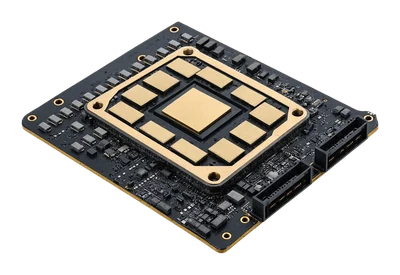
H100 SXM
80 GB HBM3 · 3.35 TB/s
$1.85/hr
AI training, fine-tuning and production LLM inference
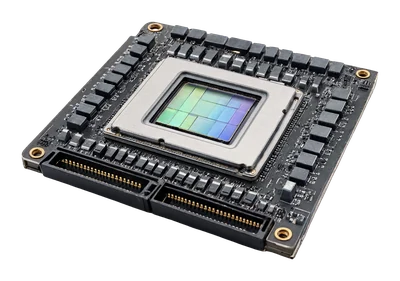
H200 SXM
141 GB HBM3e · 4.8 TB/s
$2.49/hr
Long-context LLM inference and fine-tuning above 70B
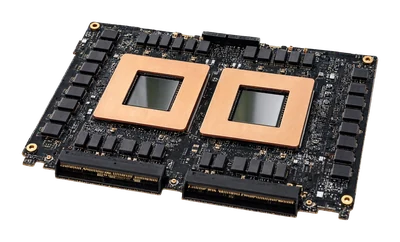
B200 SXM
180 GB HBM3e · 8 TB/s
$4.15/hr
Large-scale training and frontier model inference
GPUBank on-demand prices, all-in. Memory bar scaled to 192 GB.
09 / Rent or buy
Rent or buy an 8-GPU HGX B200
The only realistic purchase unit is an 8-GPU HGX B200 or DGX B200 server, and dated sources disagree by more than $150,000. Northflank cites Exxact's TensorEX HGX B200 Essential configuration at $390,703.50 with dual AMD EPYC and 1,536 GB of RAM, Mercatus gives $400,000 to $500,000 with $450,000 as a typical integrated quote and a DGX B200 near $515,000 (16 July 2026), and Thunder Compute gives $450,000 to $550,000 (9 October 2026)134748. Mercatus also notes that no functioning secondary market for B200 systems exists yet, so the resale value is the weakest input in any calculation. Around the server you need high-density colocation that can feed and cool about 14.3 kW, fabric ports if you will ever cluster, and someone to swap failed parts.
Our working case is a $450,000 server resold for 40 percent of its price after 24 months, which is our assumption, so depreciation is $270,000 over two years, or $11,250 a month. Colocation at $150 per kW-month for 15 kW adds $2,250, cost of capital at 8 percent a year on $450,000 adds $3,000 and spares and support add $1,000, all three our assumptions, for $17,500 a month before power. At the US commercial average of 13.97 cents per kWh for January to July 2026, 14.3 kW under load costs $2.00 per server-hour49. Renting the same eight GPUs costs $33.20 a server-hour on demand at GPUBank, $26.56 reserved and $20.75 effective with $1,000 top-ups. Owning therefore breaks even at 17,500 / (33.20 - 2.00) = 561 hours a month against on demand, which is 77 percent of the month, at about 713 hours against the reserved rate, and never against the effective rate: at 730 hours owning costs $18,958 and renting $15,147.50.
The answer moves with the inputs. At Exxact's $390,703.50 and 50 percent resale the fixed cost falls to about $14,000 a month and owning breaks even with on demand at about 450 hours; at $550,000 and 40 percent resale it rises to about $20,700 and 662 hours. Staff time is left out, and so is any discount you can negotiate on the server. Buy if you already have high-density colocation, can keep the node above about 80 percent busy for two years, need the hardware on your own premises, or need dozens of nodes. Rent if your use is bursty or below that level, if you cannot wait for an allocation, or if a B300 or Rubin generation in 18 months would leave you holding a depreciating server.

| Hours a month | Rent at $4.15 | Rent at $2.59 effective | Own | Cheaper |
|---|---|---|---|---|
| 100 | $3,320.00 | $2,075.00 | $17,699.77 | Rent |
| 250 | $8,300.00 | $5,187.50 | $17,999.43 | Rent |
| 400 | $13,280.00 | $8,300.00 | $18,299.08 | Rent |
| 550 | $18,260.00 | $11,412.50 | $18,598.74 | Rent |
| 650 | $21,580.00 | $13,487.50 | $18,798.51 | Own beats on demand; the effective rate beats owning |
| 730 | $24,236.00 | $15,147.50 | $18,958.33 | Own beats on demand; the effective rate beats owning |
Server price: Mercatus typical integrated quote, 16 July 2026; Exxact $390,703.50 via Northflank; Thunder Compute $450,000 to $550,000, 9 October 2026. The $96,000 shown as host is our cost of capital ($72,000) and support ($24,000) over 24 months; colocation is $150 per kW-month for 15 kW.
10 / What to choose
The cheapest B200 depends on the unit.

Serving a 70B to 400B model to many users
B200 on demand or reserved, in FP4
At full batch it produces Llama 2 70B tokens for $0.094 per million at GPUBank's list price, against $0.132 on an H100 and $0.167 on an H200.

Fine-tuning a 70B model in bursts
B200 interruptible at $2.49, or a full node on demand
A measured 2.2x over the H100 per GPU means about the same cost per job in under half the time, and spot cuts the bill by 40 percent if you checkpoint.

Pre-training across many nodes
A reserved InfiniBand cluster or a GB200 NVL72 rack
Single-node offers cannot carry the fabric traffic; Lambda's clusters start at 16 GPUs and two weeks, and NVL72 adds NVLink across 72 GPUs.

Image generation or models under 80 GB
H100 SXM at $1.85 instead
In FP8 diffusion the B200 is only 1.6 times faster, so 1,000 SDXL images cost $0.22 on an H100 against $0.30 on a B200.
11 / Questions
What people ask before renting one.
The cheapest B200 hour on any provider's page in mid-October 2026 is Nebius's preemptible tier from $0.99, but it is the floor of a dynamic spot price that can rise to $8.49 and stops the VM with 60 seconds of notice12. The cheapest fixed spot price with published terms is GPUBank's $2.49, with five minutes of notice5. For an uninterrupted dedicated GPU, Deep Infra's $3.69 container is the lowest list price we found, followed by packet.ai's shared Dynamic tier at $3.75, Beam at $4.11 and GPUBank at $4.15, which falls to about $2.59 with a $1,000 top-up62014. On multi-year contracts Vultr quoted $2.99 for 48 months50. Which of these is cheapest for you depends on how much interruption, sharing or commitment the job can accept.
A B200 costs between about $2.50 and $14.25 per GPU-hour in October 2026 on fixed terms, plus a dynamic spot floor of $0.99 at Nebius, and the spread is set by terms more than by the GPU. Single-GPU on-demand instances with CPU and RAM included run from $3.69 at Deep Infra and $4.15 at GPUBank to $7.87 at Verda, $7.99 at Runpod and $8.50 at Nebius657241. Neocloud 8-GPU nodes sit at $5.43 to $8.60 per GPU, multi-year reservations at $2.99 to $4.49, and the hyperscalers at $14.00 to $14.24 on demand, with Google offering no on-demand price at all222716351238. Multiply by eight for any offer sold only by the node.
You can rent a single B200 from a growing number of providers, though the large clouds still sell only 8-GPU instances. Deep Infra, GPUBank, Beam, Verda, Nebius, Runpod, Lambda, Koyeb, Modal and packet.ai all sell one GPU, and on GPUBank a machine of 2, 4 or 8 GPUs costs that multiple of the single-GPU price with the same multiple of vCPU, RAM and NVMe6511. AWS's p6-b200.48xlarge, Google's a4-highgpu-8g, Oracle's BM.GPU.B200.8 and CoreWeave's HGX B200 come only as eight GPUs, and Lambda's 1-Click Clusters start at sixteen35381227. One B200 is enough to serve a model of up to about 170 GB in its deployed precision, which in FP4 covers models of roughly 300 billion parameters with room for the KV cache, and to fine-tune anything that fits in that memory.
Both figures come from NVIDIA, but 180 GB is what a rented B200 gives you. Early HGX B200 specifications listed up to 192 GB of HBM3e per GPU, and several providers still print that number, while NVIDIA's DGX B200 page lists 1,440 GB for eight GPUs, or 180 GB each9. The clouds that state usable memory, including Lambda, Verda, Deep Infra and GPUBank, expose 180 GB, and so does Oracle's BM.GPU.B200.8 shape117612. The difference is capacity on the HBM stacks that is not exposed to software. When you size a model, a KV cache or a batch, plan on 180 GB per GPU and leave a few gigabytes for the CUDA context and the framework.
A B200 spot instance is worth it for any job that checkpoints regularly and can lose a few minutes of work: batch inference, evaluation sweeps and checkpointed training all qualify, and user-facing endpoints do not. Notice periods differ more than prices. GPUBank's interruptible tier at $2.49 gives five minutes of notice, runs a checkpoint hook, stops rather than deletes the machine and credits 30 minutes if a notice is missed5. Nebius gives 60 seconds through SIGTERM and prices its spot dynamically between $0.99 and $8.4912. Verda's fixed spot is $3.94, Together AI's preemptible $4.09 and CoreWeave's $4.26 per GPU on a node71727. Measure the cost of one interruption, the work since the last checkpoint plus the restart, before counting the discount as real.
On a marketplace an independent host sets the price and supplies the machine around the GPU, while on a managed cloud the provider fixes the instance shape and the billing rules. On Lium, Vast.ai, Akash or Runpod Community Cloud the CPU, RAM, disk speed and network vary from one listing to the next; Akash prices the GPU alone and adds CPU, memory, storage and the IP lease in each provider's bid, and Vast bills disk and bandwidth on top and keeps billing storage until the instance is destroyed3032. Reliability is the host's, and so is a machine slower than its listing suggests. A managed offer such as Deep Infra, Beam, Verda, Nebius or GPUBank gives a fixed vCPU and RAM allocation per GPU and published billing terms. In mid-October 2026 no marketplace B200 we could see was cheaper than the cheapest managed single GPU, the reverse of the usual pattern on consumer cards, so on this card a marketplace is where you look for a whole node when the managed clouds are sold out rather than for a lower rate4.
The B200 is worth it over both cards for high-throughput inference of large models and over the H200 for training, while against the H100 for training it buys time rather than savings. In MLPerf Inference v5.0, eight B200s served Llama 2 70B at 98,443 tokens per second against 33,072 for eight H200s and 31,106 for eight H100s, which at GPUBank's prices is $0.094 per million tokens on the B200, $0.167 on the H200 and $0.132 on the H10041. The B200 ran in FP4 and Hopper in FP8, and on SDXL at equal FP8 precision the gain shrinks to 1.6 times, which makes the H100 cheaper per image. For fine-tuning, NVIDIA's measured 2.2x over the H100 makes the cost per job about equal while the B200 finishes in less than half the time10.
No, Google Cloud does not sell its B200 machine type on ordinary on-demand terms. Its documentation says that to provision A4 machine types you must reserve capacity, use Spot VMs, use Flex-start VMs or create a resize request in a managed instance group, and its pricing page shows N/A in the on-demand column3738. In us-central1 the a4-highgpu-8g, with eight B200s, 224 vCPU, 3,968 GB of RAM and 12,000 GiB of local SSD, costs $39.6336 an hour on Spot, $64.44 on Dynamic Workload Scheduler Flex-start, $90.22 in calendar mode, $88.9272 on a one-year commitment and $56.7072 on three years38. Flex-start is the closest thing to on demand: you request capacity for up to a set duration and the scheduler starts the VM when it is available. AWS does sell the B200 on demand, but at $14.24 per GPU inside an 8-GPU instance, two to four times the neocloud rate, and what that premium buys is the surrounding platform rather than a faster GPU35.
Azure's public price list does not include an ND B200 v6 SKU, so we found no B200 price on Microsoft's own pages. What the Azure Retail Prices API does list is the ND GB200 v6, a virtual machine with four Grace Blackwell GPUs, at $108.16 an hour on Linux in East US, East US 2 and West US 3, which is $27.04 per GPU and the highest per-GPU figure in this survey39. The same API lists one-year and three-year reservations for that VM. Aggregator figures for an ND B200 v6 disagree with each other and could not be traced to Microsoft, so we leave the B200 row for Azure empty rather than guess. Teams committed to Azure for platform reasons should ask their account team for B200 capacity, and teams that are not will find the B200 far cheaper elsewhere.
A single B200 running all month, 730 hours, costs $3,029.50 at GPUBank on demand, $2,423.60 reserved and about $1,893 effective with $1,000 top-ups, and $2,693.70 at Deep Infra's $3.6956. At other providers the same month costs about $4,365 at Runpod Community's $5.98, $5,745 at Verda's $7.87 and $6,205 at Nebius's $8.50, before storage2471. An 8-GPU node costs $24,236 at GPUBank on demand, $19,388.80 reserved, $21,549.60 at Deep Infra, $22,133.60 on Civo's 36-month contract and $82,976.18 on an AWS Capacity Block1636. Add persistent storage, $0.03 per GB-month at GPUBank and $0.071 per GiB-month at Nebius, and egress on clouds that bill it. For part-time use, multiply your real hours by the rate, rounding each session up first on providers that bill by the hour.
Buy only if you can keep an 8-GPU server busy for more than about 77 percent of every month for two years and already have colocation that can take about 14.3 kW. With a $450,000 server, 40 percent resale after two years, colocation at $150 per kW-month, 8 percent cost of capital, $1,000 a month for support and US commercial power at 13.97 cents per kWh, owning costs about $17,500 a month plus $2.00 per server-hour of power4749. That breaks even with GPUBank on demand at $33.20 per node-hour at about 561 hours a month and with the reserved rate at about 713 hours, while against the effective rate after $1,000 top-ups, $20.75 per node-hour, owning never breaks even within a month. Buying makes sense for data that must stay on your premises, for fleets of dozens of nodes, or for teams with cheap power and space.
An 8-GPU HGX B200 server, the only practical way to buy a B200, costs about $390,000 to $550,000 in 2026 depending on vendor and configuration. Northflank cites Exxact's TensorEX HGX B200 Essential configuration at $390,703.50, Mercatus puts a typical integrated quote at $450,000 within $400,000 to $500,000 and the DGX B200 near $515,000, and Thunder Compute gave $450,000 to $550,000 in October134748. Per GPU, Mercatus says the B200 lists at $30,000 to $40,000 in 8-GPU volumes with street quotes of $45,000 to $50,000, but an SXM module is useless without a baseboard. NVIDIA publishes no DGX price list, and Mercatus notes that no functioning secondary market for B200 systems exists yet, which makes resale value the most uncertain input in any rent-or-buy calculation.
A DGX B200 draws up to about 14.3 kW according to NVIDIA, and NVIDIA's MLPerf write-up gives each Blackwell GPU in those systems a thermal design power of 1,000 W910. At the US commercial average of 13.97 cents per kWh for January to July 2026, a fully loaded server uses about $2.00 of electricity an hour, or about $1,460 over a 730-hour month, before the cooling overhead of the facility49. Most traditional colocation racks are provisioned at 5 to 10 kW, so a single B200 server can need a high-density rack or a dedicated power feed, and some HGX B200 chassis are liquid-cooled. When you rent, power and cooling are inside the hourly price, which is part of why a B200 hour costs more than the server price divided by its lifetime hours.
On a provider with stock, a B200 can be running in about a minute, while reserved and hyperscaler capacity can take days or weeks to arrange. GPUBank gives a median of 48 seconds from launch to a machine that has passed its health check, in Frankfurt or Ashburn, and its meter starts only then5. Nebius requires a quota increase above its default of zero, Google requires a reservation, Spot or Flex-start, AWS Capacity Blocks are booked for future dates, and Lambda's clusters start at two weeks and 16 GPUs3373611. GetDeploying marked Lambda, Massed Compute, Hyperstack's on-demand flavour, Sesterce and Runpod Community out of stock on 15 October, so check live availability before planning around a price15.
GPUBank is paid from a prepaid US dollar balance topped up in cryptocurrency, and its B200 hour includes the vCPU, RAM, local NVMe, an IPv4 address and all traffic, so the only possible extra line is a persistent disk at $0.03 per GB-month5. Accepted coins include Bitcoin, Ethereum, USDT, USDC, Monero and more than a dozen others, top-ups run from $25 to $5,000, and the bonus of 20 percent from $25, 35 percent from $100 and 60 percent from $1,000 brings the effective on-demand hour to about $3.46, $3.07 and $2.59. Cards are not accepted for now, which rules GPUBank out for teams that can only pay by card. The balance never expires, every account and every team member can have a monthly spend cap, billing is per second with no minimum, and if a host fails during a job the machine restarts on a healthy host with the same disk and the interrupted session is credited in full.
Sources
Sources
- 01Nebius documentation, Compute pricingB200 $8.50 on demand since 1 October, dynamic preemptible from $0.99 since 8 October, disk prices · read 16 Oct 2026
- 02Nebius documentation, Preemptible VMsSIGTERM 60 seconds before stop; volumes kept, dynamic IPs not · read 16 Oct 2026
- 03Nebius documentation, Compute quotasDefault B200 quota for VMs without reservations is 0 · read 16 Oct 2026
- 04Lium, B200 marketplace page22 B200s available from $5.94 per GPU-hour, billed per second · read 16 Oct 2026
- 05GPUBank pricingB200 SXM rates, inclusions, billing, spot and reserved terms, top-up bonuses · read 16 Oct 2026
- 06Deep Infra, GPU instances1x B200 at $3.69/hour with 16 vCPU, 250 GB RAM, 2 TB SSD; per-minute billing, no egress fees · read 16 Oct 2026
- 07Verda pricing1x B200 SXM6 $7.87 on demand, $3.94 spot, serverless $8.66, long-term discounts · read 16 Oct 2026
- 08fal pricingB200 $7.99/h list, as low as $5.49/h · read 16 Oct 2026
- 09NVIDIA DGX B200 product page1,440 GB HBM3e, 64 TB/s, 14.4 TB/s NVLink, FP4 and FP8 figures, about 14.3 kW maximum · read 16 Oct 2026
- 10NVIDIA technical blog, Blackwell in MLPerf Training v4.12x GPT-3 and 2.2x Llama 2 70B LoRA per GPU against Hopper; 1,000 W TDP per GPU · read 16 Oct 2026
- 11Lambda pricingB200 instances $6.69 (8x) to $6.99 (1x); 1-Click Clusters $9.86 to $8.87 · read 16 Oct 2026
- 12Oracle Cloud price list (cetools API), OCI Compute GPU B200B200 GPU per hour $14.00 pay as you go (part B110978) · read 16 Oct 2026
- 13Northflank blog, How much does an NVIDIA B200 GPU cost$5.87 per GPU-hour; Exxact HGX B200 at $390,703.50 · read 16 Oct 2026
- 14Beam pricingB200 machine from $4.11/hr with 28 vCPU, 256 GB RAM, 2 TB NVMe; no egress fees · read 16 Oct 2026
- 15GetDeploying, Nvidia B200 rental pricesStock flags, Sesterce, Lyceum, Daytona, Hostinger, Cirrascale, Vultr spot (aggregator, 15 October) · read 16 Oct 2026
- 16Civo pricing8x B200 node on 12, 24 and 36-month commitments; no on-demand price · read 16 Oct 2026
- 17Together AI pricingHGX B200 $8.19 on demand, $4.09 preemptible, reserved $7.99 to $6.79 · read 16 Oct 2026
- 18Koyeb pricingB200 $5.50/hr with 15 vCPU, 240 GB RAM, 320 GB disk · read 16 Oct 2026
- 19Baseten pricingB200 $0.16633 per minute · read 16 Oct 2026
- 20packet.ai pricingB200 Dynamic (shared) $3.75 and Dedicated $6.99, US East · read 16 Oct 2026
- 21GMI Cloud pricingB200 from $5.00, limited availability, contact sales · read 16 Oct 2026
- 22Massed Compute pricing8x B200 SXM6 $43.46/hr with 280 vCPU, 2,800 GB RAM · read 16 Oct 2026
- 23Hyperstack GPU pricingB200 $6.00 on demand, reservation from $5.10 · read 16 Oct 2026
- 24Runpod pricingB200 Secure Cloud $7.99, Community $5.98, serverless $8.64, storage rates · read 16 Oct 2026
- 25E2E Networks GPU pricingB200 $7.99/hr with 32 vCPU, 400 GB RAM, per-minute billing · read 16 Oct 2026
- 26Crusoe Cloud pricingB200 HGX $8.50 per GPU-hour on demand · read 16 Oct 2026
- 27CoreWeave pricingHGX B200 node $68.80 on demand, $34.11 spot; GB200 NVL72 $42.00 an hour for 4 GPUs · read 16 Oct 2026
- 28Shadeform, H200 vs B200 directory pageB200 from $6.52/hr; no live instance listed · read 16 Oct 2026
- 29UpCloud pricingNew B200 prices from 20 October in EUR, billed by the started hour · read 16 Oct 2026
- 30ComputePrices, B200Akash $5.00, Hyperbolic $5.99, Vast.ai $6.25 (aggregator, 13 to 15 October) · read 16 Oct 2026
- 31Vast.ai, B200 pricing pageNo current offers on 16 October · read 16 Oct 2026
- 32Vast.ai documentation, BillingStorage billed while stopped; bandwidth billed per byte · read 16 Oct 2026
- 33Cerebrium pricingB200 $0.00167 per second · read 16 Oct 2026
- 34Modal pricingB200 $0.001736 per second (GPU only) · read 16 Oct 2026
- 35Amazon EC2 On-Demand pricing (AWS price list feed, US East N. Virginia, Linux)p6-b200.48xlarge $113.9328/hr, 192 vCPU, 2,048 GiB, 8 x 3,840 GB NVMe · read 16 Oct 2026
- 36Amazon EC2 Capacity Blocks for ML pricingp6-b200.48xlarge $113.666 per instance-hour; u-p6e-gb200x72 $761.904 · read 16 Oct 2026
- 37Google Cloud documentation, accelerator-optimized machinesA4 requires a reservation, Spot, Flex-start or a MIG resize request · read 16 Oct 2026
- 38Google Cloud, accelerator-optimized VM pricinga4-highgpu-8g: on demand N/A, Spot $39.6336, Flex-start $64.44, calendar $90.22, 1-year $88.9272, 3-year $56.7072 · read 16 Oct 2026
- 39Azure Retail Prices API, ND GB200 v6Standard_ND128isr_NDR_GB200_v6 $108.16/hr in East US; no ND B200 v6 SKU listed · read 16 Oct 2026
- 40packet.ai, packet.ai vs Verda comparisonDynamic tier described as scheduler-enforced multi-tenant, billed hourly · read 15 Oct 2026
- 41MLCommons, MLPerf Inference v5.0 results (summary_results.json)Closed datacenter results 5.0-0056 (DGX B200), 5.0-0057 (DGX H100), 5.0-0060 (H200), 5.0-0010, 5.0-0039, 5.0-0065 · read 16 Oct 2026
- 42NVIDIA technical blog, Blackwell in MLPerf Inference v5.0Llama 2 70B B200 against H200, FP4 on Blackwell · read 16 Oct 2026
- 43Nebius blog, bare-metal-class performance in MLPerf Inference v5.1HGX B200 Llama 2 70B 101,611 tokens/s server, 101,246 offline (entry 5.1-0077) · read 16 Oct 2026
- 44Lambda blog, MLPerf Inference v5.1 on HGX B200Llama 2 70B 99,993.9 tokens/s server, 102,725 offline, FP4, TensorRT 10.11, CUDA 12.9 · read 16 Oct 2026
- 45NVIDIA data center inference performance pageLatest-round 8x B200 Llama 2 70B result (102,398 tokens/s server) · read 16 Oct 2026
- 46NVIDIA technical blog, Blackwell in MLPerf Training v5.0Up to 2.6x per GPU over Hopper on GB200 NVL72; Llama 2 70B LoRA 2.5x · read 15 Oct 2026
- 47Mercatus, NVIDIA B200 server price 2026$400,000 to $500,000, typical $450,000; DGX B200 about $515,000; no secondary market (16 July 2026) · read 16 Oct 2026
- 48Thunder Compute, NVIDIA B200 pricing8-GPU HGX B200 system $450,000 to $550,000 (updated 9 October 2026) · read 16 Oct 2026
- 49EIA, Electric Power Monthly, table 5.3US commercial average 13.97 cents per kWh, January to July 2026 · read 16 Oct 2026
- 50Vultr, NVIDIA B200 page (read by the research pass on 15 October; blocked on 16 October)From $2.99 per GPU-hour on a 48-month contract · read 15 Oct 2026
- 51Vultr public API, bare-metal plansvbm-256c-3072gb-8-b200-gpu at $68.00/hr, no locations listed · read 16 Oct 2026
What we could not confirm
Vultr's B200 page, which the research pass read on 15 October as "from $2.99 per GPU-hour on a 48-month contract", was behind a bot check on 16 October, and Vultr's public API listed its 8-GPU bare-metal plan at $68 an hour with no location51, so the $2.99 is kept as a dated reading and the $3.20 spot node comes from GetDeploying. Akash's pricing page loaded without its table and Vast.ai's page showed no offers, so their $5.00 and $6.25 come from ComputePrices; Sesterce's $4.11 and Vultr's spot price come from GetDeploying. The $3.74 Boost Run node seen on Shadeform in September, Yotta Shakti's $2.91 and E2E Networks' $3.02 reservations could not be found again: Yotta's page now shows rupee prices per term and E2E's shows $7.99 on demand. Deep Infra and Beam do not show live stock and Lambda's on-demand billing granularity was not stated. packet.ai's pricing page gives no billing granularity, and the hourly billing in our 61-minute example comes from its comparison pages. Runpod's Secure Cloud B200 is $7.99 on its pricing page but $6.79 in several of its own articles. The 1,000 W per GPU is the thermal design power NVIDIA gives for its MLPerf Training v4.1 systems, not a datasheet figure. NVIDIA's current performance page lists no H100 or H200 rows, so the generation table uses MLPerf Inference v5.0, the latest round we could verify with all three cards on the same benchmarks; the MI300X has no single-node v5.0 entry on these benchmarks. The resale value, colocation rate, cost of capital, support cost and the 10 to 30 percent marketplace slowdown are our assumptions.
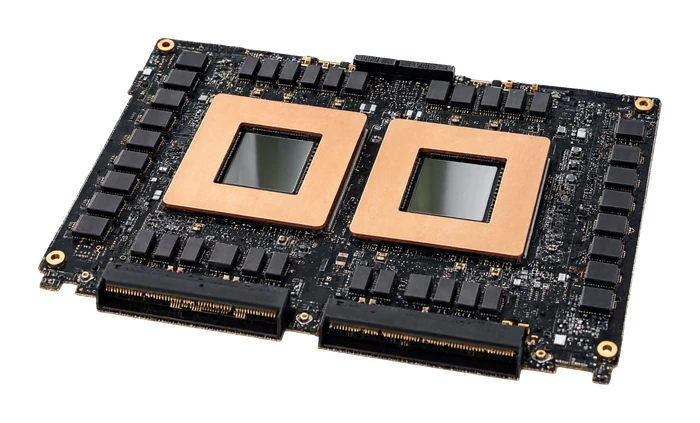
B200 SXM on GPUBank
One B200, not a node of eight, billed by the second.
- 28 vCPU, 283 GB RAM, 2 TB NVMe, IPv4 and traffic in $4.15/hr
- Billed by the second after the health check
- Interruptible $2.49, reserved $3.32
 28 vCPU, 283 GB RAM, 2 TB NVMe, IPv4 and traffic in $4.15/hr
More GPU price guides
Where to rent the other cards at the cheapest price.
H200 SXM141 GB HBM3eFrom $1.49 spot · $2.49 all-inH100 SXM80 GB HBM3From $1.11 spot · $1.85 all-in H100 PCIe80 GB HBM2eFrom $0.81 spot · $1.35 all-inMI300X192 GB HBM3From $0.99 spot · $1.65 all-in
 RTX PRO 600096 GB GDDR7 ECCFrom $0.69 spot · $1.15 all-in
 A100 SXM80 GB HBM2eFrom $0.57 spot · $0.95 all-in
 L40S48 GB GDDR6 ECCFrom $0.33 spot · $0.55 all-in
 RTX 509032 GB GDDR7From $0.29 spot · $0.48 all-in
 RTX 409024 GB GDDR6XFrom $0.14 spot · $0.23 all-in