Updated 15 Oct 2026 · 28 offers checked
Where to rent an RTX 5090 at the cheapest price
We read every RTX 5090 offer we could find on the provider's own page, priced what each hour actually includes, and worked out the monthly bill, the speed you get for it and the point where buying the card would cost less.
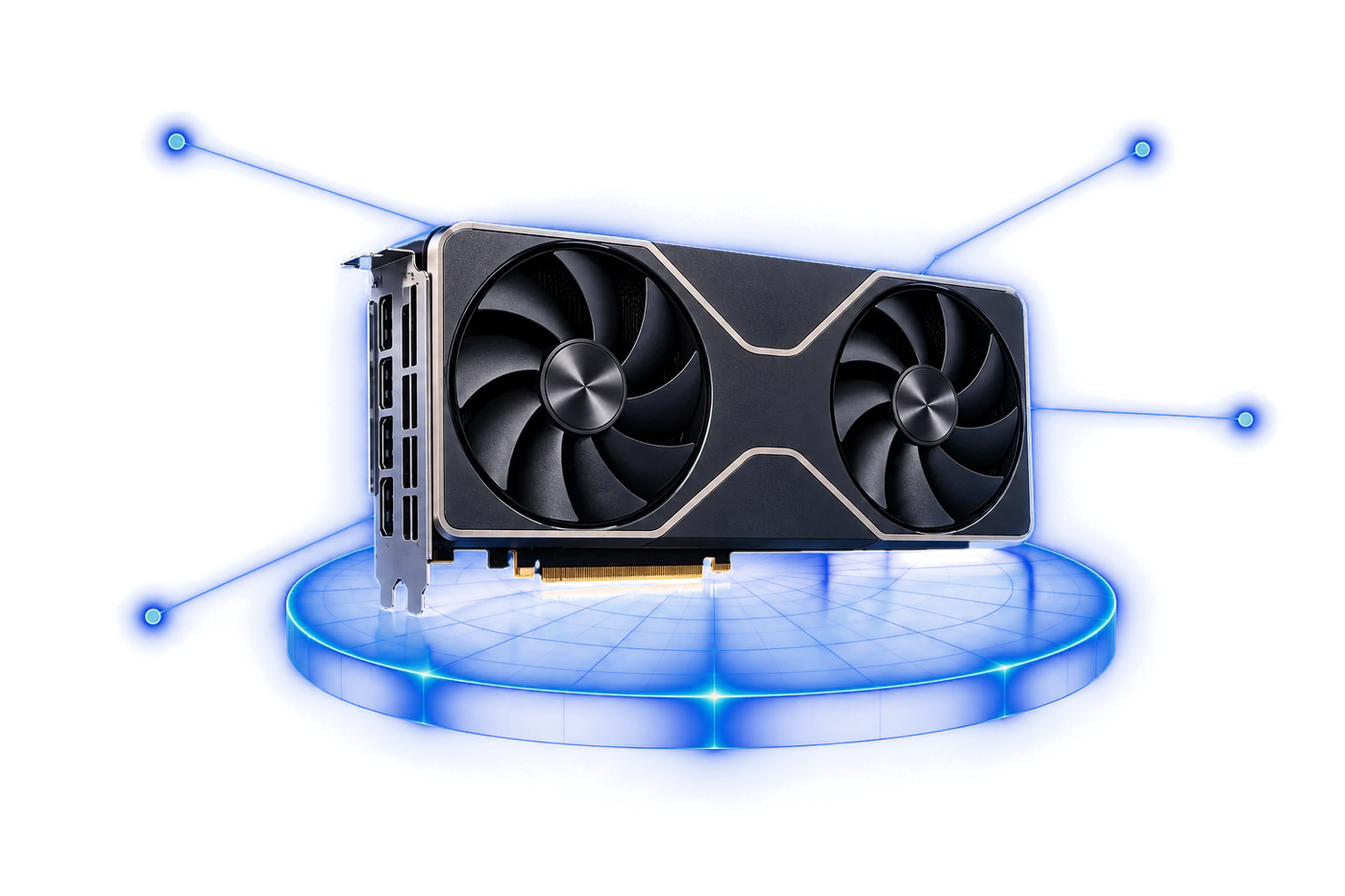 32 GBGDDR7, 512-bit
21,760CUDA cores
1,792 GB/smemory bandwidth
575 Wboard power
The short answer, 15 Oct 2026
- $0.25/hrCheapest hour you can get. SaladCloud at its lowest priority, on consumer PCs that can take the job back at any time, with 4 vCPU, 8 GB of RAM and no persistent disk.6
- $0.29/hrCheapest hour on a known machine. GPUBank's interruptible RTX 5090, with the same 9 vCPU, 35 GB of RAM, 500 GB NVMe, IPv4 and traffic as on demand, five minutes of notice before a reclaim and the disk kept.1
- $0.48/hrCheapest on demand with the whole machine stated. GPUBank, $0.36 effective after a $100 top-up.1 HyperAI lists $0.35 but publishes no disk or traffic terms, and Vast.ai's $0.37 headline had no offers behind it on 16 October.14167
Renting an RTX 5090 is not like renting a datacenter GPU. The supply comes almost entirely from specialised GPU clouds and from peer-to-peer marketplaces where independent hosts list their own machines, and the posted prices for what looks like the same hour of the same silicon run from a quarter of a dollar to well over a dollar. The spread is not noise: each price buys a different machine, a different meter and a different promise about what happens when something breaks, and the cheapest line on a pricing page often turns into a bill that is not the cheapest at the end of the month.
There is therefore no single cheapest RTX 5090, only a cheapest hour for each level of risk you are willing to carry. A card in somebody's spare room, rented at the lowest priority of a distributed network, costs about 25 cents an hour, but the job can be stopped at any moment, the container gets a few vCPUs and little memory, and the models are downloaded again whenever the work lands on a new machine. A managed instance in a datacenter with local NVMe, a public IP and included traffic costs about twice that, and still half of what the best-known GPU clouds ask for the same card. This page is published by GPUBank, a GPU cloud run by GPU Compute OÜ in Tallinn, so read our own entry with that in mind: it is measured on the same terms as every other offer, and the text says plainly where a marketplace listing or a spot tier beats it.
01 / The price ladder
Every RTX 5090 offer we could verify, on one scale.
Each dot is one offer, placed by its price per GPU-hour and grouped by the kind of product it is, because a spot hour and a managed hour are not the same thing even when they cost the same. Prices are the provider's own figure on 15 Oct 2026 unless the table further down says it comes from an aggregator or from the provider's own dated snapshot.
Managed on demandA fixed machine at one hourly price, from the provider's own fleet.
MarketplaceIndependent hosts set their own price; the machine varies by listing.
Spot and priority tiersCheaper hours that can be taken back.
ReservedA week, a month or longer, paid whether the card works or not.
ServerlessBilled by active seconds at a higher hourly equivalent.
02 / Why not AWS
The big clouds do not rent it, and the reason is a licence.
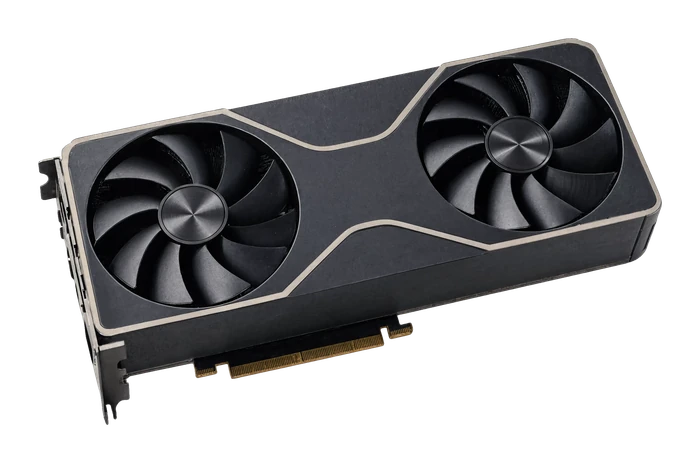
The RTX 5090 is a consumer card built on NVIDIA's GB202 Blackwell chip, with 21,760 CUDA cores, 680 fifth-generation Tensor Cores and 32 GB of GDDR7 on a 512-bit bus for 1,792 GB/s of memory bandwidth, drawing up to 575 W from a recommended 1,000 W supply.23 It went on sale on 30 January 2025 at $1,999, and for AI work its two real advantages over the RTX 4090 are 78 percent more memory bandwidth, which largely sets how fast a language model writes tokens, and native FP4 in its Tensor Cores. It has no NVLink, no ECC memory and no way of splitting the card between users, which starts to matter once a job spans several cards or runs unattended for weeks.
The hyperscalers stay away for a contractual reason rather than a technical one. In December 2017 NVIDIA added a "No Datacenter Deployment" clause to the licence of its GeForce driver,5 and the current licence keeps it in clause 2.8, which says the GeForce software is licensed only for GeForce hardware you own and "is not licensed for datacenter deployment".4 The licence does not define what a datacenter is, and how each specialised provider squares its own deployment with it is not something any of them publishes, so we do not speculate about it here. What is visible is the result: none of the six largest GPU clouds listed an RTX 5090 when we checked, and every offer on this page comes from a specialised GPU cloud or a marketplace.

NVIDIA GeForce Software LicenseCurrent version
2.8 You agree that GeForce or Titan SOFTWARE: (i) is licensed for use only on GeForce or Titan hardware products you own, and (ii) is not licensed for datacenter deployment.
December 2017: "No Datacenter Deployment. The SOFTWARE is not licensed for datacenter deployment, except that blockchain processing in a datacenter is permitted."
 AWSNo RTX 5090
 Google CloudNo RTX 5090
 Microsoft AzureNo RTX 5090
 Oracle CloudNo RTX 5090
 LambdaNo RTX 5090
 CoreWeaveNo RTX 5090
03 / Five kinds of offer
Compare like with like, or the cheapest price lies.
A managed cloud sells a fixed machine, the GPU with its vCPUs, memory and local disk, at one hourly price that may or may not include the public IP, the persistent storage and the traffic. A peer-to-peer marketplace lets independent hosts post their own GPU price and adds storage, bandwidth and sometimes a platform fee as separate lines set by each host, on hardware that ranges from colocated servers to gaming PCs. The other three kinds trade something away for the price, and putting a spot hour next to a managed hour without saying so is how most "cheapest GPU" lists end up comparing things that cannot be compared.

Managed on demand
A known machine at a fixed rate
You get the stated vCPU, memory and disk every time, and the provider answers for the host. Read what the rate leaves out.
$0.35 to $1.19/GPU-hr

Marketplace
A host-set price per listing
The cheapest headline rates, on machines that differ from one listing to the next. Storage and bandwidth are billed by the host.
$0.37 to $0.85/GPU-hr

Spot and priority tiers
Cheaper hours that can be taken back
Fine for work that saves checkpoints or can be retried. What matters is the notice you get and whether your disk survives.
$0.25 to $0.50/GPU-hr

Reserved
A week, a month or a year
The lowest steady rate, paid whether the card works or not, often sold by the whole 8-GPU server.
$0.38 to $0.64/GPU-hr

Serverless
Billed by the active second
You pay only while a request runs, at a much higher hourly equivalent. Worth it for very bursty traffic only.
$1.09 and up/GPU-hr
04 / Provider by provider
What each price buys, and what it leaves out.
The captures below were taken on 15 Oct 2026 from each provider's own RTX 5090 or pricing page. They are there so you can see the figure in its context, next to the conditions that go with it.
GPUBankAll-in
$0.48/hr
Managed on demand · Paris, Singapore, Ashburn queue
9 vCPU35 GB RAM500 GB NVMeIPv4All trafficDisk $0.03/GB-mo
GPUBank lists the RTX 5090 at $0.48 an hour on demand, or $0.000133 a second, and the rate covers the vCPUs, the memory, the local NVMe scratch disk, one public IPv4 address and everything you send or receive. The only other line a receipt can carry is a persistent disk at $0.03 per GB-month. Billing is per second with no minimum and starts only once the machine has passed its health check, a failed launch is not billed, and a stopped machine costs nothing but its persistent disk. The interruptible tier costs $0.29 with five minutes of notice and a stop rather than a deletion, a week or a month reserved costs $0.38, and a host failure during a job restarts the machine on a healthy host with the same disk and credits the session in full. Payment is a prepaid balance topped up in crypto from $25, with a bonus of 20 to 60 percent that brings the effective hour down to between $0.40 and $0.30; cards are not accepted for now. The limits are a smaller machine than Beam's, two regions with stock on the day, and crypto as the only way to pay.1
Checked 15 Oct 2026
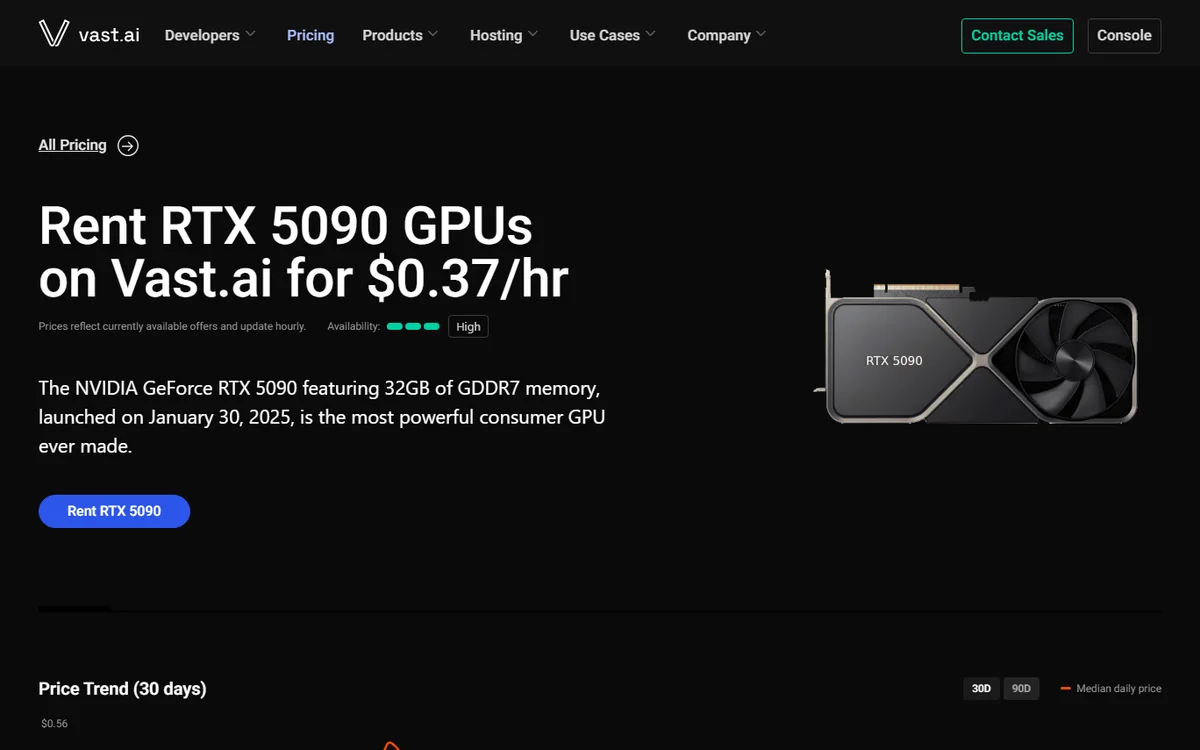
 Vast.ai
$0.37/hr
Marketplace · hosts worldwide
GPUStorageBandwidthVaries by host
Vast.ai's RTX 5090 page advertised $0.37 an hour on 15 Oct 2026, a figure drawn from the offers live at that moment and refreshed every hour, but the same page said "No current offers" on 14 and 16 October, which is how a thin marketplace for a new card behaves: a few hosts list, rent out and disappear. That price is the GPU rate only: Vast's own billing documentation says that stopping an instance does not avoid storage costs and that bandwidth is charged for every byte sent or received, at prices each host sets, so the total depends on the listing you pick.8 Billing is per second after a $5 minimum deposit.9 Vast rewards buyers who read a listing carefully: its reliability score, the CPU and PCIe generation around the card, the disk speed, the uplink and the storage rate decide more about the real cost than the headline.7
Checked 15 Oct 2026
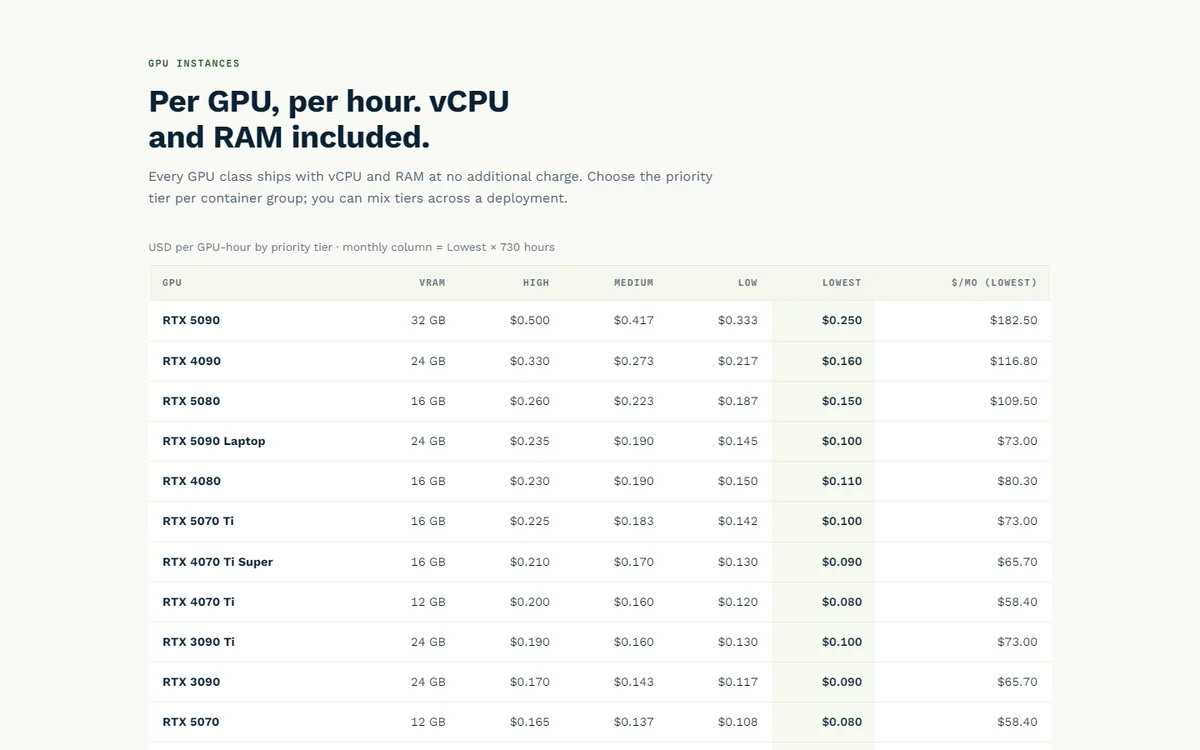
 SaladCloud
$0.25 to $0.50/hr
Distributed consumer PCs · by priority
vCPURAMNo persistent diskPreemptible below high
SaladCloud sells the RTX 5090 at four priority tiers, $0.500 for high, $0.417 for medium, $0.333 for low and $0.250 for its lowest batch tier, per GPU-hour with vCPU and RAM included and billed per second. The machines are consumer PCs on a distributed network, and the lower the priority, the more readily your container is moved off a machine for higher-paying work; aggregators list every tier with 4 vCPU and 8 GB of RAM. There is no persistent disk in the pricing we read, so models go in the container image or in external storage. For a retryable queue of image jobs it is the cheapest RTX 5090 hour there is; for an interactive session or a long fine-tune it is the wrong tool.6
Checked 15 Oct 2026
 Clore.ai
From $0.44/hr
Marketplace · on demand, spot, bare metal
GPU server10 % fee on demand2.5 % on spot
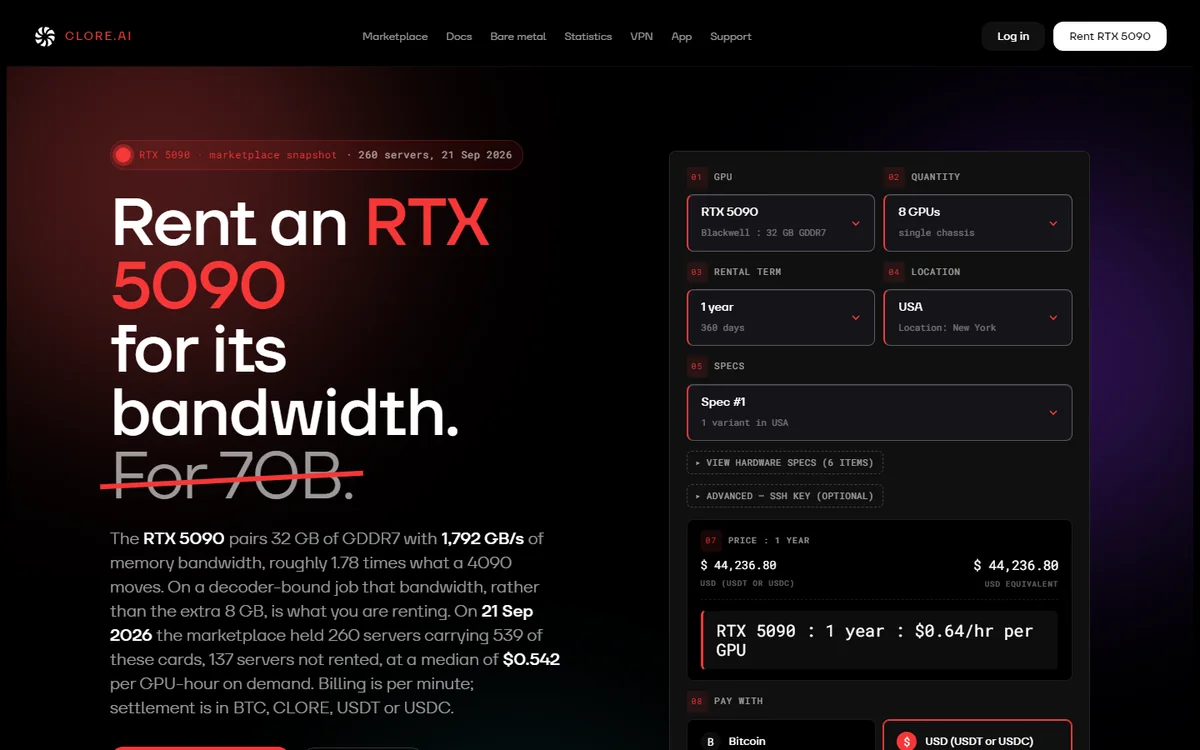
Clore.ai's RTX 5090 page advertised "from $0.44/hr" and reported its own snapshot of 21 September 2026: 539 cards on 260 servers, a median of $0.542 per GPU-hour on demand, a spot median of $0.521 and a lowest spot quote of $0.175. Billing is per minute, the marketplace takes 10 percent on on-demand rentals and 2.5 percent on spot, and payment is in BTC, CLORE, USDT or USDC. Clore also sells bare metal in blocks of eight cards, quoted at $0.64 to $1.06 per GPU-hour in the USA, the UK, Japan and Slovenia, on 14-day terms in the UK and 30-day terms elsewhere. The spot median sitting so close to the on-demand median says something useful: on this marketplace the deep discounts are individual listings that go fast, not the norm.10
Checked 15 Oct 2026
 Runpod
$1.19/hr
Managed on demand · 30+ regions
9 vCPU35 GB RAMContainer diskVolumes
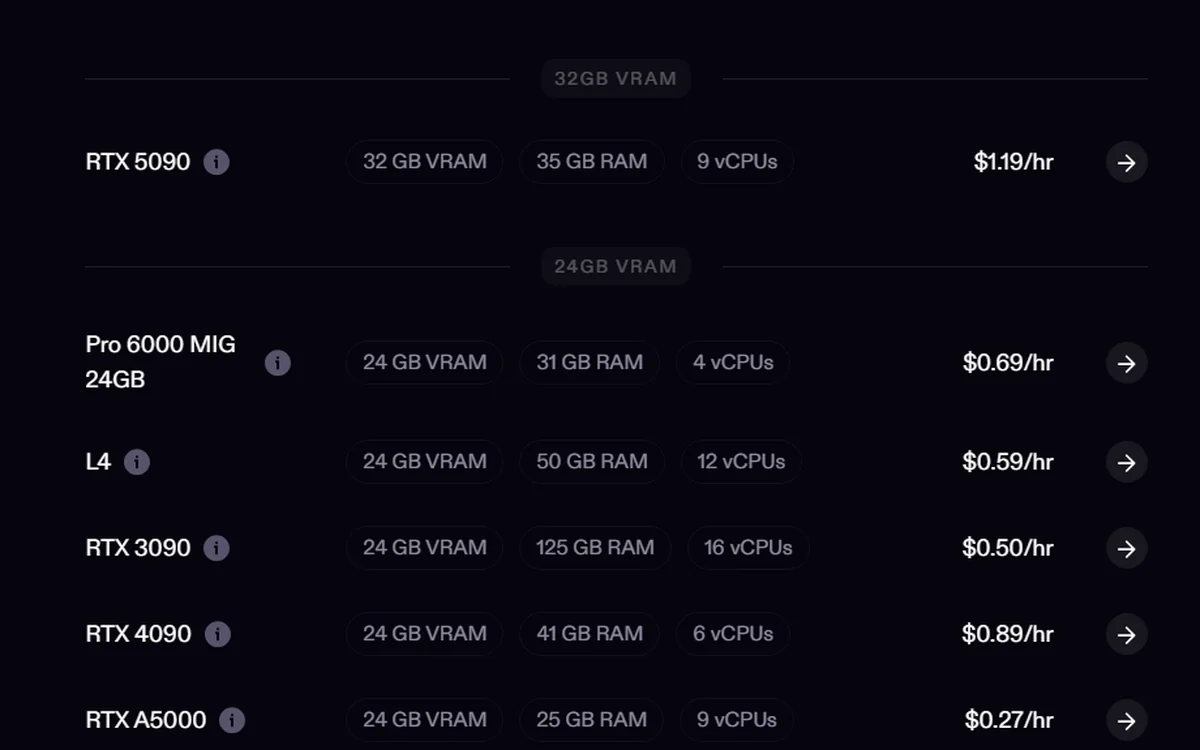
Runpod's pricing page listed the RTX 5090 at $1.19 an hour with 9 vCPU and 35 GB of RAM, billed per second, on a page last updated on 8 October. Storage is billed separately: $0.10 per GB-month for container disks and running volumes, $0.20 per GB-month for a volume attached to a stopped pod, and $0.07 per GB-month for network storage under 1 TB. The visible card shows only that Secure Cloud rate, while the page's structured data gives $0.69 for Community Cloud, which runs on third-party hosts and which GetDeploying showed in stock on 16 October.16 A serverless RTX 5090 worker costs $1.58 an hour. Runpod's case is breadth, with serverless endpoints, clusters and a large catalogue, rather than the price of this particular card.11
Checked 15 Oct 2026
The rest of the market
CloudRift's RTX 5090 page quoted $0.65 an hour on demand, and $0.62, $0.59 and $0.55 for one-week, one-month and three-month reservations, without detailing the machine around the card on that page.12 Beam lists a machine with 12 vCPU, 64 GB of RAM and 500 GB of NVMe from $0.72 an hour, the most generous machine of the managed offers, and RTX 5090 serverless time at $1.09 an hour for the GPU alone.13 HyperAI's pricing page listed the RTX 5090 at $0.35 an hour, which would undercut every managed offer here, and GetDeploying shows it in stock with 16 vCPU and 40 GB of RAM, but HyperAI's own page names only the 32 GB of VRAM, says nothing about disk, IP or traffic, and warns that the card may have queues at peak hours, so we cannot yet tell whether it is a cheaper all-in hour or a cheaper GPU line; it deserves a look on its own site.1416
Shadeform, a broker that resells other clouds, appears at $0.65 per card on aggregators, with inclusions set by the underlying cloud, and Novita AI at $0.56 on demand and $0.365 spot, both marked out of stock; neither figure could be read on the provider's own page.15 GetDeploying also lists GPUhub at $0.46 with 25 vCPU and 90 GB of RAM, GPU.ai at $0.69 and Oblivus at $0.90 with 14 vCPU and 80 GB, none confirmed on the provider's own page.16 Lium's marketplace ranged from $0.50 to $0.85 across its listed pods,17 Spheron advertised $0.78 with no capacity on the day,18 and Akash appeared at $0.57 to $0.68 on aggregators for the GPU alone. LeaderGPU in the Netherlands rents a single card for €449 a month and a server with eight RTX 5090s for €2,690 a month, both excluding VAT, the latter about €0.46 per GPU-hour if every card is busy all month.3019 SaladCloud's tiers are newer than most articles quoting them: on 12 September 2026 it raised high priority from $0.450 to $0.500, medium from $0.380 to $0.417 and low from $0.310 to $0.333, and left the lowest tier at $0.250.27
05 / Every offer in one table
The whole comparison, sorted by kind and price.
| Provider | USD / GPU-hr | Kind | What the price includes | Billing | Basis |
|---|---|---|---|---|---|
| HHyperAI | $0.35 | Managed on demand | 16 vCPU, 40 GB RAM per aggregator; disk and traffic not published | Hourly | Provider page14 |
| GGPUhub | $0.46 | Managed on demand | 25 vCPU, 90 GB RAM per aggregator | Not stated | Aggregator16 |
| GPUBank | $0.48 | Managed on demand | vCPU, RAM, 500 GB NVMe, IPv4, traffic | Per second | Provider page1 |
 Novita AI | $0.56 | Managed on demand | 16 vCPU, 58 GB RAM; listed out of stock | Per second | Aggregator15 |
 CloudRift | $0.65 | Managed on demand | Machine not detailed on the page | Hourly | Provider page12 |
 Shadeform | $0.65 | Managed on demand | Broker, inclusions of the underlying cloud | Per cloud | Aggregator15 |
| GGPU.ai | $0.69 | Managed on demand | Machine not listed | Not stated | Aggregator16 |
 Beam | $0.72 | Managed on demand | 12 vCPU, 64 GB RAM, 500 GB NVMe | Hourly | Provider page13 |
 Spheron | $0.78 | Managed on demand | No capacity on the check date | Per minute | Provider page18 |
 Oblivus | $0.90 | Managed on demand | 14 vCPU, 80 GB RAM per aggregator | Not stated | Aggregator16 |
| Runpod Secure Cloud | $1.19 | Managed on demand | 9 vCPU, 35 GB RAM; disks extra | Per second | Provider page11 |
| Vast.ai | $0.37 | Marketplace | GPU only; host storage and bandwidth; no offers on 16 Oct | Per second | Provider page7 |
| Clore.ai | $0.44 | Marketplace | GPU server; 10 % fee; median $0.542 on 21 Sep | Per minute | Provider page10 |
 Lium | $0.50 | Marketplace | Per host, up to $0.85 | Per second | Provider page17 |
 Akash | $0.57 | Marketplace | GPU only, lease priced separately | Lease | Aggregator15 |
| Runpod Community | $0.69 | Marketplace | 9 vCPU, 35 GB RAM; disks extra | Per second | Provider page11 |
| SaladCloud | $0.25 | Spot and priority tiers | Lowest priority; 4 vCPU, 8 GB RAM | Per second | Provider page6 |
| GPUBank | $0.29 | Spot and priority tiers | As on demand, 5 min notice, disk kept | Per second | Provider page1 |
| SaladCloud | $0.333 | Spot and priority tiers | Low priority | Per second | Provider page6 |
| Novita AI | $0.365 | Spot and priority tiers | Spot, listed out of stock | Per second | Aggregator15 |
| SaladCloud | $0.417 | Spot and priority tiers | Medium priority | Per second | Provider page6 |
| SaladCloud | $0.50 | Spot and priority tiers | High priority, still on consumer PCs | Per second | Provider page6 |
| GPUBank | $0.38 | Reserved | Week or month, prepaid | Per term | Provider page1 |
| CloudRift | $0.55 | Reserved | Three months | Per term | Provider page12 |
| CloudRift | $0.59 | Reserved | One month | Per term | Provider page12 |
| Clore.ai | $0.64 | Reserved | 8-GPU bare metal, 14 or 30 days; up to $1.06 | Per term | Provider snapshot10 |
| Beam | $1.09 | Serverless | GPU only, CPU and RAM extra | Active time | Provider page13 |
| Runpod | $1.58 | Serverless | Flex worker, 32 GB class | Per second | Provider page11 |
All prices read on 15 Oct 2026. A row marked "Aggregator" could not be read on the provider's own page that day.
06 / The real monthly bill
The hourly rate is not the monthly bill.
The rate on a pricing page is the number every provider wants you to compare and the least reliable guide to what you will pay, because the month's bill also depends on what you keep on disk, what a stopped machine still costs, how the meter counts and who pays for the time lost to a host that fails or turns out to be slower than advertised. The same GPU rate also comes with very different machines: GPUBank's $0.48 includes 9 vCPU and 35 GB of RAM, SaladCloud's tiers come with 4 vCPU and 8 GB, and the marketplaces price the GPU and leave the rest to the host. A small CPU allocation leaves a 1,792 GB/s card waiting on image decoding or tokenisation, and those idle GPU seconds are billed at the full rate.
Storage is what most often doubles a cheap bill, and the question that matters is what is billed while nothing runs. On GPUBank it is the persistent disk alone, at $0.03 per GB-month prorated by the hour, and deleting the disk ends the charge. Runpod charges $0.20 per GB-month for a volume attached to a stopped pod, and Vast.ai bills an instance's storage for every second it exists, running or not, at a host-set rate that one competitor puts at $0.10 to $0.15 per GB-month, a range we could not confirm on a live listing.11820 Billing granularity is the quiet tax on short jobs, as the meter below shows, and the last line is time: pulling 30 GB of model weights over a 100 Mbit/s uplink takes about 40 minutes of paid GPU time, against four at 1 Gbit/s.
One 61-minute job, three meters
Per secondGPUBank, Runpod, Vast.ai, SaladCloud
61 min billed
Per minuteClore.ai, Spheron
61 min billed
Per hourHourly meters
120 min billed +97 %
Three workloads, priced for a month
The three bills below use each provider's rate on 15 Oct 2026. Vast.ai's storage is priced at $0.12 per GB-month, the middle of the range quoted above, and its bandwidth is left out because it depends on the host; SaladCloud has no persistent disk, so its total leaves out wherever you keep the models.
GPUBank
100 h GPU$48.00
Storage 200 GB$6.00
OtherNone
Month$54.00
All-in rate, persistent disk at $0.03/GB-month
From a $100 top-up: $40.00
All-inVast.ai
100 h GPU$37.00
Storage 200 GB$24.00
OtherBandwidth
Month$61.00
Headline offer; storage at a typical $0.12/GB-month, bandwidth not priced
SaladCloud low
100 h GPU$33.30
Storage 200 GBNone
OtherNo disk
Month$33.30
Preemptible; weights live in the image or object storage
Runpod
100 h GPU$119.00
Storage 200 GB$14.00
OtherNone
Month$133.00
Network volume at $0.07/GB-month
GPUBank
60 h GPU$28.80
Storage 100 GB$3.00
OtherNone
Month$31.80
All-in rate, persistent disk at $0.03/GB-month
From a $100 top-up: $23.56
All-inGPUBank interruptible
60 h GPU$17.40
Storage 100 GB$3.00
OtherCheckpoints
Month$20.40
The trainer resumes from its last checkpoint
Vast.ai
60 h GPU$22.20
Storage 100 GB$12.00
OtherBandwidth
Month$34.20
Headline offer; storage at a typical $0.12/GB-month, bandwidth not priced
SaladCloud low
60 h GPU$19.98
Storage 100 GBNone
OtherNo disk
Month$19.98
Preemptible; weights live in the image or object storage
Runpod
60 h GPU$71.40
Storage 100 GB$7.00
OtherNone
Month$78.40
Network volume at $0.07/GB-month
GPUBank
730 h GPU$350.40
Storage 50 GB$1.50
OtherNone
Month$351.90
All-in rate, persistent disk at $0.03/GB-month
From a $100 top-up: $260.67
All-inGPUBank reserved
730 h GPU$277.40
Storage 50 GB$1.50
OtherNone
Month$278.90
One month, prepaid, non-refundable once started
Vast.ai
730 h GPU$270.10
Storage 50 GB$6.00
OtherBandwidth
Month$276.10
Headline offer; storage at a typical $0.12/GB-month, bandwidth not priced
SaladCloud high
730 h GPU$365.00
Storage 50 GBNone
OtherOne replica
Month$365.00
Consumer PCs; a second replica is advisable
Runpod
730 h GPU$868.70
Storage 50 GB$3.50
OtherNone
Month$872.20
Network volume at $0.07/GB-month
For the ComfyUI user the verified numbers favour GPUBank at $54.00 a month, or $40.00 paid from a $100 top-up, against about $61.00 on Vast before bandwidth; SaladCloud's low tier is cheaper on paper at $33.30 if you can live without a persistent disk and with preemption. For the LoRA team, GPUBank's interruptible tier at $20.40 wins if the trainer resumes cleanly from a checkpoint, and on-demand wins otherwise. For the endpoint that runs all month the answer changes: Vast's headline rate and HyperAI's $0.35 both come in under GPUBank's on-demand price over 730 hours, GPUBank's reservation at $278.90 narrows the gap, and paying for on-demand hours from a $1,000 top-up brings GPUBank to $219.94, the lowest of the totals we could verify with traffic included.
Your own month
GPUBank at $0.48 plus $0.03/GB-month, paid from the chosen top-up; Vast.ai at $0.37 plus $0.12/GB-month, before bandwidth; Runpod at $1.19 plus $0.07/GB-month; SaladCloud low priority at $0.333 with no disk.
07 / Benchmarks
How fast it is, and what an output costs.
The RTX 5090 is the right card when the model, its activations and its cache fit in 32 GB and the job is limited by memory bandwidth or tensor throughput rather than capacity: most image generation, much video generation at moderate resolution, language models up to about 32 billion parameters at 4-bit and LoRA on 7B to 14B models. The figures below are measurements published by others, each with the settings it was taken with; we have not rerun them, and where results disagree we say so.
ComfyUI discussion #9002. One 5090 user reached 5.46 s with optimisations; NVIDIA claims just over 5 s with an FP4 build.2129
Hardware Corner, llama-bench build 466c1911; Qwen3 32B still ran at 52 tok/s with 45K tokens of context.22
1,000 FLUX images
$1.17
RTX 5090 at $0.48 · 4090: $0.72
Context on Qwen3 32B
~47K
tokens before 32 GB is full
vLLM, 30B AWQ
2.0×
4,570 vs 2,259 tok/s on a 4090
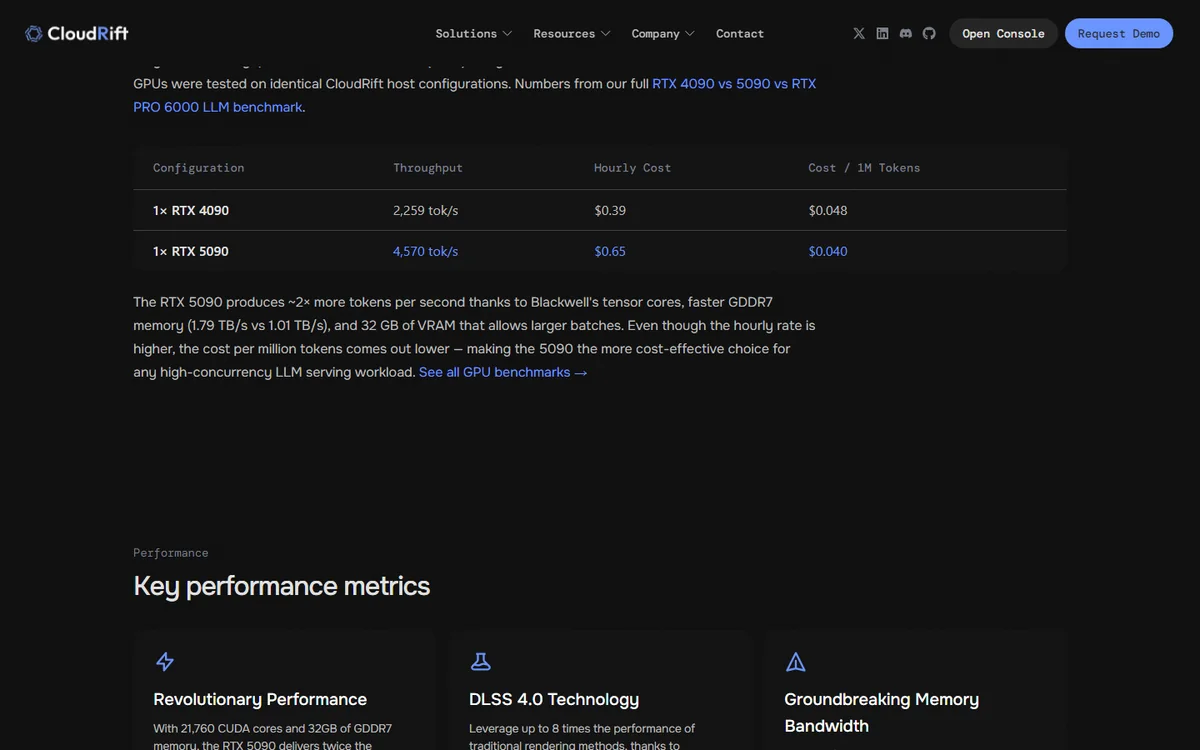
For batched serving the gap is wider than for a single user. CloudRift measured Qwen3-Coder-30B in AWQ with an FP8 KV cache and an 8K context at 4,570 tokens per second on one RTX 5090 against 2,259 on an RTX 4090, both on its own hosts.12 At GPUBank's rates that is $0.029 per million tokens on the 5090 and $0.028 on the 4090, so the cost per token is a wash and the 5090's case is latency and headroom. For image work the arithmetic goes the other way at FP8: a thousand FLUX images cost $1.17 on the 5090 and $0.72 on the 4090, which is faster per image on the 5090 and cheaper per image on the 4090, unless an FP4 build or larger batches close the gap.
08 / What fits in 32 GB
Which models one card can hold, and at what precision.
| Model | 16-bit | 8-bit | 4-bit |
|---|---|---|---|
| Llama 3.1 8B | Fits16 GB | Fits8 GB | Fits5 GB |
| Qwen3 14B | Tight30 GB | Fits16 GB | Fits9 GB |
| Gemma 3 27B | No54 GB | Tight29 GB | Fits16 GB |
| Qwen3 32B | No66 GB | No35 GB | Fits19 GB |
| Llama 3.3 70B | No141 GB | No75 GB | No41 GB |
Weights only, at 2, about 1.06 and about 0.58 bytes per parameter. "Tight" means the weights load but leave too little for a useful context. Measured: Qwen3 32B at 4-bit runs with about 47K tokens of context.22
09 / When another card wins
A card that costs more per hour can cost less per job.
Thirty-two gigabytes is the limit once a model does not fit, once a long context pushes the KV cache into the space the weights need, or once a job has to spread across cards that only talk to each other over PCIe. Two RTX 5090s can serve a 70B model, and one published run measured Llama 3.3 70B at 26.9 tokens per second across two cards with Ollama,23 but every exchange crosses PCIe and training scales poorly. A larger card that finishes in half the time, or holds the model without splitting it, is not more expensive; here is how the cards GPUBank rents line up.
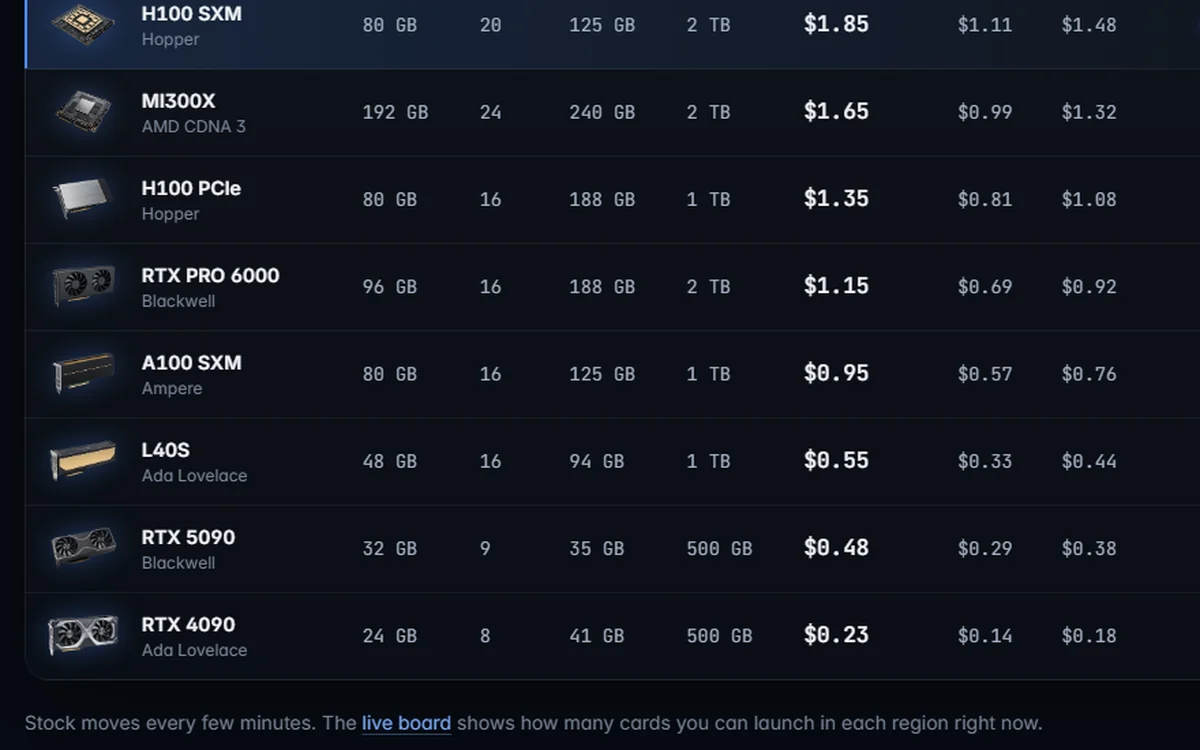
RTX 4090
24 GB GDDR6X · 1.0 TB/s
$0.23/hr
ComfyUI, SDXL and LoRA training on 8B models
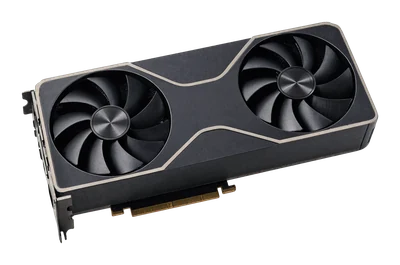
RTX 5090
32 GB GDDR7 · 1.8 TB/s
$0.48/hr
FLUX, SDXL, AI video and small language models
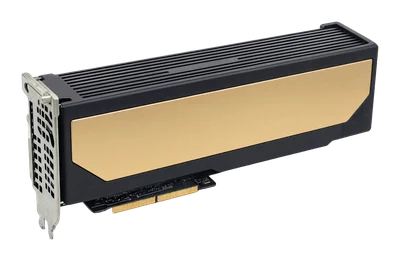
L40S
48 GB GDDR6 ECC · 864 GB/s
$0.55/hr
Stable Diffusion, video, Whisper transcription and embeddings
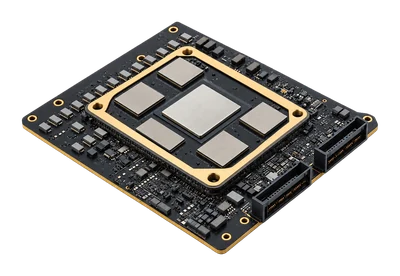
A100 SXM
80 GB HBM2e · 2.0 TB/s
$0.95/hr
LoRA and QLoRA fine-tuning, batch inference
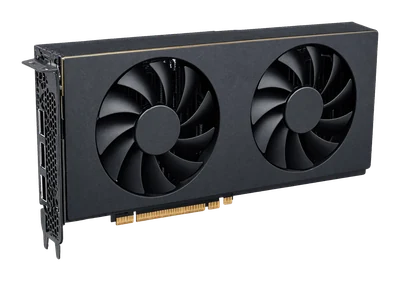
RTX PRO 6000
96 GB GDDR7 ECC · 1.8 TB/s
$1.15/hr
Serving 70B models in 4-bit and AI video generation
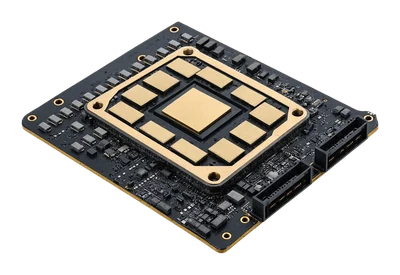
H100 SXM
80 GB HBM3 · 3.35 TB/s
$1.85/hr
AI training, fine-tuning and production LLM inference
GPUBank on-demand prices, all-in. Memory bar scaled to 96 GB.
10 / Rent or buy
Buying wins only past about 540 hours a month.
Street prices have stayed far above the $1,999 launch price. BestValueGPU showed the cheapest new card at $4,999 and used cards at $3,822 on 13 October, GPU Price History showed the lowest new listing at $7,199.99 two days earlier, and GPUPoet's October average of the three cheapest daily listings was $6,058, so treat any single figure as a snapshot.242528 Our assumptions, which the calculator lets you change, are the lower $4,999, a $1,500 host machine, $2,000 of resale value after two years, and 725 W at the wall under load once the rest of the system is counted. At the US residential average of 18.19 cents per kWh for January to July 2026,26 an hour of load costs $0.13 in power, and owning costs (4,999 + 1,500 − 2,000) ÷ 24 = $187.46 a month before any power.
Renting at $0.48 costs $0.35 an hour more than the power alone, so the card pays for itself at $187.46 ÷ $0.35 = 538 hours a month, which is eighteen hours a day for two years. Against GPUBank's reserved rate of $0.38 the break-even is 756 hours, more than the 730 a month holds, and against the interruptible rate or a top-up's effective price it never comes. At the EU household average of €0.29 per kWh the power alone takes most of the margin.31 If street prices return to $1,999, the break-even against $0.48 falls to about 179 hours a month, and buying starts to make sense for anyone who keeps one card busy most working days and can host it.
| Hours a month | Rent at $0.48 | Rent at $0.30 effective | Own, US power | Cheaper |
|---|---|---|---|---|
| 20 | $9.60 | $6.00 | $190.10 | Rent |
| 100 | $48.00 | $30.00 | $200.65 | Rent |
| 400 | $192.00 | $120.00 | $240.21 | Rent |
| 538 | $258.24 | $161.40 | $258.41 | Break-even |
| 730 | $350.40 | $219.00 | $283.73 | Own |
11 / What to choose
The cheapest RTX 5090 depends on the job.

A queue of image jobs that can be retried
SaladCloud at $0.25 to $0.333
The cheapest hours there are; a preemption only costs a retry, and the thin CPU allocation rarely matters for a queue.

Interactive work and fine-tunes on a known machine
GPUBank at $0.48, $0.36 effective
The lowest verified price that includes the machine, the IPv4 and the traffic, with a disk that survives every stop at $0.03/GB-month.

You know how to read a listing
Vast.ai from $0.37, Clore.ai from $0.44
Rewarding if you check reliability, uplink, disk speed and the storage rate before you rent, and keep an eye on the bill.

An endpoint that runs all month
GPUBank reserved at $0.38, or on-demand from a $1,000 top-up
A steady load is where reservations and prepaid credit pay; check HyperAI's $0.35 on its own site against what it includes.
12 / Questions
What people ask before renting one.
The cheapest hours on 15 Oct 2026 were on capacity that can be taken back: SaladCloud's lowest priority at $0.25 an hour on consumer PCs, then GPUBank's interruptible tier at $0.29 with five minutes of notice and the disk kept. Marketplace listings come and go: Vast.ai advertised $0.37 for the GPU alone on 15 October but showed no current offers on 14 and 16 October, and Clore.ai's own snapshot put its on-demand median at $0.542. HyperAI lists $0.35, with 16 vCPU and 40 GB of RAM according to GetDeploying, but publishes no disk or traffic terms and warns of queues at peak hours. Among managed clouds that state the whole machine, GPUBank was lowest at $0.48 with 9 vCPU, 35 GB of RAM, a 500 GB NVMe disk, a public IPv4 address and all traffic included, and a top-up bonus takes the effective rate to between $0.40 and $0.30.
Expect $0.25 to $1.19 an hour for on-demand or priority capacity in October 2026, with a median on-demand price of $0.72 across the 16 providers GetDeploying could price on 16 October. Managed offers we read at source sit at $0.48 (GPUBank), $0.65 (CloudRift), $0.72 (Beam) and $1.19 (Runpod Secure Cloud), with Runpod's Community Cloud at $0.69. Reservations run from GPUBank's $0.38 to CloudRift's $0.55 to $0.62, and serverless GPU time costs $1.09 an hour on Beam before CPU and memory and $1.58 on Runpod. A full 730-hour month at $0.48 comes to $350.40.
Because NVIDIA's GeForce driver licence says, in clause 2.8, that the software "is not licensed for datacenter deployment", a restriction NVIDIA first added in December 2017. The large clouds therefore build on datacenter parts such as the L4, the L40S and the H100, and the RTX 5090 is rented out by specialised GPU clouds and peer-to-peer marketplaces instead. None of AWS, Google Cloud, Azure, Oracle, Lambda or CoreWeave listed an RTX 5090 when we checked.
One card serves models up to about 32 billion parameters at 4-bit, around 14 billion at 8-bit and 8 billion at 16-bit, with room left for the context. Hardware Corner measured Qwen3 32B at 4-bit in llama.cpp at 61 tokens per second with a 4K context, and the card reached roughly 47,000 tokens of context before its memory was full. A 70B model needs two RTX 5090s or a 96 GB card such as the RTX PRO 6000; LoRA and QLoRA on 7B to 14B models fit, a full 16-bit fine-tune of a 7B model does not.
It is faster and carries 8 GB more memory, but it is not always cheaper per result. In ComfyUI's community benchmark FLUX.1 dev at FP8 takes 8.78 seconds an image on a 5090 against 11.28 on a 4090, so at GPUBank's rates a thousand images cost $1.17 on the 5090 and $0.72 on the 4090. For batched LLM serving CloudRift measured 4,570 against 2,259 tokens per second with vLLM, which makes the cost per token about the same. Rent the 4090 when 24 GB is enough, and the 5090 when you need the memory, lower latency or FP4.
Rent the RTX 5090 for models that fit in 32 GB and a handful of concurrent users, and the H100 for larger models, long contexts or training that spans several GPUs. The H100 SXM has 80 GB of HBM3 at 3.35 TB/s and NVLink between cards, the RTX 5090 32 GB at 1.8 TB/s and no NVLink. On GPUBank the H100 SXM costs $1.85 an hour against $0.48, and for a 70B model at 4-bit the 96 GB RTX PRO 6000 at $1.15 is often the cheaper middle ground.
Yes: it is the fastest consumer card for image generation, and its 32 GB holds FLUX.1 dev with room for LoRAs and ControlNets. In ComfyUI's community benchmark of the default FLUX dev FP8 workflow it took 8.78 seconds an image, and one user reached 5.46 seconds with optimisations, against 11.28 on an RTX 4090 and 26 on an RTX 3090; NVIDIA claims just over five seconds with an FP4 build. At GPUBank's $0.48 a thousand FP8 images cost about $1.17, or $0.73 at the tuned speed, against $0.72 on an RTX 4090, so the 4090 stays cheaper per image when 24 GB is enough and the 5090 wins on wait time and headroom. GPUBank's ComfyUI templates, including one for Wan 2.2 video, launch on it directly.
Sometimes for inference, and rarely for training. Two cards give 64 GB, enough for a 70B model at 4-bit, and one published run measured Llama 3.3 70B at 26.9 tokens per second across two RTX 5090s with Ollama, but every exchange between the cards crosses PCIe because the 5090 has no NVLink, so tensor-parallel serving and multi-card training scale poorly. On GPUBank two RTX 5090s cost $0.96 an hour against $1.15 for one 96 GB RTX PRO 6000, which holds the same 70B model on a single card without splitting it and is usually the cheaper answer per token. Data-parallel jobs, where each card holds its own copy of a model that fits in 32 GB, scale well on two or four cards.
Yes. GPUBank reserves the RTX 5090 at $0.38 an hour for a week or a month, prepaid on cards set aside for you, cancellable before the start date and not refundable once started, with the same machine as on demand; a 730-hour month comes to $277.40. CloudRift reserves it at $0.62 for a week, $0.59 for a month and $0.55 for three months, and LeaderGPU rents a single card at €449 a month or an eight-card server at €2,690 a month, both excluding VAT. Clore.ai's bare-metal blocks start at eight cards on 14 or 30-day terms at $0.64 to $1.06 per GPU-hour. A reservation only pays if the card will be busy most of the term: at GPUBank's prices it beats on-demand use past about 578 hours a month.
Renting is cheaper unless the card does real work for most of every day over two years. With the card at $4,999, a $1,500 host, $2,000 of resale value after two years and US power at 18.19 cents per kWh, owning costs about $187.46 a month plus $0.13 per hour of load, which only beats renting at $0.48 past about 538 hours a month, and never beats the reserved or interruptible rates. At the $1,999 launch price the break-even falls to about 179 hours.
They can move a monthly bill more than the gap between two headline rates. Per-second billing charges a 61-minute job for 61 minutes, an hourly meter charges it for 120. Vast.ai keeps billing storage while an instance is stopped and bills bandwidth per byte at host rates, Runpod charges $0.20 per GB-month for an idle volume, and GPUBank charges only a persistent disk at $0.03 per GB-month with traffic included. For 100 hours a month with 200 GB of models those terms decide whether the bill is about $54 or closer to $60 to $70.
It depends on the host, which is what a marketplace is. Vast.ai shows a reliability score and a maximum rental duration per listing, Clore.ai shows ratings and the hardware around the card, and both let you filter on them; some RTX 5090 hosts run older CPUs on PCIe 3.0, which slows data loading. On marketplaces the renter usually pays for time lost to a failing host, whereas GPUBank does not bill a failed launch and credits the whole session when a host fails during a job.
Use a persistent disk or volume and check what it costs while nothing runs. On GPUBank a persistent disk at $0.03 per GB-month is the only charge on a stopped machine, so 200 GB costs $6.00 a month. Runpod's network storage costs $0.07 per GB-month under 1 TB, Vast.ai bills an instance's storage for as long as the instance exists, and SaladCloud containers have no persistent disk, so the weights travel in the image or in object storage.
Yes for jobs that checkpoint often or can simply be retried, no for interactive sessions. GPUBank's interruptible RTX 5090 costs $0.29 instead of $0.48, gives five minutes of notice through the metadata endpoint, a webhook and the console, runs your checkpoint hook and stops the machine with its disk intact. SaladCloud's $0.25 tier reschedules the container on another PC, and Clore.ai's own snapshot shows the median spot price close to the on-demand median, so check the discount before counting on it.
Within a few minutes on a managed cloud with ready templates. GPUBank reports a median of 48 seconds from launch to a machine that passed its health check, and about two and a half minutes for vLLM 0.11 or four minutes for ComfyUI with its models synced, none of it billed before the health check. On a marketplace the start time depends on the host's disk, its uplink and whether your image is already cached there.
Sources
Sources
- 01GPUBank pricingGPUBank rates, inclusions, billing and top-up bonuses · read 15 Oct 2026
- 02NVIDIA GeForce RTX 5090 product pageCUDA cores, memory, bus, power · read 15 Oct 2026
- 03NVIDIA RTX 50 Series announcementLaunch date, $1,999 price, 1,792 GB/s, 680 Tensor Cores · read 15 Oct 2026
- 04NVIDIA GeForce software licenceClause 2.8, no datacenter deployment · read 15 Oct 2026
- 05NVIDIA developer forum, "Driver EULA update: No Datacenter Deployment"The December 2017 wording · read 14 Oct 2026
- 06SaladCloud pricingRTX 5090 at four priority tiers, vCPU and RAM included · read 16 Oct 2026
- 07Vast.ai, Rent RTX 5090 GPUs$0.37 headline on 15 Oct; no current offers on 14 and 16 Oct · read 16 Oct 2026
- 08Vast.ai documentation, BillingStorage billed while stopped, bandwidth per byte · read 15 Oct 2026
- 09Vast.ai documentation, Quickstart$5 minimum deposit · read 15 Oct 2026
- 10Clore.ai, Rent RTX 5090Headline price, 21 Sep 2026 snapshot, bare-metal quotes, fees, per-minute billing · read 16 Oct 2026
- 11Runpod pricing (updated 8 October 2026)Secure $1.19 and Community $0.69 rates, machine, storage, $1.58 serverless · read 16 Oct 2026
- 12CloudRift, Rent RTX 5090 GPUsOn-demand and reserved rates, vLLM benchmark · read 16 Oct 2026
- 13Beam pricingRTX 5090 machine at $0.72/hr, serverless rate · read 15 Oct 2026
- 14HyperAI pricingRTX 5090 at $0.35/hr, queues at peak hours · read 16 Oct 2026
- 15ComputePrices, RTX 5090Shadeform, Novita AI and Akash rates (aggregator) · read 14 Oct 2026
- 16GetDeploying, RTX 5090 rental prices$0.72 median across 16 priced providers; HyperAI, GPUhub, GPU.ai, Oblivus rows (aggregator) · read 16 Oct 2026
- 17Lium, RTX 5090Marketplace range · read 14 Oct 2026
- 18Spheron GPU rentalListed rate, no capacity on the day · read 14 Oct 2026
- 19LeaderGPU, 8x RTX 5090 serverMonthly price excluding VAT · read 15 Oct 2026
- 20Thunder Compute, "Vast.ai GPU Pricing 2026"Typical Vast storage rate (a competitor's estimate) · read 14 Oct 2026
- 21ComfyUI discussion #9002, FLUX.1 dev FP8 benchmarkSeconds per image on RTX 5090, 4090, 3090 · read 15 Oct 2026
- 22Hardware Corner, RTX 5090 LLM benchmarksllama.cpp tokens per second, Qwen3 8B, 14B, 32B · read 15 Oct 2026
- 23Presenc, RTX 5090 local LLM benchmarksLlama 3.3 70B on two cards (DatabaseMart run) · read 14 Oct 2026
- 24BestValueGPU, RTX 5090 price historyNew and used street prices on 13 Oct 2026 · read 14 Oct 2026
- 25GPU Price History, RTX 5090 (US)Lowest new listing on 11 Oct 2026 · read 15 Oct 2026
- 26EIA, Electric Power Monthly, table 5.3US residential price, January to July 2026 · read 15 Oct 2026
- 27SaladCloud blog, Upcoming SaladCloud price changes: September 12, 2026High, medium and low tiers raised on 12 Sep 2026 · read 14 Oct 2026
- 28GPUPoet, RTX 5090 price in October 2026Average of the three cheapest daily listings · read 14 Oct 2026
- 29NVIDIA blog, GeForce RTX 50 Series launchFLUX.1 dev in just over five seconds on the RTX 5090 with FP4 (vendor claim) · read 14 Oct 2026
- 30LeaderGPU, GPU VPS with RTX 5090Single card at €449 a month excluding VAT · read 14 Oct 2026
- 31Eurostat, household electricity prices, second half of 2025EU household average · read 15 Oct 2026
What we could not confirm
Vast.ai's $0.37, which was live on 15 October but had no offers behind it on 14 and 16 October; the live lowest Clore.ai price beyond its own 21 September snapshot; the Vast.ai storage and bandwidth rate of a given listing, which only shows on live offers; HyperAI's disk and traffic terms and any reservation price, which its pricing page does not state (its vCPU and RAM come from GetDeploying); Shadeform's, Novita AI's, GPUhub's, GPU.ai's and Oblivus's prices on their own pages; SaladCloud's storage options; and a reliable European street price for the card. Third-party benchmarks were not rerun by us. Prices move every week: if you find a figure that has changed, the date next to it tells you how old ours is.
RTX 5090 on GPUBank
One price for the card and the machine around it.
- 9 vCPU, 35 GB RAM, 500 GB NVMe, IPv4 and traffic in $0.48/hr
- Billed by the second after the health check
- Interruptible $0.29, reserved $0.38
 9 vCPU, 35 GB RAM, 500 GB NVMe, IPv4 and traffic in $0.48/hr
More GPU price guides
Where to rent the other cards at the cheapest price.
 B200 SXM180 GB HBM3eFrom $2.49 spot · $4.15 all-in
 H200 SXM141 GB HBM3eFrom $1.49 spot · $2.49 all-inH100 SXM80 GB HBM3From $1.11 spot · $1.85 all-in
 H100 PCIe80 GB HBM2eFrom $0.81 spot · $1.35 all-in
 MI300X192 GB HBM3From $0.99 spot · $1.65 all-inRTX PRO 600096 GB GDDR7 ECCFrom $0.69 spot · $1.15 all-inA100 SXM80 GB HBM2eFrom $0.57 spot · $0.95 all-inL40S48 GB GDDR6 ECCFrom $0.33 spot · $0.55 all-inRTX 409024 GB GDDR6XFrom $0.14 spot · $0.23 all-in