Updated 16 Oct 2026 · 35 offers checked
Where to rent an H200 SXM at the cheapest price
We read more than thirty H200 SXM offers on the providers' own pages, sorted them by what each hour really buys, and worked out the monthly bill, the speed per dollar and the point at which buying an eight-GPU server would cost less.
The short answer, 16 Oct 2026
- $0.79/hrCheapest hour you can get. Nebius preemptible H200 capacity starts at $0.79 per GPU-hour, but since 8 October it is a dynamic spot price that can move every 15 minutes up to $5.39, one cent below the on-demand rate, and the VM can be taken back at any time1.
- $2.80/hrCheapest marketplace listing. The lowest live Vast.ai ask was $2.80 for a single H200 on a host in Japan, a GPU rate to which storage and bandwidth are added at prices each host sets23.
- $2.49/hrCheapest hour with IP and traffic included. GPUBank's $2.49 includes 24 vCPU, 276 GB of RAM, 2 TB of NVMe, a public IPv4 address and all traffic, billed per second4. Beam lists a lighter 1-GPU machine for less, at $2.09, without a confirmed stock level56.
The H200 SXM is rented at prices that differ by a factor of thirteen for what looks like the same hour of the same chip. On 16 October 2026 the lowest figure on a provider's own page was a $0.79 spot floor at Nebius, the cheapest marketplace ask was $2.80 on Vast.ai, a single managed GPU with its CPU, memory and disk ran from $2.09 to about $5.44 at the specialised clouds, and the four large clouds charged between $7.91 and $10.60 per GPU for an eight-GPU instance125789. GetDeploying, which tracks 49 providers, put the median on-demand price at $4.94 across the 34 that publish one, up about 27 percent over twelve months6. The spread is not noise: each price buys a different product, from the GPU slice of a stranger's server to a whole HGX node with InfiniBand, and the cheapest line on a pricing page is often not the cheapest bill at the end of the month.
This page sorts the offers into five kinds, within which prices can fairly be compared, says what each price leaves out, works through three monthly bills and the rent-or-buy arithmetic for an eight-GPU server, and shows where the 141 GB of memory actually saves money compared with an H100. Prices were re-read on the providers' own pages on 16 October 2026; where a page could not be read, the figure is marked as coming from an aggregator, and providers that could not be checked at all were left out. The page is published by GPUBank, a GPU cloud run by GPU Compute OÜ in Tallinn, which rents the H200 SXM itself. Read our own entry with that in mind: it is measured on the same terms as every other offer, and the text says where a spot tier, a marketplace host or another cloud beats it.
01 / What 141 GB buys
What 141 GB buys you
The table counts the cards needed to hold each model's weights at FP8 while leaving about 15 percent of memory for the KV cache and activations, rounded up to one, two, four or eight cards, with sixteen meaning two eight-GPU nodes. The H200 halves the card count for most of the models people actually serve. Llama 3.3 70B in FP8 takes about 71 GB at one byte per parameter, nearly 73 GB as published with its embeddings in BF16, which leaves an H100 no useful room for the cache, so it needs two H100s with tensor parallelism, or a single H200 with 70 GB to spare44. Qwen3 235B-A22B moves from four H100s to two H200s, Llama 3.1 405B from a full H100 node to four H200s, and DeepSeek V3 or R1, published in FP8 at 671B parameters, from two H100 nodes linked by InfiniBand to one H200 node4546. The vLLM team made the same point at the 405B launch: one 8xH200 machine holds the model, where H100s need FP8 on a node or sixteen cards in BF1647.
Where the card count does not change, the extra memory goes into the cache, which sets how many requests and how much context a GPU serves at once. With Llama 3.3 70B in FP8, an FP8 KV cache costs 160 KiB per token (80 layers, 8 key-value heads of 128 dimensions, keys and values at one byte). On an H100, after 67.7 GiB of weights and a working reserve, about 5 GiB are left, roughly 32,500 tokens of cache in total, which is less than one full 128K-token conversation; on an H200 about 63 GiB remain, roughly 410,000 tokens, more than twelve times as much44. That is the difference between a handful of concurrent users and dozens, and it is why NVIDIA's own H200 comparisons ran larger batches than the H100 could hold. Models that fit an H100 with room to spare, such as Llama 3.1 8B, Qwen3 32B or gpt-oss-120b in its native MXFP4 form, gain batch and context from an H200 but not a card, and are usually cheaper on the H10048.
Cards needed to hold the weights at FP8, with room for the cache
H100 SXM, 80 GBH200 SXM, 141 GB
Fits either card many times over; the H200 only adds batch and context.
One card on both; at 16-bit it is tight on an H100 and comfortable on an H200.
71 GB of FP8 weights leave no cache room on 80 GB; one H200 removes tensor parallelism.
Shipped in MXFP4 (about 61 GiB), which OpenAI says runs on a single 80 GB GPU; the FP8 count applies only to an 8-bit conversion.
Mixture of experts, 22B active; half the cards on H200.
A full H100 node at FP8; at BF16 one 8x H200 node against sixteen H100s.
Published in FP8; 16 means two H100 nodes linked by InfiniBand, against one H200 node.

Room left for context, Llama 3.3 70B FP8, one card
Computed, not measured: 81,559 MiB (H100) and 143,771 MiB (H200) of device memory, 95 % usable as in a vLLM gpu_memory_utilization of 0.95, minus 67.7 GiB of FP8 weights (embeddings and output layer kept in BF16) and 3 GiB of activations and runtime, divided by an FP8 KV cache of 160 KiB per token (80 layers x 8 KV heads x 128 dims x 2 x 1 byte). The model's own limit is 131,072 tokens per sequence.44
02 / The card
What the H200 SXM is, and who rents it
The H200 SXM is NVIDIA's Hopper GPU with a larger and faster memory system: 141 GB of HBM3e at 4.8 TB/s, NVLink at 900 GB/s, up to 700 W of configurable power and up to seven MIG instances of 18 GB each, mounted on four- or eight-GPU HGX boards10. Its compute is the H100's, 3,958 FP8 teraFLOPS with sparsity or about 1,979 dense, so the gain is entirely in memory: against the H100 SXM's 80 GB at 3.35 TB/s it has 76 percent more capacity and 43 percent more bandwidth1011. That makes it faster wherever the GPU waits on memory, which is most of the time when a large language model writes tokens, and it lets a model fit on fewer cards, which removes tensor parallelism or frees room for a larger batch and a longer context. When a job is bound by arithmetic rather than memory, as large-batch training of a mid-size model often is, an H200 does little more than an H100.
The H200 NVL is a different product and is kept out of every price on this page. It is a dual-slot, air-cooled PCIe card with the same 141 GB at 4.8 TB/s, but its power ceiling is 600 W, its FP8 rating is 3,341 teraFLOPS with sparsity rather than 3,958, and it links to at most three other cards through two- or four-way NVLink bridges instead of an eight-way NVSwitch fabric10. Marketplaces mix the two: on 16 October Vast.ai's search returned NVL listings from $3.80 next to SXM listings from $2.80, and Lium links an NVL page from $3.85 beside its SXM range212. A listing that only says "H200" should be checked for its form factor before it is compared with an SXM price, because for a model split across GPUs the SXM board's full fabric is what you are paying for.
The card reaches two groups of customers through two kinds of seller. Large clouds and bare-metal specialists sell it in its native unit, the eight-GPU HGX server, to teams that train across a full NVLink domain or serve a model of several hundred billion parameters, and they price it by the node. Specialised clouds and marketplaces slice the same servers into one, two or four GPUs for teams serving a single 70B-class model with a long context, fine-tuning above 70B parameters, or running experiments that do not fit in 80 GB. Almost every cheap hour on this page comes from the second kind of seller, and almost every price above $6 from the first.

03 / The price ladder
Five kinds of H200 offer, and how to compare them
A managed cloud sells a fixed machine, the GPU with its vCPUs, memory and local disk, at one hourly price, and for the H200 the machine varies a great deal: GPUBank and Runpod attach 24 vCPU and 276 GB of RAM to each GPU, Beam 24 vCPU and 192 GB, Verda 44 vCPU and 170 GB, Civo 23 vCPU and 169 GB4135714. Some of these prices also include the public IP and all traffic, others bill them separately, and several of the lowest are only sold by the eight-GPU server, which turns a $2.48 rate into a $19.84 hour before anything runs6. A peer-to-peer marketplace lets independent hosts post their own GPU price and adds storage and bandwidth as separate lines, on hardware that varies from listing to listing: on Vast.ai the cheapest H200 ask on 16 October was $2.80 on a host with 28 vCPU and about 258 GB of RAM in Japan, with a reliability score of 94.8 percent2.
The other three kinds trade something away for the price. Spot or interruptible capacity can be taken back, and what matters is whether its price is fixed and how much notice you get: Nebius's preemptible floor of $0.79 floats with demand up to $5.39, while GPUBank's $1.49 is fixed with five minutes of notice14. Reserved capacity is paid whether the card is busy or not, usually for months or years, and the lowest reserved rates on this page come with terms from a single month at GPUBank to 36 months at Civo414. Serverless platforms bill only the seconds a container works, at a higher hourly equivalent, which is cheaper than an idle instance only when traffic is bursty. Putting a $0.79 spot hour next to a $2.49 managed hour without saying so is how most H200 price lists end up comparing things that cannot be compared.
H200 prices have risen over the past year rather than fallen. GetDeploying measured the median on-demand price up about 27 percent in twelve months, Nebius raised its on-demand rate from $4.50 to $5.40 on 1 October, Runpod's Secure Cloud pod now lists $5.29 where its own articles still quote $4.59, and Hyperbolic, which launched single H200s at $2.65 in September 2025, lists $3.99 today6113151617. AWS's Capacity Block for the p5e went from $34.61 an instance-hour in December 2025 to $54.924 now, about 59 percent more per GPU1819. The cheapest interruptible hours moved the other way, as Nebius's spot floor fell from a fixed $2.45 to a dynamic $0.79, so the market is widening at both ends rather than softening, whatever some October guides forecast.
Managed on demandA fixed machine at one hourly price.
MarketplaceHosts set their own price; machines vary.
Spot and interruptibleCheaper hours that can be taken back.
ReservedCommitted for a term, paid either way.
ServerlessBilled by active seconds.
04 / Provider by provider
What each price buys, and what it leaves out.
The captures below were taken on 16 Oct 2026 from each provider's own H200 or pricing page, so every figure can be read next to the conditions printed beside it.
GPUBankAll-in
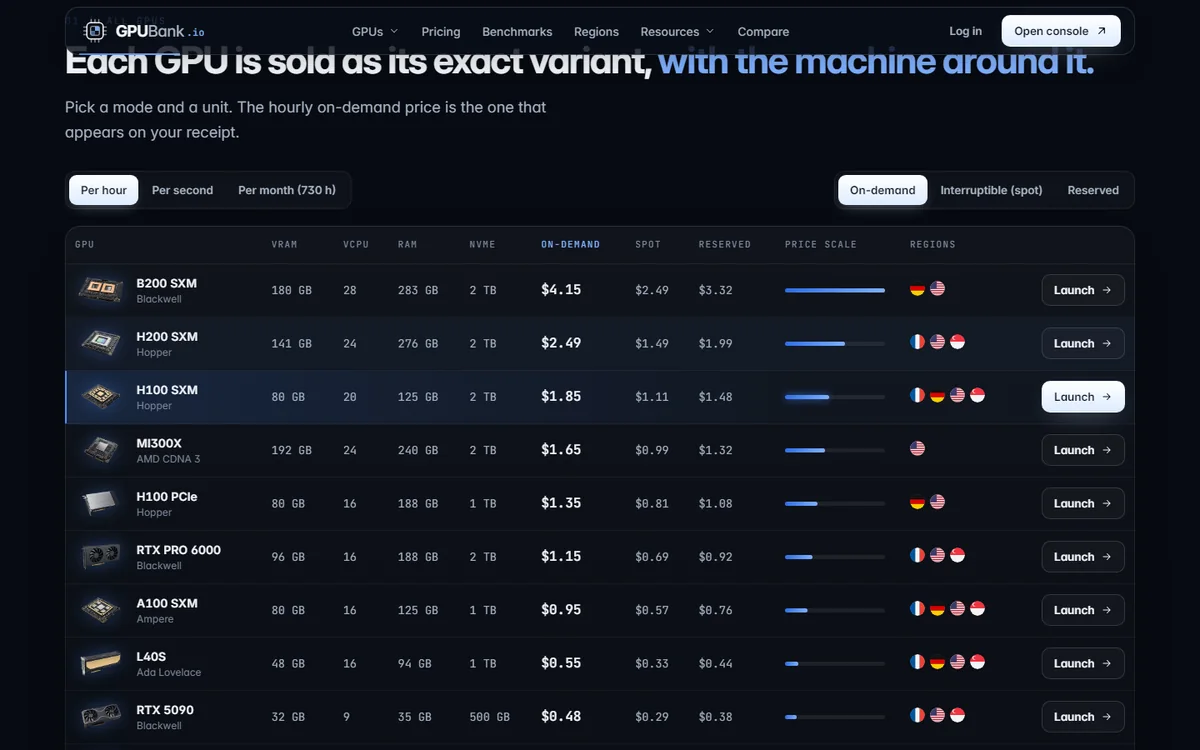
$2.49/hr
Managed cloud · 1 to 8 GPUs · Paris, Ashburn, Singapore
24 vCPU276 GB RAM2 TB NVMePublic IPv4All trafficPersistent disk $0.03/GB-month
GPUBank's H200 SXM costs $2.49 per GPU-hour with the machine around it in the price: 24 vCPU, 276 GB of RAM and a 2 TB local NVMe disk per GPU, one public IPv4 address and all inbound and outbound traffic, on machines of one, two, four or eight GPUs. Billing is per second with no minimum and starts only after the machine passes its health check, so a launch that fails costs nothing, and a stopped machine costs only its persistent disk at $0.03 per GB-month. The same card is $1.49 as interruptible capacity with five minutes of notice, a checkpoint hook and a stop rather than a deletion, and $1.99 reserved for a week or a month, prepaid. Payment is a prepaid balance topped up in crypto from $25, with a bonus that lowers the effective on-demand hour to about $1.56 on a $1,000 top-up. GPUBank does not sell multi-node InfiniBand clusters.4
Checked 16 Oct 2026
 Beam
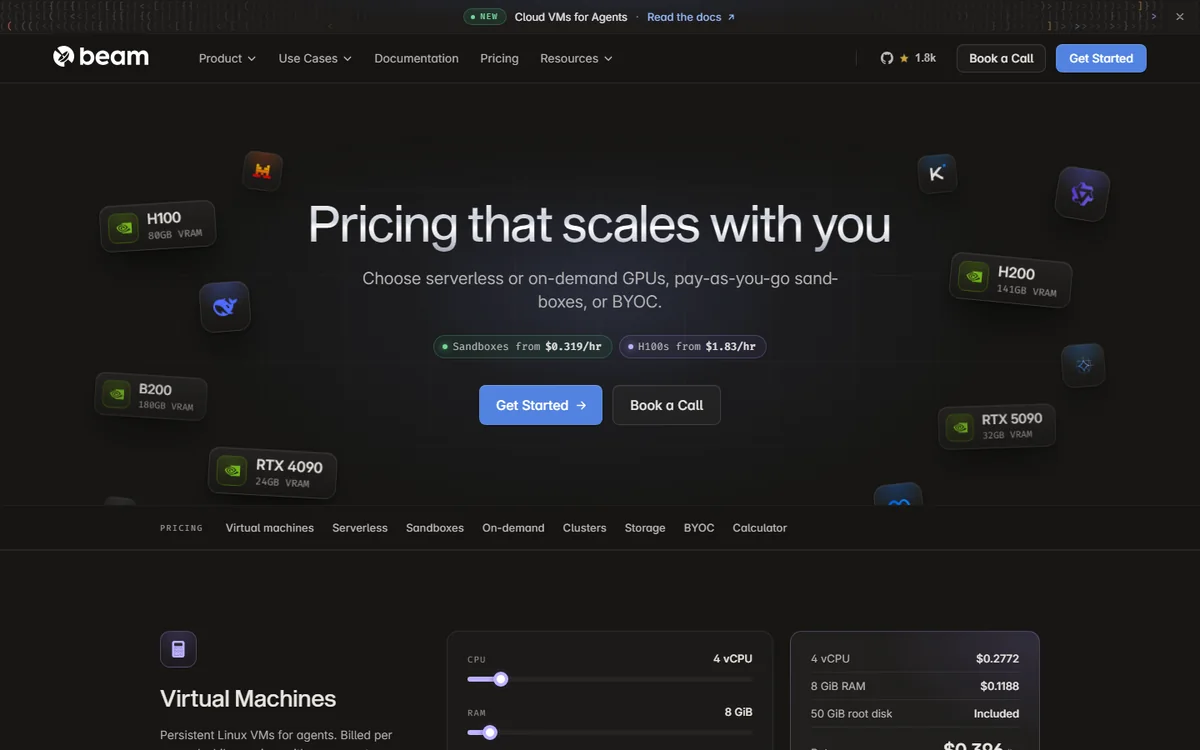
$2.09/hr
Managed cloud · single-GPU machine
24 vCPU192 GB RAM2 TB NVMeStock not reportedNo serverless H200
Beam's pricing page lists an on-demand H200 SXM5 machine from $2.09 an hour with 24 vCPU, 192 GB of RAM and a 2 TB NVMe drive, the lowest list price for a whole single-GPU H200 machine that we found on a provider's own page on 16 October. It undercuts GPUBank by 40 cents an hour and comes with the same 24 vCPU and the same local disk, but 84 GB less system memory. Two things could not be confirmed. GetDeploying lists the offer with its stock status as not reported, so we cannot say whether a card was free to launch that day, and the page does not say how the machine is billed, whether a public IP and traffic are included, or what happens to the disk when the machine stops. Beam's serverless table, which bills by the second, does not include the H200 at all. If Beam can provision the card when you need it, it is the cheapest managed hour on this page.5
Checked 16 Oct 2026
 Vast.ai
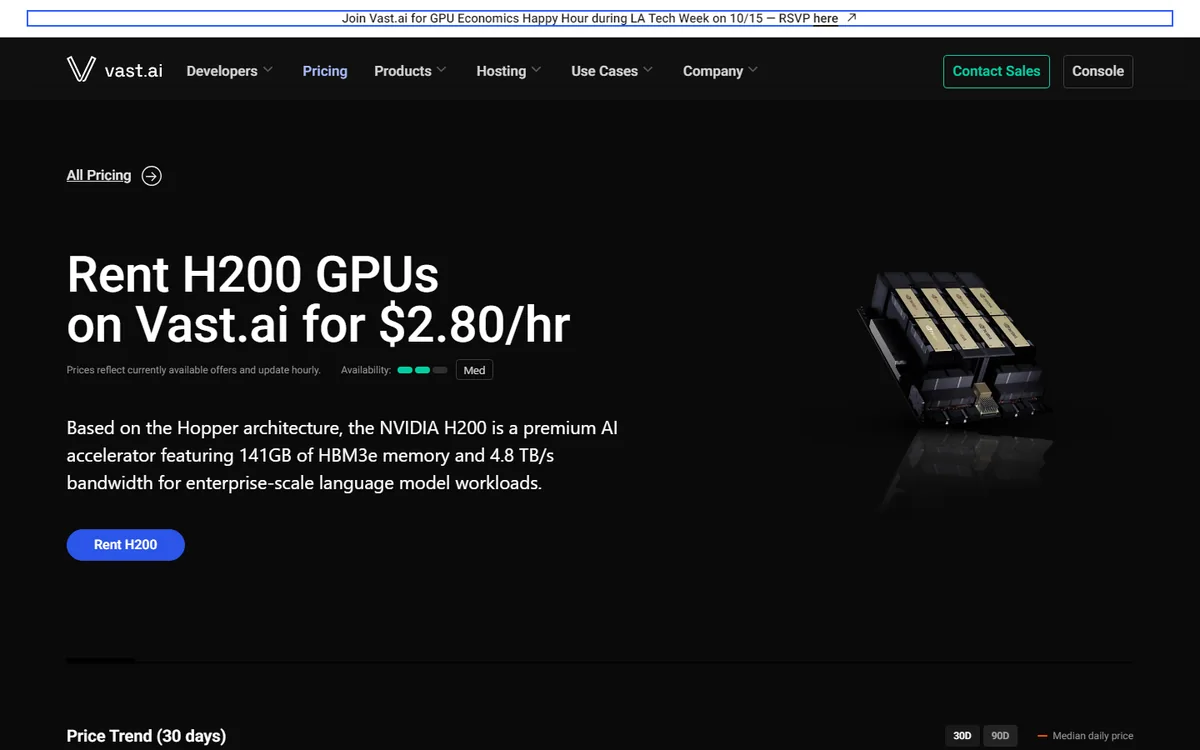
from $2.80/hr
Marketplace · host-set prices
vCPU and RAM of the hostStorage billed while stoppedBandwidth per hostSXM and NVL mixed
Vast.ai is a marketplace where independent hosts set their own price, so its H200 figure is the cheapest live ask rather than a list price. On 16 October its search returned SXM listings from $2.80 per GPU-hour, the cheapest a single H200 with 28 vCPU and about 258 GB of RAM on a host in Japan with a reliability score of 94.8 percent, then $4.00 in Georgia and $4.61 in Romania. Separate H200 NVL listings started at $3.80, so check the form factor before comparing. The rate covers the GPU and the host's CPU and memory share; storage is billed for as long as the instance exists, running or stopped, and bandwidth is charged at each host's rate, which can add tens of dollars a month to a cheap hour. Billing is by the second from a prepaid balance. Vast suits short, checkpointed jobs on a budget, less so an endpoint that must stay up.2
Checked 16 Oct 2026
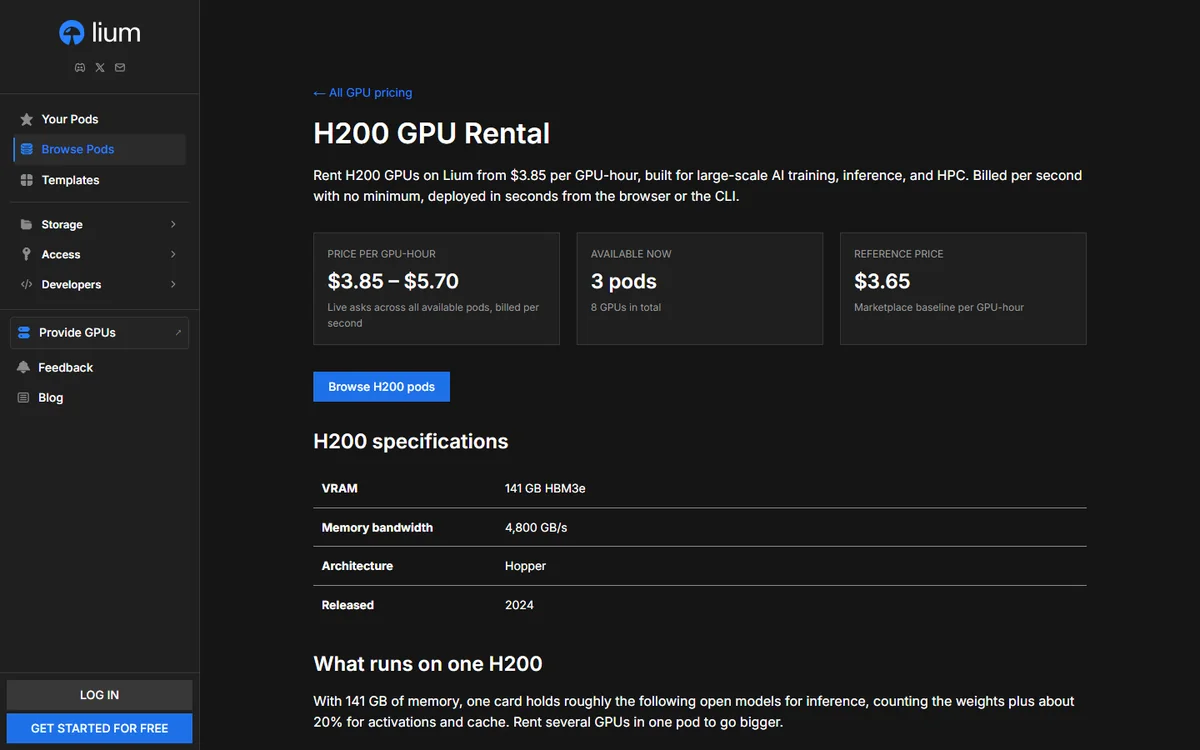
 Lium
$3.73 to $5.70/hr
Marketplace · pods from independent providers
Pod incl. local diskSpecs vary by podLowest asks on 8-GPU pods
Lium is a marketplace of pods offered by independent providers, priced for the whole pod including the node's local disk, with vCPU, memory and storage that differ from one pod to the next. Its H200 page showed a live range of $3.73 to $5.70 per GPU-hour on 16 October, against a marketplace reference price of $3.65, and links a separate H200 NVL page from $3.85. On our 29 September reading the cheapest ask had been $3.40, so the floor moved up by a third of a dollar in two weeks, which is typical of a market where a handful of hosts set the price. The lowest asks tend to be on multi-GPU pods, so check the pod size before assuming a single card is available at the headline figure. Lium bills by the second and suits users who want a marketplace with per-pod pricing rather than separately billed disk.12
Checked 16 Oct 2026
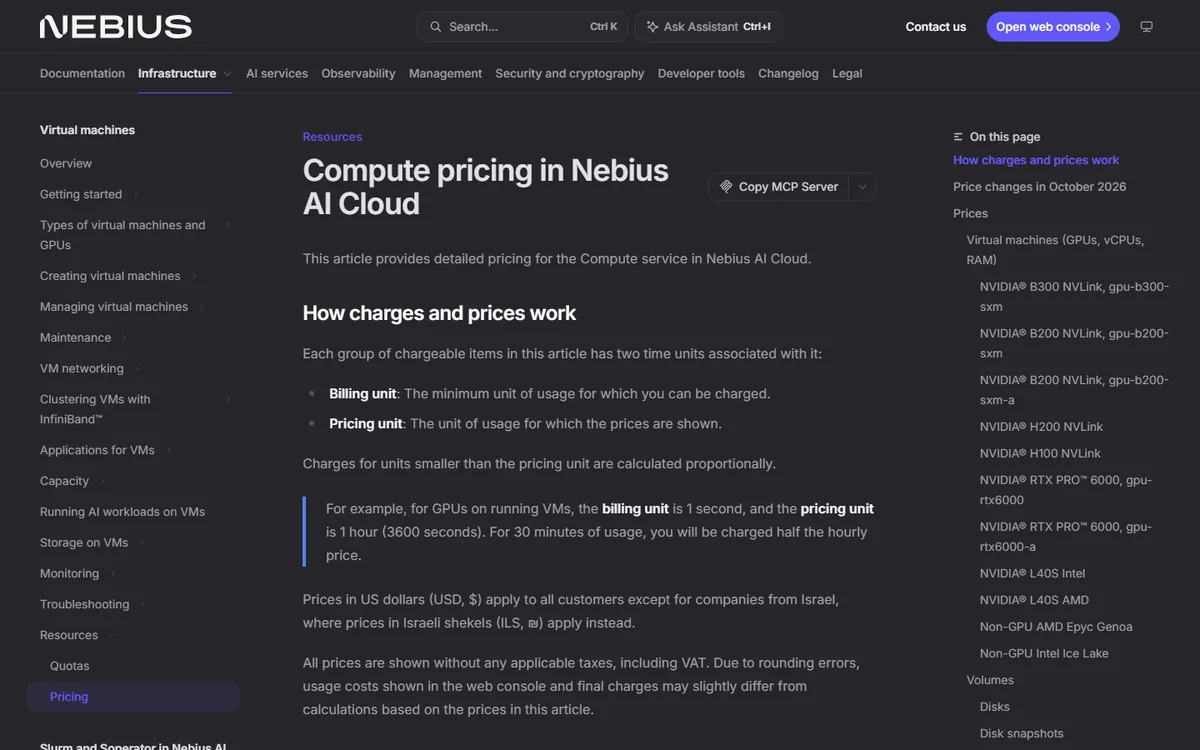
 Nebius
$5.40/hr · spot from $0.79
Managed cloud · presets of 1 or 8 GPUs
16 vCPU200 GB RAMVolumes extraSpot price changes every 15 min
Nebius raised its on-demand H200 price from $4.50 to $5.40 per GPU-hour on 1 October 2026 and on 8 October switched its preemptible tier from a fixed $2.45 to dynamic spot pricing listed "from $0.79". That floor is the lowest H200 figure on any provider's own page, but Nebius states that spot prices follow capacity and demand, can change during use as often as every 15 minutes, and can rise to one cent below the on-demand rate, so a job budgeted at $0.79 may pay up to $5.39. GPUs on running VMs are billed per second, and stopped VMs are charged only for their volumes. The on-demand presets come with one or eight GPUs in its European and US regions. For checkpointed work that can stop at any moment and tolerate a moving price, Nebius spot is the cheapest place to run an H200; for a fixed budget it is a bet rather than a quote.1
Checked 16 Oct 2026
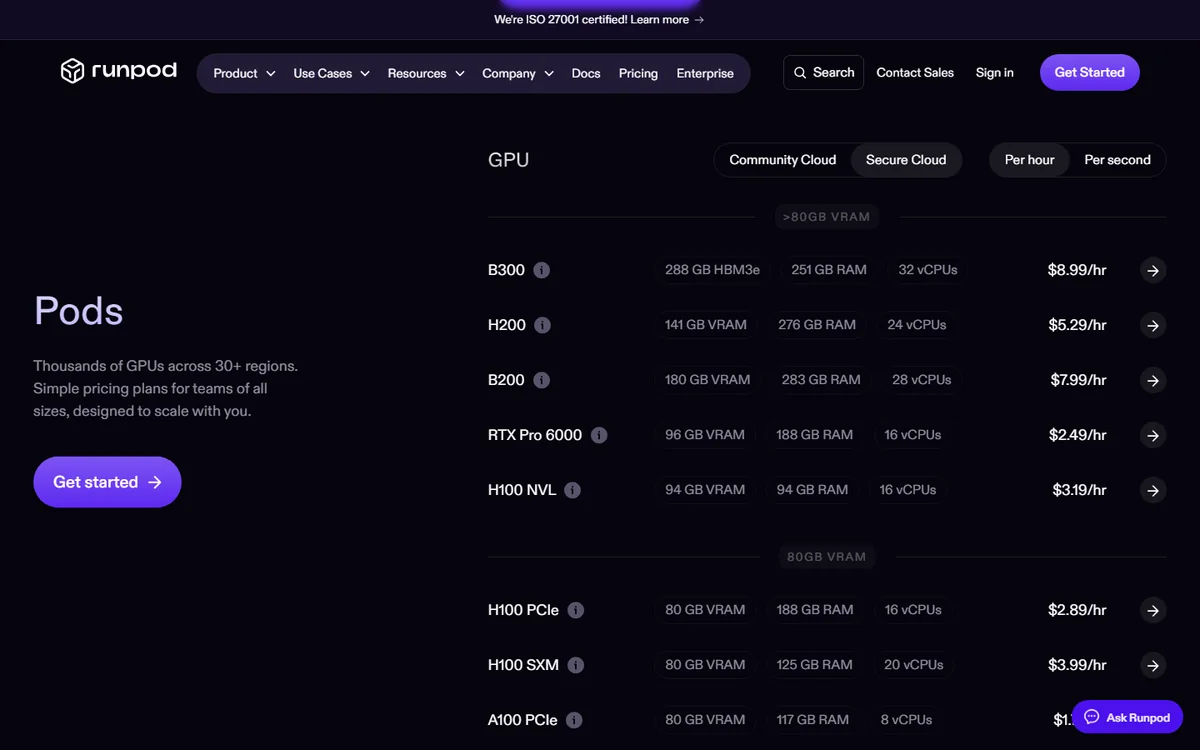
 Runpod
$5.29/hr
Managed cloud and community hosts · per second
24 vCPU276 GB RAMNetwork volume $0.07/GB-monthIdle volume disk $0.20/GB-month
Runpod's pricing page, updated 8 October 2026, lists the H200 SXM pod at $5.29 an hour on Secure Cloud with 24 vCPU and 276 GB of RAM, billed per second, while the page's structured data still carries a Community Cloud rate of $3.59 that the visible card no longer shows and GetDeploying marked out of stock. The same page gives $5.93 for a serverless H200 worker and $6.35 per GPU for Instant Clusters spanning several nodes, which is one of the few ways to rent a multi-node H200 fabric by the hour. Storage is extra: a network volume costs $0.07 per GB-month under 1 TB and $0.05 above, and a volume disk costs $0.10 while its pod runs and $0.20 while it is idle. Runpod is a mature platform with templates and a large community, but on 16 October its single-GPU H200 cost more than twice the cheapest managed offers.13
Checked 16 Oct 2026
Where GPUBank wins, and where it does not
Read against the card above, the terms behind GPUBank's $2.49 are what set it apart. The meter starts only once a machine has passed its health check, which GPUBank gives as a median of 48 seconds from launch, a failed launch is not billed, and if a host fails during a job the machine restarts on a healthy host with the same disk and the interrupted session is credited in full30. Machines of 1, 2, 4 or 8 GPUs scale the vCPU, RAM and NVMe by the same multiple, which puts a whole 8-GPU node at $19.92 an hour, and templates for vLLM, SGLang, Ollama, llama.cpp, Unsloth and Axolotl, or any Docker image, cover the usual H200 work. Among single-GPU offers that include the IP and the traffic, $2.49 was the lowest price we found on 16 October, and the interruptible tier at a fixed $1.49 and the one-month reservation at $1.99 were the lowest fixed prices in their categories on a provider's own page4.
GPUBank loses in several places, and they matter. Nebius's dynamic spot price is far below $1.49 whenever its floor holds, Beam lists a single H200 machine at $2.09, 40 cents under GPUBank, and a marketplace host occasionally undercuts both for a short job15. GPUBank does not sell multi-node clusters on an InfiniBand fabric, which Runpod's Instant Clusters, CoreWeave and the large clouds do, so a training run spanning several nodes belongs elsewhere1325. Payment is a prepaid US dollar balance topped up in crypto from $25 to $5,000, with no card payments for now; the balance never expires and top-ups carry a bonus of 20 to 60 percent, which brings the effective on-demand hour to about $2.08 with a $25 top-up, $1.84 with $100 and $1.56 with $1,000, a real discount only on money you will in fact spend4.
The rest of the market
Several specialised clouds sit between the cheap single-GPU offers and the large clouds. GMI Cloud's pricing page lists the H200 "from $3.20" per GPU-hour, marked available now, in its own data centres, without itemising what comes with it20. Civo charges $3.49 for one H200 with 23 vCPU, 169 GB of RAM and 400 GB of NVMe, with free transfer but usage rounded up to the next full hour, and $2.99 on a 36-month commitment14. Hyperstack lists $3.99 on demand and reserved capacity from $2.79, billed per minute with free traffic but public IPs charged separately21. Hyperbolic shows $3.99, refreshed weekly from its suppliers' rates, and does not bill instances that fail to come online17. DigitalOcean's H200 droplet costs $4.47 with 24 vCPU, 240 GiB of RAM, 5 TiB of scratch NVMe and 15,000 GiB of transfer, or $3.40 on a 12-month contract22. GetDeploying listed further offers we could not read on the providers' own pages: Gcore at $3.56 per GPU for an 8x bare-metal node, Canopy Wave at $4.00 for two GPUs, Runcrate at $4.24 for one, and Crusoe at $5.40 and OVHcloud at $6.20 for 8-GPU machines; Together AI could not be resolved, with $5.99 for clusters in our September reading against a $2.99 row now labelled on demand, which matches its former spot price6.
Higher up, Lyceum charges $4.49 on demand and $2.29 spot with per-second billing, Jarvislabs $4.59 with 28 vCPU and 300 GB of RAM billed per minute, and Verda $5.44 with 44 vCPU and 170 GB, or $2.72 as spot23247. CoreWeave sells only the eight-GPU node, at $50.44 an hour on demand, $6.31 per GPU, and $20.64 to $20.93 as spot25. Sesterce appeared on GetDeploying at $2.48 per GPU for an eight-GPU server marked out of stock, which we could not confirm on its own site, and the same tracker showed spot rates of $2.29 at Jarvislabs, $2.61 for a GPU-only slice at Daytona and $3.32 at Spheron6. Its reserved rows ran from fal's $2.10 for a custom deployment and Utho's $2.59 on 36 months to Contabo's $2.86 for one month, Impossible Cloud's $3.16 for six months on an 8x node, Cirrascale's $3.68 on twelve months, Together AI's $3.99 for six months, Verda's $4.08 on 24 months and Oblivus's $4.47 on 36, several last checked by the tracker on 31 August6. Among serverless platforms, Koyeb lists an H200 instance at $3.00 an hour with 15 vCPU and 240 GB of RAM, Modal bills $0.001261 per second, $4.54 an hour, with CPU and memory metered on top, and Verda's serverless containers cost $5.9826277. A Runpod serverless worker at $5.93 that is busy 40 percent of the time costs $2.37 per wall-clock hour, which is the comparison that matters against an always-on instance.
The large clouds, per GPU inside an eight-GPU instance
The four large clouds rent the H200 only as eight-GPU instances, so their per-GPU figure is the instance price divided by eight and the smallest bill is an entire node. Google Cloud's a3-ultragpu-8g, with 224 vCPU, 2,952 GB of RAM and 12,000 GiB of local SSD, costs $84.81 an hour on demand in its default model, $10.60 per GPU; the same row shows $42.40 for Dynamic Workload Scheduler Flex-start ($5.30 per GPU), $50.80 for Spot ($6.35), $58.47 on a one-year commitment ($7.31) and $37.21 on a three-year one ($4.65)9. Microsoft's ND96isr H200 v5 costs $84.80 an hour on Linux in East US 2, West US 2 and West US 3, $10.60 per GPU, and $110.24 in regions such as Germany West Central, while one-year and three-year reservations bring it to about $5.82 and $5.28 per GPU28. Oracle's price list gives the H200 at $10.00 per GPU-hour29.
AWS sells the H200 in two instance types. The p5en.48xlarge costs $63.296 an hour on demand in N. Virginia, $7.91 per GPU before EBS storage and egress8. Its EC2 Capacity Blocks, which reserve a node for a fixed window paid up front, list the p5e.48xlarge at $54.924 an hour ($6.866 per GPU) and the p5en at $63.158 ($7.895), with the next price revision scheduled for January 2027 and every block charged at the rate in force on the day it is bought19. A large-cloud H200 therefore costs $37 to $85 an hour for the node, which is why single-GPU buyers rarely use one unless credits, compliance or data already stored in that cloud decide for them; for a team that needs several nodes on one fabric with enterprise support, the three-year Google and Azure rates are the ones to compare with a specialised cloud's reservation.
05 / Every offer
The whole comparison, sorted by kind and price.
| Provider | USD / GPU-hr | Kind | Unit | What the price includes | Billing | Stock | Basis |
|---|---|---|---|---|---|---|---|
| Beam | $2.09 | Managed on demand | 1 GPU | 24 vCPU, 192 GB RAM, 2 TB NVMe | Not stated | Not stated | Provider page5 |
 Sesterce | $2.48 | Managed on demand | 8-GPU node | 96 vCPU, 2 TB RAM | Not stated | Sold out | Aggregator6 |
| GPUBank | $2.49 | Managed on demand | 1 GPU | 24 vCPU, 276 GB RAM, 2 TB NVMe, IPv4, traffic | Per second | In stock | Provider page4 |
 GMI Cloud | $3.20 | Managed on demand | 1 GPU | Not itemised | Not stated | In stock | Provider page20 |
 Civo | $3.49 | Managed on demand | 1 GPU | 23 vCPU, 169 GB RAM, 400 GB NVMe, transfer | Hourly, rounded up | Not stated | Provider page14 |
 Hyperstack | $3.99 | Managed on demand | 1 GPU | Up to 22 pCPU, 225 GB RAM, NVMe, traffic; IP extra | Per minute | Not stated | Provider page21 |
 Hyperbolic | $3.99 | Managed on demand | 1 GPU | Varies by supplier node | Metered | Not stated | Provider page17 |
 DigitalOcean | $4.47 | Managed on demand | 1 GPU | 24 vCPU, 240 GiB RAM, 5 TiB scratch, 15,000 GiB transfer | Not stated | Not stated | Provider page22 |
 Jarvislabs | $4.59 | Managed on demand | 1 GPU | 28 vCPU, 300 GB RAM; storage extra | Per minute | Not stated | Provider page24 |
| Runpod | $5.29 | Managed on demand | 1 GPU | 24 vCPU, 276 GB RAM; volumes extra | Per second | Not stated | Provider page13 |
| Nebius | $5.40 | Managed on demand | 1 GPU | Preset vCPU and RAM; volumes extra | Per second | Not stated | Provider page1 |
 Verda | $5.44 | Managed on demand | 1 GPU | 44 vCPU, 170 GB RAM | Not stated | Not stated | Provider page7 |
 CoreWeave | $6.31 | Managed on demand | 8-GPU node | 128 vCPU, 2,048 GB RAM, 61.44 TB NVMe | Not stated | Not stated | Provider page25 |
| Vast.ai | $2.80 | Marketplace | 1 GPU | Host vCPU and RAM; disk and bandwidth extra | Per second | In stock | Provider page2 |
| Runpod Community | $3.59 | Marketplace | 1 GPU | 24 vCPU, 276 GB RAM | Per second | Sold out | Provider page13 |
| Lium | $3.73 | Marketplace | 8-GPU pod | Whole pod incl. local disk; $5.70 on smaller pods | Per second | In stock | Provider page12 |
| Nebius | $0.79 | Spot and interruptible | 1 GPU | Dynamic floor, up to $5.39 | Per second | Not stated | Provider page1 |
| GPUBank | $1.49 | Spot and interruptible | 1 GPU | As on demand; 5 min notice, disk kept | Per second | In stock | Provider page4 |
| LLyceum | $2.29 | Spot and interruptible | 1 GPU | Not itemised | Per second | In stock | Provider page23 |
| CoreWeave | $2.58 | Spot and interruptible | 8-GPU node | 128 vCPU, 2,048 GB RAM (Europe) | Not stated | Not stated | Provider page25 |
| Verda | $2.72 | Spot and interruptible | 1 GPU | 44 vCPU, 170 GB RAM | Not stated | Not stated | Provider page7 |
| GPUBank | $1.99 | Reserved | 1 GPU | As on demand; week or month, prepaid | Per term | In stock | Provider page4 |
| Hyperstack | $2.79 | Reserved | 1 GPU | From price; term on request | Monthly invoice | On request | Provider page21 |
| Civo | $2.99 | Reserved | 1 GPU | 36-month commitment | Per term | Not stated | Provider page14 |
| DigitalOcean | $3.40 | Reserved | 1 GPU | 12-month contract | Per term | On request | Provider page22 |
 Google Cloud (3-year CUD) | $4.65 | Large clouds | 8-GPU node | 224 vCPU, 2,952 GB RAM, 12,000 GiB SSD | Committed | Not stated | Provider page9 |
 Azure (3-year reservation) | $5.28 | Large clouds | 8-GPU node | 96 vCPU, 1,850 GiB RAM | Committed | Not stated | Provider page28 |
 AWS (Capacity Block p5e) | $6.87 | Large clouds | 8-GPU node | Instance; EBS and egress extra | Prepaid block | Not stated | Provider page19 |
| AWS (p5en on demand) | $7.91 | Large clouds | 8-GPU node | Instance; EBS and egress extra | Per second | Not stated | Provider page8 |
 Oracle Cloud | $10.00 | Large clouds | 8-GPU node | Bare-metal BM.GPU.H200.8 | Per hour | Not stated | Provider page29 |
| Google Cloud | $10.60 | Large clouds | 8-GPU node | 224 vCPU, 2,952 GB RAM, 12,000 GiB SSD | Per second | Not stated | Provider page9 |
| Microsoft Azure | $10.60 | Large clouds | 8-GPU node | 96 vCPU, 1,850 GiB RAM (East US 2) | Per hour | Not stated | Provider page28 |
 Koyeb | $3.00 | Serverless | 1 GPU | 15 vCPU, 240 GB RAM, 320 GB disk | Per second | Not stated | Provider page26 |
 Modal | $4.54 | Serverless | 1 GPU | GPU only; CPU and RAM metered | Per second | Not stated | Provider page27 |
| Runpod Serverless | $5.93 | Serverless | 1 GPU | Worker; storage extra | Per second | Not stated | Provider page13 |
"Aggregator" rows could not be read on the provider's own page that day; "Provider snapshot" rows come from a page dated by the provider.
06 / The real monthly bill
What an H200 hour really costs
The hourly rate is the largest line on an H200 bill but rarely the only one, and the other lines decide which offer is cheapest at low use. Storage comes first, and the question is what is billed while nothing runs. On GPUBank it is the persistent disk alone at $0.03 per GB-month, prorated by the hour; Nebius bills volumes but not the compute of a stopped VM; Runpod charges $0.07 per GB-month for a network volume under 1 TB and $0.20 for a volume disk while its pod is idle; Jarvislabs charges $0.10 per GB-month; and Vast.ai bills an instance's storage for as long as it exists, running or stopped, at a rate set by each host4113243. Network is the second line: GPUBank, Civo and Hyperstack include traffic, DigitalOcean includes 15,000 GiB a month, Vast.ai hosts set their own bandwidth price, and the large clouds bill egress by the gigabyte on top of an $85 hour41421223.
Billing granularity is the quiet tax on short jobs. GPUBank, Nebius, Runpod, Lyceum and Vast.ai bill per second, Hyperstack and Jarvislabs per minute, and Civo rounds usage up to the next full hour411323212414. A job that runs 61 minutes costs $2.53 at $2.49 billed by the second, while the same rate rounded to the hour bills two full hours, $4.98, 97 percent more for one minute of overrun; on Civo's $3.49 that job costs $6.98. Lost time is the last line, and the terms decide who pays for it. GPUBank credits a session interrupted by a host failure and the last 30 minutes of a spot machine whose notice was missed, Hyperbolic does not bill instances that never come online, and on a marketplace a host that fails, a listing that turns out to be an NVL card or a CPU too weak for tokenisation all cost time you pay for at the full rate417.
Three workloads, priced for a month
GPUBank
264 h GPU$657.36
Storage$9.00
OtherNone
Month$666.36
$2.49 all-in, traffic and IPv4 included
All-inBeam
264 h GPU$551.76
Storage
OtherNot stated
Month$551.76
$2.09 machine with 2 TB NVMe; stock and disk terms not confirmed
Vast.ai
264 h GPU$739.20
Storage$45.00
OtherBandwidth
Month$784.20
Cheapest live ask; storage assumed at $0.15/GB-month, bandwidth not priced
Civo
264 h GPU$921.36
Storage
OtherNone
Month$921.36
$3.49, hourly rounding (whole hours here), transfer free
Runpod
264 h GPU$1,396.56
Storage$21.00
OtherNone
Month$1,417.56
Secure Cloud pod, network volume at $0.07/GB-month
One H200 serving a 70B model in FP8 with a long context during working hours runs 264 hours a month. On GPUBank that is 264 times $2.49, $657.36, plus $9.00 for 300 GB of persistent disk, $666.36 with the traffic included, or about $416 of cash when paid from a $1,000 top-up credited at $1,600. Beam's $2.09 machine costs $551.76 for the same hours and wins on list price if a card is free and its disk terms suit you, which we could not confirm. Vast.ai's cheapest ask comes to $739.20 plus about $45 of storage at an assumed $0.15 per GB-month, because an instance that sleeps at night still pays for its disk, before any bandwidth. Civo's whole-hour rounding costs nothing here since the endpoint runs in whole hours, but its $3.49 rate makes $921.36, and Runpod's Secure pod with a network volume comes to $1,417.56.
GPUBank interruptible
480 h GPU$715.20
Storage$60.00
OtherRework $35.76
Month$810.96
$1.49 fixed, 5 min notice, stopped not deleted
All-inGPUBank on demand
480 h GPU$1,195.20
Storage$60.00
OtherNone
Month$1,255.20
No interruptions, no rework
All-inNebius preemptible
480 h GPU$379.20
Storage
OtherRework $18.96
Month$398.16
Dynamic floor of $0.79 held all run; can rise to $5.39; volumes not priced
LLyceum spot
480 h GPU$1,099.20
Storage
OtherRework $54.96
Month$1,154.16
$2.29 spot; storage not published for this card
CoreWeave spot
480 h GPU$1,238.40
Storage
OtherRework $61.92
Month$1,300.32
$20.64 per 8-GPU node in Europe; storage not priced
Two 30-hour runs on eight H200s are 480 GPU-hours, and for every interruptible option we add 5 percent of rework for the steps lost to reclaims. GPUBank's interruptible tier costs 480 times $1.49, $715.20, plus $60.00 for 2 TB of disk and $35.76 of rework, $810.96 in all, against $1,255.20 on demand with no interruption. Nebius spot at its $0.79 floor would cost $379.20 plus $18.96 of rework before storage, about half of GPUBank's spot bill, but its price can change every 15 minutes up to $5.39, at which the same hours would cost $2,587.20, so it is the winner only if the floor holds. Among fixed prices GPUBank's tier is the cheapest by about $340 against Lyceum's $2.29 spot, $1,154.16 before storage, and by more against CoreWeave's European spot node at $2.58, $1,300.32. Its stop-not-delete behaviour makes the 5 percent assumption realistic.
GPUBank reserved
5840 h GPU$11,621.60
Storage$150.00
OtherNone
Month$11,771.60
One month prepaid at $1.99, traffic included
All-inGPUBank on demand
5840 h GPU$14,541.60
Storage$150.00
OtherNone
Month$14,691.60
$2.49, stop any time
All-inHyperstack reserved
5840 h GPU$16,293.60
Storage
OtherPublic IP
Month$16,293.60
From $2.79 reserved, term on request; egress free
Civo
5840 h GPU$20,381.60
Storage
OtherNone
Month$20,381.60
8 x H200 at $27.92/hr on demand, transfer free
CoreWeave
5840 h GPU$36,821.20
Storage
OtherStorage, egress
Month$36,821.20
$50.44 per 8-GPU node-hour on demand
AWS p5en
5840 h GPU$46,206.08
Storage
OtherEBS, egress
Month$46,206.08
$63.296/hr on demand in us-east-1, before EBS and egress
A full node serving a 405B-class or DeepSeek-class model for a month is 5,840 GPU-hours. A month of GPUBank reserved capacity costs 5,840 times $1.99, $11,621.60, plus $150.00 for 5 TB of disk, $11,771.60 with the 20 TB of traffic included; on demand the same month is $14,691.60. Hyperstack's reserved rate from $2.79 comes to $16,293.60 before public IPs, for a term set with its sales team, and Civo's eight-GPU machine at $27.92 an hour costs $20,381.60 with free transfer. CoreWeave's $50.44 node-hour makes $36,821.20 and AWS's p5en at $63.296 makes $46,206.08, both before storage and egress, which at AWS would add more than $1,700 for 20 TB. The answer changes only for teams holding cloud credits or needing several nodes on one InfiniBand fabric, which GPUBank does not sell.
07 / Measured speed
Performance, measured by others
In NVIDIA's MLPerf Inference v5.0 submission, closed division, an eight-GPU H200 system produced 33,072 tokens per second on Llama 2 70B in the Server scenario and 34,988 Offline, against 98,443 and 98,858 for eight B200s, about three times more, although the Blackwell entries ran in FP4, so part of the gap is precision31. On Mixtral 8x7B the same table gives 61,802 tokens per second for the H200 node against 126,845 for eight B200s. In the same v5.0 round NVIDIA's DGX H100 (entry 5.0-0057) served Llama 2 70B at 31,106 tokens per second, both Hopper systems in FP8 on TensorRT 10.8, so on that model eight H200s did only 6 percent more work than eight H100s at full batch32. On Mixtral 8x7B in v4.1, with both cards at 700 W, eight H200s produced 57,177 tokens per second against 50,796 for eight H100s in Server, a gain of 13 percent33. NVIDIA's larger H200 gains on Llama 2 70B come partly from configuring the card at 1,000 W, above a standard 700 W SXM part, so they should not be expected on a rented machine33, and NVIDIA's datasheet figure of 1.9 times the H100 ran the H200 at batch 32 against batch 8, which measures memory headroom rather than like-for-like speed10.
At GPUBank's list price these results translate into a first estimate of the cost per output, assuming MLPerf-grade tuning that few deployments match. The H200 node at $19.92 an hour makes 119 million Llama 2 70B tokens an hour, $0.167 per million, and 206 million Mixtral tokens, $0.097 per million31334. On a model above 600B parameters the figures come from untuned runs: Verda served DeepSeek V3 on eight H200s with SGLang 0.4.1, 1,024 tokens in and 1,024 out, and measured 2,378 output tokens per second in BF16 at four requests per second and 2,864 in FP8 at eight, which at $19.92 an hour is $2.33 and $1.93 per million output tokens34. Verda itself calls these approximate results without H200-specific kernel tuning, so a carefully configured node will do better, and tuned deployments go much further: the SGLang team's expert-parallel setup reported 22,300 output tokens per second per node on twelve 8x H100 nodes with 2,000-token inputs and put the cost at $0.20 per million output tokens35. Treat Verda's figures as what a first deployment of a frontier-size open model gets from one H200 server, not as its ceiling.
MLCommons entries 5.0-0057 (DGX H100), 5.0-0060 (H200) and 5.0-0056 (DGX B200), all NVIDIA. Offline: 31,307, 34,988 and 98,858.32
NVIDIA Technical Blog, MLPerf Inference v4.1. Offline: 52,416 and 59,022.33
Verda, published 8 January 2025; FP8 runs used an fp8_e5m2 KV cache; median TTFT 767 ms at BF16, 4 req/s.34
SPOT FLOOR
$0.79
Nebius preemptible, dynamic, up to $5.39
MARKET MEDIAN
$4.94
On demand, 34 providers, GetDeploying
GPUBANK ALL-IN
$2.49
24 vCPU, 276 GB RAM, 2 TB NVMe, IPv4, traffic
08 / Per job, not per hour
H200 or another card, per job rather than per hour
Against the H100 the arithmetic is close. At GPUBank the H200 costs $2.49 and the H100 SXM $1.85, 35 percent more, while the measured like-for-like gain is 13 percent on Mixtral 8x7B in MLPerf v4.1 and 6 percent on Llama 2 70B in v5.0, so eight H100s make a million Mixtral tokens for about $0.081 against $0.097 on eight H200s, and a million Llama 2 70B tokens for $0.132 against $0.16743332. For any model whose weights and working cache fit comfortably in 80 GB, the H100 is the cheaper rental per job. The H200 wins when its 141 GB changes the shape of the deployment by removing cards, as the card-count table on this page shows model by model, and each card removed recovers the 35 percent premium several times over.
The B200 at $4.15 makes Llama 2 70B tokens for about $0.094 per million against $0.167 on the H200 in the MLPerf v5.0 results, 44 percent less, so a team that can serve in FP4 or FP8 on Blackwell-optimised software gets more output per dollar, and its 180 GB holds more than the H200's 141 GB431. The MI300X at $1.65 offers 192 GB at 5.3 TB/s for two-thirds of the H200's price, but the evidence on its speed disagrees. Tom's Hardware read AMD's first MLPerf Llama 2 70B results as roughly in line with the H100, while The Next Platform put the same MI300X result at about 60 percent of an H200's work, which at 66 percent of the price would make it about 10 percent dearer per token; an October 2025 arXiv study measured 37 to 66 percent of H100 and H200 throughput in realised inference, and SemiAnalysis found it on par with the H200 on vLLM for Llama 3.1 405B but behind on TensorRT-LLM436373839. It wins per job only where your model and engine run well on ROCm. The A100 SXM at $0.95 is the cheap choice for models that fit in 80 GB and do not need FP8, which Ampere lacks. The H200 remains the default when you want CUDA, FP8 and 141 GB on one card without changing your stack.

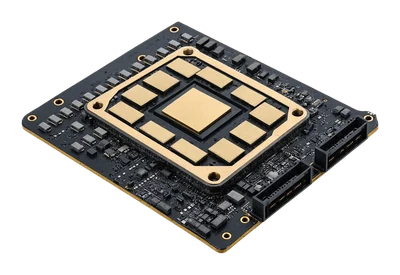
MI300X
192 GB HBM3 · 5.3 TB/s
$1.65/hr
Very large models on a single card, on ROCm
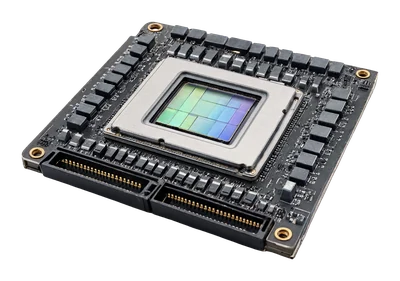
H100 SXM
80 GB HBM3 · 3.35 TB/s
$1.85/hr
AI training, fine-tuning and production LLM inference
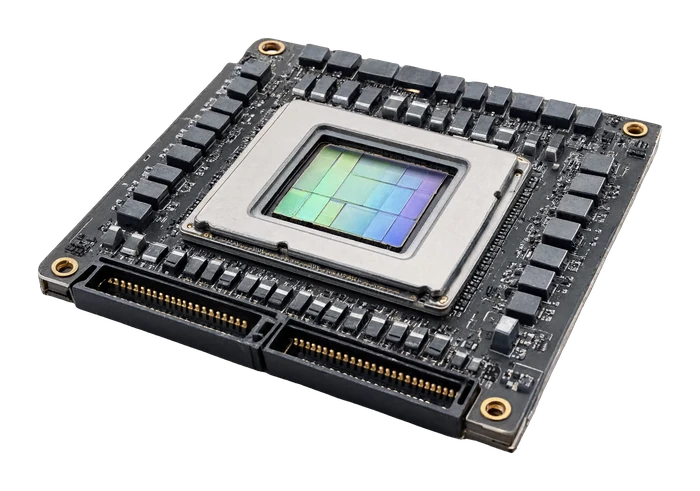
H200 SXM
141 GB HBM3e · 4.8 TB/s
$2.49/hr
Long-context LLM inference and fine-tuning above 70B
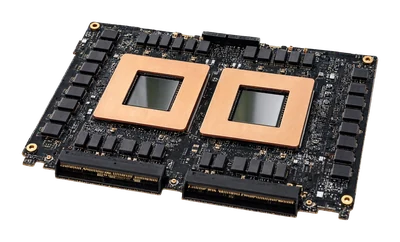
B200 SXM
180 GB HBM3e · 8 TB/s
$4.15/hr
Large-scale training and frontier model inference
GPUBank on-demand prices, all-in. Memory bar scaled to 192 GB.
09 / Rent or buy
Rent or buy an eight-GPU H200 server
The realistic purchase unit is the whole server, because the SXM module mounts on an HGX baseboard and cannot go into a workstation; the single-card option is the H200 NVL, a different product. Mercatus put an eight-GPU HGX H200 system at $320,000 to $420,000 in July 2026, with $370,000 as the typical integrated price, and the module alone at $32,000 to $40,00040. Thunder Compute gives $350,000 to $450,000, and Ace Computers lists its Matrix HGX H200 server from $478,992, so $370,000 is a mid-market figure rather than a floor4142. Our base case resells the server for 40 percent, $148,000, after 24 months, which makes depreciation $9,250 a month; colocation at $1,500 a month, cost of capital at 8 percent a year on $370,000, about $2,467 a month, and $500 a month of support and spares bring the fixed cost to about $13,717 a month, and all four of those inputs are our assumptions. Power is an assumed 10.2 kW at the wall under load at the US commercial average of 13.97 cents per kWh for January to July 2026, $1.42 for each hour of real use43.
Renting the same eight GPUs on GPUBank costs $19.92 per node-hour on demand, so owning would break even at 13,717 / (19.92 - 1.42) = 741 hours a month, more than a 730-hour month contains. At full use owning costs about $14,757 a month, against $14,541.60 for renting on demand, $11,621.60 for a month of GPUBank's reserved node and $9,088.50 when paid from a $1,000 top-up. Leave out the cost of capital, as a buyer paying cash that would otherwise earn nothing can, and the break-even falls to about 608 hours, 83 percent of the month. Against the market median of $4.94 per GPU owning wins above about 360 hours, and against AWS's $63.30 node-hour above about 22268. Buy only if you would otherwise pay median or large-cloud rates for most of the month, or if data must stay on your hardware; against a specialised cloud at this price, renting costs less at every level of use.
| Hours a month | Rent at $2.49 | Rent at $1.56 effective | Own | Cheaper |
|---|---|---|---|---|
| 100 | $1,992.00 | $1,245.00 | $13,859.16 | Rent |
| 200 | $3,984.00 | $2,490.00 | $14,001.66 | Rent |
| 300 | $5,976.00 | $3,735.00 | $14,144.15 | Rent |
| 400 | $7,968.00 | $4,980.00 | $14,286.65 | Rent |
| 500 | $9,960.00 | $6,225.00 | $14,429.14 | Rent |
| 600 | $11,952.00 | $7,470.00 | $14,571.63 | Rent |
| 730 | $14,541.60 | $9,088.50 | $14,756.88 | Rent, by about $215 on demand |
Server price: Mercatus typical integrated price, 8 July 2026 (range $320,000 to $420,000). The $71,200 shown as host is our cost of capital ($59,200 at 8 percent a year) and support ($12,000) over 24 months; colocation at $1,500 a month, 40 percent resale and the 10.2 kW draw are our assumptions; power at the EIA US commercial average.
10 / What to choose
The cheapest H200 depends on the job.

Serving a 70B model with long contexts
One H200 on demand or reserved
The FP8 weights fit on one card with about 410,000 tokens of cache, where an H100 needs a second card to serve the same model.

Running a 400B to 671B open model
One 8x H200 node, reserved for the month
Llama 3.1 405B and DeepSeek V3 fit one H200 node in FP8; on H100s DeepSeek needs two nodes and InfiniBand.

Fine-tuning above 70B with checkpoints
Interruptible H200 at a fixed price
A fixed spot price with five minutes of notice keeps the bill predictable and limits rework to the steps since the last checkpoint; Nebius spot is cheaper only while its floor holds.

Models that fit in 80 GB
An H100 SXM instead
Same compute, and the H200 costs 35 percent more at GPUBank while it served only 6 to 13 percent more tokens in MLPerf, so the H100 is cheaper per token.
11 / Questions
What people ask before renting one.
On 16 October 2026 a single H200 SXM cost from $2.09 to about $5.44 per GPU-hour on demand at the specialised clouds that publish a price, and $7.91 to $10.60 per GPU on the large clouds, which sell only eight-GPU instances5789. GetDeploying put the median on-demand price at $4.94 across 34 providers6. The cheapest managed offers on the providers' own pages were Beam at $2.09, with stock not reported, GPUBank at $2.49 with the IP and all traffic included, and GMI Cloud from $3.20204. Marketplaces started at $2.80 on Vast.ai before storage and bandwidth, and spot capacity went lower, from Nebius's dynamic floor of $0.79 to fixed prices of $1.49 at GPUBank and $2.29 at Lyceum2123. Before comparing two figures, check what the hour includes and whether it comes only as a whole server.
It depends on what you are willing to give up. If the job can stop at any moment and tolerate a moving price, Nebius preemptible from $0.79 per GPU-hour is the lowest figure on any provider's page, with the price allowed to rise to $5.391. If you want a fixed interruptible price with notice, GPUBank charges $1.49 with five minutes of warning and the disk kept4. For uninterrupted single-GPU use, Beam lists $2.09 for a machine whose stock was not confirmed, and GPUBank $2.49 with traffic and IPv4 included, about $1.56 effective when paid from a $1,000 top-up54. For a month of dedicated capacity, GPUBank's reservation at $1.99 was the lowest fixed reserved price we could read for so short a term. Vast.ai hosts start at $2.80 but add storage and bandwidth2.
The lowest spot figure on a provider's own page was Nebius's "from $0.79" per GPU-hour, listed since 8 October 2026, when its preemptible tier moved from a fixed $2.45 to dynamic pricing1. Nebius says the price follows capacity and demand, can change as often as every 15 minutes during use and is capped one cent below the $5.40 on-demand rate, so $0.79 is a floor rather than a quote. Fixed spot prices on 16 October were $1.49 at GPUBank, with five minutes of notice and the machine stopped rather than deleted, $2.29 at Lyceum, $2.58 per GPU for a CoreWeave eight-GPU node in Europe and $2.72 at Verda423257. Google Cloud's A3 Ultra Spot costs $6.35 per GPU, sold only by the node9. For checkpointed jobs, a fixed price with notice is easier to budget than a floor that can rise several times over mid-run.
Yes, at the specialised clouds and marketplaces, but not at the large clouds. AWS, Google Cloud, Azure and Oracle rent the H200 only as eight-GPU instances, so the smallest bill there is $37 to $85 an hour for the node depending on the pricing model9828. GPUBank, Beam, Civo, Hyperstack, DigitalOcean, Lyceum, Jarvislabs, Runpod, Nebius, Verda and Vast.ai all listed one-GPU H200 configurations in October 2026, from $2.09 to $5.44 on demand4514137. Some low headline prices, such as Sesterce at $2.48 per GPU, come only as an eight-GPU server, which costs about $20 an hour to start6. A single card suits serving one 70B-class model, fine-tuning and experiments; a full node is needed when a model exceeds 141 GB or a job trains across GPUs.
Both have 141 GB of HBM3e at 4.8 TB/s, but they are different products10. The SXM version mounts on an HGX baseboard, runs at up to 700 W and connects eight GPUs through NVLink and NVSwitch at 900 GB/s per GPU. The NVL version is a dual-slot, air-cooled PCIe card with a 600 W ceiling that links two or four cards through NVLink bridges, and its FP8 rating is 3,341 teraFLOPS with sparsity against 3,958 for the SXM. Marketplaces often list both under "H200": on 16 October Vast.ai's NVL listings started at $3.80 next to SXM listings from $2.80, and Lium's NVL page started at $3.85212. For a single card running one model the gap is modest, but for a model split across GPUs the SXM board's full fabric matters, so compare like with like.
The H200 is worth it when memory is your constraint, and usually not otherwise. It has the H100's compute but 76 percent more memory and 43 percent more bandwidth1011. In MLPerf v4.1, with both cards at 700 W, eight H200s produced 13 percent more Mixtral 8x7B tokens than eight H100s, while GPUBank charges 35 percent more for the H200, $2.49 against $1.85334. On a model that fits both cards, that makes the H100 about 16 percent cheaper per token. The H200 pays for itself when its 141 GB removes a card: Llama 3.3 70B in FP8 on one H200 instead of two H100s, Llama 3.1 405B on four H200s instead of eight H100s, or DeepSeek V3 on one node instead of two. It also holds about twelve times more KV cache for a 70B model, which matters for long contexts and many users.
Yes, in FP8, with plenty of room for the cache. The FP8 checkpoint takes about 73 GB, which leaves roughly 63 GiB of an H200's 141 GB for KV cache once a working reserve is set aside, or about 410,000 tokens with an FP8 cache by our calculation44. On an 80 GB H100 the same weights leave only about 5 GiB, around 32,500 tokens, less than one full 128K-token conversation, so in practice the model is served on two H100s with tensor parallelism. In BF16 the weights alone take about 141 GB, so one H200 cannot hold them and two are needed. One H200 at $2.49 an hour against two H100s at $3.70 is the clearest case on this page where the more expensive card is the cheaper deployment4.
One eight-GPU H200 node holds either model. Its 1,128 GB of combined memory holds Llama 3.1 405B with room for the cache, and the vLLM team noted at launch that the model runs on a single 8xH200 machine, while H100s need FP8 on a node or sixteen GPUs in BF1647. In FP8 the 405B weights take about 406 GB, so four H200s can hold them with a modest cache and eight give room for many users. DeepSeek V3 and R1 are published in FP8 at 671B parameters, which needs two H100 nodes but one H200 node46. Verda measured 2,378 output tokens per second on DeepSeek V3 in BF16 and 2,864 in FP8 on such a node with untuned SGLang34. At GPUBank the node costs $19.92 an hour on demand and $15.92 reserved4.
AWS sells the H200 in the p5e and p5en instances, each with eight GPUs. The p5en.48xlarge costs $63.296 an hour on demand in N. Virginia, $7.91 per GPU, before EBS storage and data transfer8. Its EC2 Capacity Blocks, which reserve a node for a fixed window paid up front, list the p5e.48xlarge at $54.924 an hour, $6.866 per GPU, and the p5en at $63.158, $7.895 per GPU, in about a dozen regions19. The page says the next price revision is scheduled for January 2027 and that each block is charged at the rate in force when it is bought, even if it starts after a change. A month of a p5en node on demand comes to about $46,206 before storage and egress, against $11,621.60 for a month of GPUBank's reserved node4.
Yes. Google Cloud's accelerator-optimised pricing page lists the a3-ultragpu-8g, A3 Ultra with eight H200s, 224 vCPU, 2,952 GB of RAM and 12,000 GiB of local SSD, at $84.81 an hour on its default on-demand model, $10.60 per GPU9. The same row lists Dynamic Workload Scheduler Flex-start at $42.40 an hour, $5.30 per GPU, Calendar mode at $59.36, Spot at $50.80, $6.35 per GPU, a one-year commitment at $58.47 and a three-year commitment at $37.21, $4.65 per GPU. Flex-start is the cheapest Google option that does not need a commitment, but capacity is allocated when it is available rather than on request, which suits batch jobs better than an endpoint. Like the other large clouds, Google sells the H200 only by the eight-GPU machine.
Because the products differ more than the chip does. A price can include the CPU, memory, NVMe, public IP and traffic, or only the GPU; it can be for one GPU or an eight-GPU server; it can be fixed, reserved, set by a marketplace host or set by a spot market that moves every 15 minutes1. Large clouds add enterprise networking, compliance and integration with their other services, which is why Oracle, Google and Azure sit at $10.00 to $10.60 per GPU29928. Marketplace hosts set their own asks, which move from week to week: Lium's cheapest H200 rose from $3.40 to $3.73 in a fortnight12. Stock matters too, since several of the lowest aggregator figures were marked out of stock6. Compare what a month of your workload will cost, not the headline rate.
Not over the past year. GetDeploying measured the median on-demand H200 price up about 27 percent over twelve months and 3 percent over the last 90 days, at $4.94 on 16 October 20266. Several providers raised their rates recently: Nebius moved its on-demand H200 from $4.50 to $5.40 on 1 October, and Lium's cheapest ask rose from $3.40 on 29 September to $3.73112. At the same time the lowest prices moved down, as Nebius's spot floor fell from a fixed $2.45 to a dynamic $0.79, while AWS has scheduled its next Capacity Block revision for January 202719. The picture is a market where typical prices rise while the cheapest interruptible hours fall, as Blackwell supply grows and Hopper capacity is resold more aggressively at the bottom.
An eight-GPU HGX H200 server cost $320,000 to $420,000 in July 2026 according to Mercatus, which gives $370,000 as the typical integrated price, while Thunder Compute gives $350,000 to $450,000 and Ace Computers lists a Matrix HGX H200 from $478,992; the SXM module alone sells for $32,000 to $40,000 but needs an HGX baseboard404142. Add colocation, power for a system that draws about 10 kW at the wall, support and the cost of the money. Under our assumptions, $370,000 of hardware, 40 percent resale after two years, $1,500 a month of colocation, 8 percent cost of capital, $500 a month of support and power at the US commercial average of 13.97 cents per kWh, owning costs about $13,717 a month plus $1.42 per hour of use43. That never beats GPUBank's on-demand node at $19.92 an hour within a 730-hour month, and it beats the market median only above about 360 hours46. Buying makes sense mainly for teams that would otherwise pay large-cloud rates or must keep data on their own hardware.
Yes, at a few providers. GPUBank is paid only from a prepaid US dollar balance topped up in crypto, with Bitcoin, Ethereum, USDT, USDC, Monero and more than a dozen other coins accepted for top-ups of $25 to $5,000, and a bonus of 20 to 60 percent depending on the amount brings the effective H200 hour to about $2.08 with $25, $1.84 with $100 and $1.56 with $1,000; the balance never expires, and cards are not accepted for now4. Lium accepts top-ups by card or by crypto12. Most other clouds in this comparison, and all four large clouds, bill a card or an invoice in the usual way. A top-up bonus is a real discount only on money you will in fact spend, so size a top-up to the hours you expect to use rather than to the largest bonus tier.
That depends entirely on the provider's reclaim terms, so read them before starting a long job. On GPUBank's interruptible tier you get five minutes of notice through the metadata endpoint, a webhook and the console; your checkpoint hook runs, the machine is stopped rather than deleted, the disk and public IP survive, and if the notice is missed the last 30 minutes are credited4. On Nebius, preemptible VMs can be stopped whenever capacity is needed and the price can change every 15 minutes, while stopped VMs keep billing only for their volumes1. On Vast.ai, an interruptible instance is paused when a higher bid arrives and its storage keeps billing until you destroy it3. Whatever the provider, write checkpoints to a persistent disk frequently and budget for redoing some work, which our fine-tuning scenario sets at 5 percent.
Sources
Sources
- 01Nebius AI Cloud documentation, Compute pricingH200 $5.40 from 1 October, preemptible from $0.79 from 8 October, spot rules, per-second billing · read 16 Oct 2026
- 02Vast.ai, live H200 offers (public search API, same data as vast.ai/pricing/gpu/H200)Cheapest SXM ask $2.80 (Japan), NVL listings from $3.80 · read 16 Oct 2026
- 03Vast.ai documentation, PricingStorage billed while stopped, bandwidth per host, interruptible pausing · read 15 Oct 2026
- 04GPUBank, pricingH200 SXM on-demand, interruptible and reserved prices, inclusions, billing, top-up bonuses, regions · read 16 Oct 2026
- 05Beam, pricingH200 SXM5 machine from $2.09/hr, 24 vCPU, 192 GB RAM, 2 TB NVMe · read 16 Oct 2026
- 06GetDeploying, Nvidia H200 rental prices (aggregator)Median $4.94 across 34 providers, 12-month trend, Sesterce and Jarvislabs spot rows, Beam stock status · read 16 Oct 2026
- 07Verda, pricingH200 SXM5 $5.44 on demand, $2.72 spot, serverless $5.98 · read 16 Oct 2026
- 08AWS, EC2 On-Demand pricing (public price list, US East N. Virginia, Linux)p5en.48xlarge $63.296 per hour · read 16 Oct 2026
- 09Google Cloud, accelerator-optimized VM pricinga3-ultragpu-8g on-demand, Flex-start, Calendar, Spot and CUD prices · read 16 Oct 2026
- 10NVIDIA H200 Tensor Core GPUSXM and NVL specifications · read 16 Oct 2026
- 11NVIDIA H100 Tensor Core GPUH100 SXM 80 GB at 3.35 TB/s · read 15 Oct 2026
- 12Lium, H200Live range $3.73 to $5.70, lowest on 8-GPU pods, reference $3.65, NVL from $3.85, card or crypto top-ups · read 16 Oct 2026
- 13Runpod, pricing (updated 8 October 2026)H200 pod $5.29, Community $3.59, serverless $5.93, Instant Clusters $6.35, storage prices · read 16 Oct 2026
- 14Civo, pricingH200 $3.49 on demand, $3.29 to $2.99 committed, hourly rounding, free transfer · read 16 Oct 2026
- 15Runpod, NVIDIA H200 guideOlder Secure Cloud figure of $4.59 and Community $3.59 · read 15 Oct 2026
- 16Hyperbolic blog, Introducing H200s on HyperbolicH200 launched at $2.65 per hour in September 2025 · read 15 Oct 2026
- 17Hyperbolic, marketplaceH200 $3.99, weekly refresh, no charge for failed instances · read 16 Oct 2026
- 18The Register, AWS raises EC2 Capacity Block prices (5 January 2026)p5e Capacity Block from $34.61 to $39.80 per instance-hour · read 15 Oct 2026
- 19AWS, Amazon EC2 Capacity Blocks for ML pricingp5e $54.924 and p5en $63.158 per instance-hour, next update January 2027 · read 16 Oct 2026
- 20GMI Cloud, pricingH200 from $3.20 per GPU-hour, available now · read 16 Oct 2026
- 21Hyperstack, GPU pricingH200 SXM $3.99 on demand, reserved from $2.79, per-minute billing, free traffic, IP extra · read 16 Oct 2026
- 22DigitalOcean, GPU Droplets pricingH200 $4.47, 12-month $3.40, droplet specification and transfer · read 16 Oct 2026
- 23Lyceum, pricingH200 $4.49 on demand, $2.29 spot, per-second billing · read 16 Oct 2026
- 24Jarvislabs, pricingH200 SXM $4.59, 28 vCPU, 300 GB RAM, per-minute billing, storage $0.10/GB-month · read 16 Oct 2026
- 25CoreWeave, pricingHGX H200 node $50.44/hr, spot $20.93 (NA) and $20.64 (Europe) · read 16 Oct 2026
- 26Koyeb, pricingH200 serverless instance $3.00/hr, 15 vCPU, 240 GB RAM · read 16 Oct 2026
- 27Modal, pricingH200 $0.001261 per second, CPU and memory rates · read 16 Oct 2026
- 28Microsoft Azure, Linux virtual machines pricing (Retail Prices API, Standard_ND96isr_H200_v5)$84.80/hr in East US 2, $110.24 in other regions, 1-year and 3-year reservations · read 16 Oct 2026
- 29Oracle Cloud price list (Compute, GPU, H200)H200 $10.00 per GPU-hour · read 16 Oct 2026
- 30GPUBank, home pageHealth check before billing, host failure credit, 48 s median launch · read 15 Oct 2026
- 31NVIDIA Technical Blog, Blackwell in MLPerf Inference v5.08x H200 and 8x B200 on Llama 2 70B, Mixtral 8x7B, SDXL · read 16 Oct 2026
- 32MLCommons, MLPerf Inference v5.0 results (summary_results.json)Closed datacenter entries 5.0-0056 (DGX B200), 5.0-0057 (DGX H100), 5.0-0060 (H200): Llama 2 70B, FP8 on Hopper, TensorRT 10.8 · read 16 Oct 2026
- 33NVIDIA Technical Blog, Blackwell in MLPerf Inference v4.18x H200 and 8x H100 on Mixtral 8x7B at 700 W, H200 at 1,000 W on Llama 2 70B · read 16 Oct 2026
- 34Verda, DeepSeek V3 inference benchmark on NVIDIA H200SGLang 0.4.1 throughput on 8x H200, BF16 and FP8 · read 16 Oct 2026
- 35LMSYS blog, large-scale expert parallelism for DeepSeek with SGLang (5 May 2025)52.3k input and 22.3k output tokens/s per node on 12 nodes of 8x H100; $0.20 per million output tokens · read 16 Oct 2026
- 36Tom's Hardware, AMD posts first Instinct MI300X MLPerf resultsMI300X roughly in line with H100 on MLPerf Llama 2 70B · read 16 Oct 2026
- 37The Next Platform, the first AI benchmarks pitting AMD against NvidiaMI300X about 60 percent of the H200 Llama 2 70B inference load in MLPerf v4.1 · read 15 Oct 2026
- 38Ambati and Diep, MI300X inference performance analysis (arXiv 2510.27583)MI300X at 37 to 66 percent of H100 and H200 realised LLM inference · read 15 Oct 2026
- 39SemiAnalysis, AMD vs NVIDIA inference benchmark (23 May 2025)MI300X on par with H200 on vLLM for Llama 3.1 405B; H200 ahead on TensorRT-LLM · read 15 Oct 2026
- 40Mercatus, NVIDIA H200 server price 2026$320,000 to $420,000, typical $370,000, module $32,000 to $40,000 (8 July 2026) · read 16 Oct 2026
- 41Thunder Compute, NVIDIA H200 pricing (October 2026)HGX H200 server $350,000 to $450,000 · read 15 Oct 2026
- 42Ace Computers, Matrix HGX H200 serverListed from $478,992 · read 15 Oct 2026
- 43EIA, Electric Power Monthly, table 5.3US commercial average 13.97 cents per kWh, January to July 2026 (preliminary) · read 16 Oct 2026
- 44Meta, Llama 3.3 70B Instruct model card70B parameters, 128K context, architecture used for the KV cache arithmetic · read 16 Oct 2026
- 45Qwen, Qwen3-235B-A22B model card235B total, 22B active parameters · read 16 Oct 2026
- 46DeepSeek, DeepSeek-V3 model card671B parameters, FP8 weights · read 16 Oct 2026
- 47vLLM blog, Announcing Llama 3.1 support in vLLM405B on a single 8xH200 machine, FP8 on 8xH100, 16 GPUs in BF16 · read 16 Oct 2026
- 48OpenAI, gpt-oss-120b model card117B parameters, MXFP4, single 80 GB GPU · read 16 Oct 2026
What we could not confirm
Beam's $2.09 machine was read on Beam's own pricing page, but no source confirmed that a card was in stock and the page does not state its billing granularity, IP or traffic terms. Vast.ai's H200 page headline read $2.80, the same as the cheapest SXM ask in Vast's public search API that day, but the page does not separate SXM from NVL listings. Sesterce's $2.48 and Jarvislabs' $2.29 spot rate come from GetDeploying only, and Runpod's $3.59 Community rate appears only in its page's structured data, not on the visible card. GMI Cloud's page lists $3.20 where a 29 September reading and GMI's own blog had $2.60; we use the pricing page. Providers we could not re-read on 16 October (io.net, Shadeform, Seeweb, Gcore, E2E Networks, AceCloud, Clore.ai, Taiga Cloud, Northflank, Akash, Massed Compute, which is now labelled NVL) were left out rather than shown with stale prices. Storage prices for Nebius, Lyceum and CoreWeave were not read, Vast.ai storage at $0.15 per GB-month is an assumption, and the AWS egress estimate uses its published $0.09 per GB tier without a re-read. The KV cache capacities are our arithmetic, not measurements, and the colocation cost, support, cost of capital, 10.2 kW draw and resale value in the ownership model are assumptions. The server prices from Thunder Compute and Ace Computers and the AWS Capacity Block history come from third-party pages, and the GetDeploying rows for Gcore, Canopy Wave, Runcrate, Crusoe, OVHcloud and the reserved offers were not read on the providers' own pages.
H200 SXM on GPUBank
A 70B model on one card, billed by the second.
- 24 vCPU, 276 GB RAM, 2 TB NVMe, IPv4 and traffic in $2.49/hr
- Billed by the second after the health check
- Interruptible $1.49, reserved $1.99
 24 vCPU, 276 GB RAM, 2 TB NVMe, IPv4 and traffic in $2.49/hr
More GPU price guides
Where to rent the other cards at the cheapest price.
B200 SXM180 GB HBM3eFrom $2.49 spot · $4.15 all-inH100 SXM80 GB HBM3From $1.11 spot · $1.85 all-in H100 PCIe80 GB HBM2eFrom $0.81 spot · $1.35 all-inMI300X192 GB HBM3From $0.99 spot · $1.65 all-in
 RTX PRO 600096 GB GDDR7 ECCFrom $0.69 spot · $1.15 all-in
 A100 SXM80 GB HBM2eFrom $0.57 spot · $0.95 all-in
 L40S48 GB GDDR6 ECCFrom $0.33 spot · $0.55 all-in
 RTX 509032 GB GDDR7From $0.29 spot · $0.48 all-in
 RTX 409024 GB GDDR6XFrom $0.14 spot · $0.23 all-in