Updated 16 Oct 2026 · 28 offers checked
Where to rent an MI300X at the cheapest price
Twenty-eight MI300X offers from sixteen providers, rechecked on 16 October 2026 and compared on what the hour really buys: the machine around the card, the smallest unit you can rent, what a stopped instance costs and how mature the ROCm software is today.
The short answer, 16 Oct 2026
- $0.50/hrCheapest listing we found. A Runpod Community Cloud MI300X at $0.50 per GPU-hour, read on the MadeByAgents tracker on 15 October 2026; it is a host's listing on a marketplace that can disappear within the hour, and we could not open it on Runpod's own pages1.
- $0.99/hrCheapest hour on a provider's own page. GPUBank's interruptible tier at $0.99 per GPU-hour, 40 percent below its on-demand rate, for which you give up the right to keep the card: a reclaim comes with five minutes of notice and stops the machine without deleting it2.
- $1.65/hrCheapest whole machine on demand. GPUBank at $1.65 per GPU-hour with 24 vCPU, 240 GB of RAM, 2 TB of NVMe, a public IPv4 address and all traffic included, $0.94 below DigitalOcean's $2.59, the next single-GPU on-demand offer23.
The MI300X is an awkward card to shop for. Far fewer clouds rent it than rent the H100, the offers range from a single GPU billed by the second to an eight-GPU server on a one-year contract, and the per-GPU number an aggregator shows usually hides which of those it is. On 16 October 2026 the same AMD accelerator could be had at $0.50 on a marketplace, $0.99 as an interruptible GPUBank machine, $1.11 as one eighth of an Azure spot VM, $2.59 as a single DigitalOcean Droplet and $6.00 as one eighth of an Oracle bare-metal server12435. Those are five different products, which differ in how long you keep the card, how much CPU and disk come with it, whether you must take eight at once and who pays when a host dies halfway through a job.
We started from a survey GPUBank ran on 29 September 2026 and rechecked every row on 16 October on the provider's own page wherever it could be read without an account, naming the aggregator and its date where it could not. Several rows had moved. Hot Aisle's own pricing page shows $2.99 for its virtual machines and no longer mentions the older $1.99 rate; Runpod no longer lists the card on its pricing page; Seeweb quotes 2.35 euros, about $2.63 at the ECB rate of 15 October; and the $2.63 Azure reservation in our starting data turned out to be the three-year term, not the one-year6784. This page is published by GPUBank, a GPU cloud run by GPU Compute OÜ in Tallinn, so read our own entry with that in mind: it is measured on the same terms as every other offer, and the text says plainly where a marketplace, a spot tier or a long reservation elsewhere beats it.
01 / What runs today
What runs on an MI300X in October 2026
ROCm is no longer the obstacle it was in 2024, and the version numbers show how fast it moves. AMD released ROCm 10.1.0 on 5 October 2026, built with its new TheRock system, and its release notes list the MI300X (gfx942) as supported with PyTorch 2.14.0, JAX 0.11.1, vLLM 0.29.0 and SGLang 0.5.182425. PyTorch publishes official 2.14.1 wheels for ROCm 7.2 and 7.14, vLLM documents MI300 support from ROCm 6.3 and now ships its own ROCm images in place of AMD's deprecated rocm/vllm ones, Triton lists AMD GPUs on ROCm 6.2 and later as supported hardware, and bitsandbytes says all its features work on CDNA, with gfx942 in its PyPI wheels26172728. A team on stock PyTorch, vLLM or SGLang with a Hugging Face model usually has an endpoint running the same day.
The gaps are in everything tied to NVIDIA. TensorRT-LLM is an NVIDIA-only library and has no ROCm build; FlashAttention 2 runs on the MI300X through its Composable Kernel and Triton backends, but the Hopper-specific FlashAttention 3 exists on ROCm only as an FP8 path in the Triton backend; and SGLang's own AMD page says that quantisation methods depending on Marlin or NVIDIA kernels, including awq_marlin, gptq_marlin, gguf, modelopt_fp8 and modelopt_fp4, do not work293031. Hugging Face TGI is in maintenance mode and its README names only the MI210 and MI250, DeepSpeed says it is developed and tested on the MI100 and MI200, and xFormers labels its ROCm wheel experimental323334. The kernel backend also decides speed: vLLM's February 2026 post measured its AITER attention up to 3.82 times faster than the older ROCm path on the MI300X35.
In engineering time this splits teams cleanly. If your stack is PyTorch with standard layers, vLLM or SGLang serving a popular open model in BF16 or FP8, or llama.cpp through its HIP backend, budget an afternoon to pull the right ROCm image, pin versions and benchmark the attention backend36. If you depend on TensorRT-LLM engines, Marlin-quantised checkpoints, custom CUDA or PTX kernels, or a training framework tested only on NVIDIA, budget days to weeks: kernels have to be ported through HIP or rewritten in Triton, quantised weights re-exported in a format ROCm supports, and every upgrade retested, because ROCm, PyTorch and vLLM versions must match. At $1.65 against $1.85 for an H100, the MI300X saves $0.20 an hour, about $146 a month per card at full use, so the port pays for itself only when the memory advantage, not the hourly rate, is what you are buying.

Software status on the MI300X, 16 Oct 2026
7Works
4Partial
1Missing
12components checked
Runs on the MI300X 7
Runs with limits 4
Does not run 1
Fits on one MI300X, not on one H100
Model weights against the memory of one card
One H100, 80 GBOne MI300X, 192 GB
Llama 4 Scout (109B MoE)FP8
Qwen3 235B-A22B (MoE)4-bit
Mistral Large 2 (123B)FP8
Mixtral 8x22B (141B MoE)FP8
Llama 3.3 70BBF16
Qwen2.5 72BBF16
02 / The card
What the MI300X is and who rents it
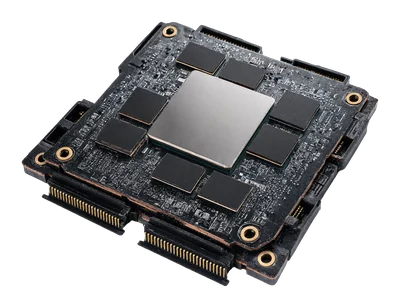
The AMD Instinct MI300X is a CDNA 3 accelerator launched on 6 December 2023 with 304 compute units, 192 GB of HBM3 on an 8,192-bit interface at 5.3 TB/s, and peak dense throughput of 1.3 PFLOPS in FP16 and 2.61 PFLOPS in FP8, at a typical board power of 750 W9. It ships only as an OAM module, mounted eight to a baseboard and joined by eight Infinity Fabric links of 128 GB/s each, so there is no PCIe version for a workstation and every MI300X you rent sits in an eight-GPU server, whether or not the provider sells you all eight9. Its successors are the MI325X with 256 GB, which DigitalOcean already rents at $3.80, and the CDNA 4 MI350X and MI355X with 288 GB3. The memory is the whole argument: 192 GB holds a 70B model in 16-bit weights on one card, which no 80 GB H100 can do, and that alone explains most of the demand for it.
The market splits into two camps. One sells single GPUs: GPUBank in machines of 1, 2, 4 or 8, DigitalOcean in 1 or 8, Seeweb in 1, 2, 4 or 8, Hot Aisle in virtual machines of 1, 2 or 4 and Spheron in 1 or 2237610. The other sells only the eight-GPU server or a contract for one: Microsoft Azure with its ND MI300X v5, Oracle with BM.GPU.MI300X.8, Vultr, Crusoe, TensorWave, Cirrascale, Cyfuture AI, Denvr and Hot Aisle's bare-metal tier111213. The buyers are mostly inference teams serving models between 70B and 400B parameters, and price-sensitive teams who will trade CUDA's convenience for a lower hourly rate, and between those two camps of sellers the price on providers' own pages runs from $0.99 to $6.00 per GPU-hour for the same silicon.
03 / The price ladder
How to read MI300X prices
Three things must match before two MI300X prices can be compared. The first is the mode: on-demand capacity is yours until you stop it, spot or interruptible capacity can be taken back, and reserved capacity is prepaid or contracted for a week to three years. The second is the unit, because a per-GPU price on Azure, Oracle, Vultr, Crusoe or Cirrascale is the price of an eight-GPU server divided by eight, so the smallest bill you can run up there is eight times the headline4512. The third is what the hour includes, from vCPU, RAM and local disk to the public IP, outbound traffic and the disk that keeps billing while the machine is off. A marketplace headline is a host's asking price for a GPU in whatever box it sits in; a managed price is a defined machine with defined inclusions. They are not the same product, so the table below sorts offers by type first.
For this card the five kinds of offer look like this. Managed single-GPU on demand runs from $1.65 on GPUBank through $2.59 on DigitalOcean, about $2.63 on Seeweb and $2.99 on Hot Aisle to $3.59 on Spheron, with Crusoe at $3.45 and Cyfuture AI at $2.79 selling only whole nodes2376101311. Marketplaces are thin: the only live listings we found were Runpod Community at $0.50 and OpenRelay at $1.99, both through trackers114. Spot capacity costs $0.99 on GPUBank for one GPU, $1.11 per GPU on an eight-GPU Azure VM and $1.85 on Vultr, which GetDeploying showed sold out2411. Reservations start at $1.32 on GPUBank for a week or a month, followed by $1.62 on a 12-month Cyfuture node and $1.91 on a 12-month DigitalOcean contract. We found no serverless MI300X billed by the second of work.
Managed on demandA fixed machine at one hourly price.
MarketplaceHosts set their own price; machines vary.
Spot and interruptibleCheaper hours that can be taken back.
ReservedCommitted for a term, paid either way.
04 / Provider by provider
What each price buys, and what it leaves out.
The captures below were taken on 16 Oct 2026 from each provider's own MI300X or pricing page, so every figure can be read next to the conditions printed beside it.
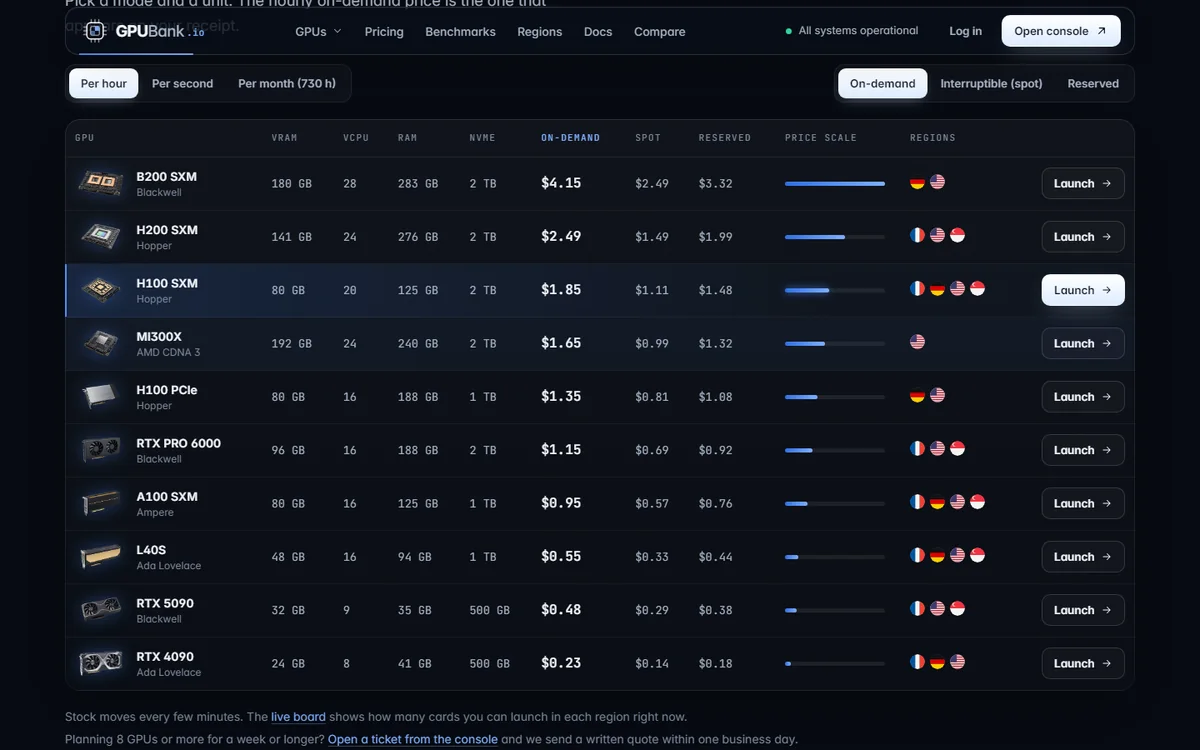
GPUBankAll-in
$1.65/hr
Managed cloud · 1 to 8 GPUs · Ashburn
24 vCPU240 GB RAM2 TB NVMeIPv4 and all trafficSpot $0.99Reserved $1.32Persistent disk $0.03/GB-month
GPUBank rents the MI300X by the single GPU at $1.65 an hour, with 24 vCPU, 240 GB of RAM, a 2 TB local NVMe disk, a public IPv4 address and all traffic in the price, billed per second from the moment the machine passes its health check2. Interruptible capacity costs $0.99 with five minutes of notice and a stop rather than a deletion, and a reservation of one week or one month costs $1.32, prepaid. A stopped machine bills only its persistent disk at $0.03 per GB-month, and a host failure restarts the machine elsewhere with the interrupted session credited. The card is listed only in Ashburn, and the median time from launch to a machine that has passed its health check is 48 seconds16. Payment is a prepaid balance in crypto from $25, and any Docker image can be launched, which on this card means a ROCm image rather than the CUDA templates.2
Checked 16 Oct 2026
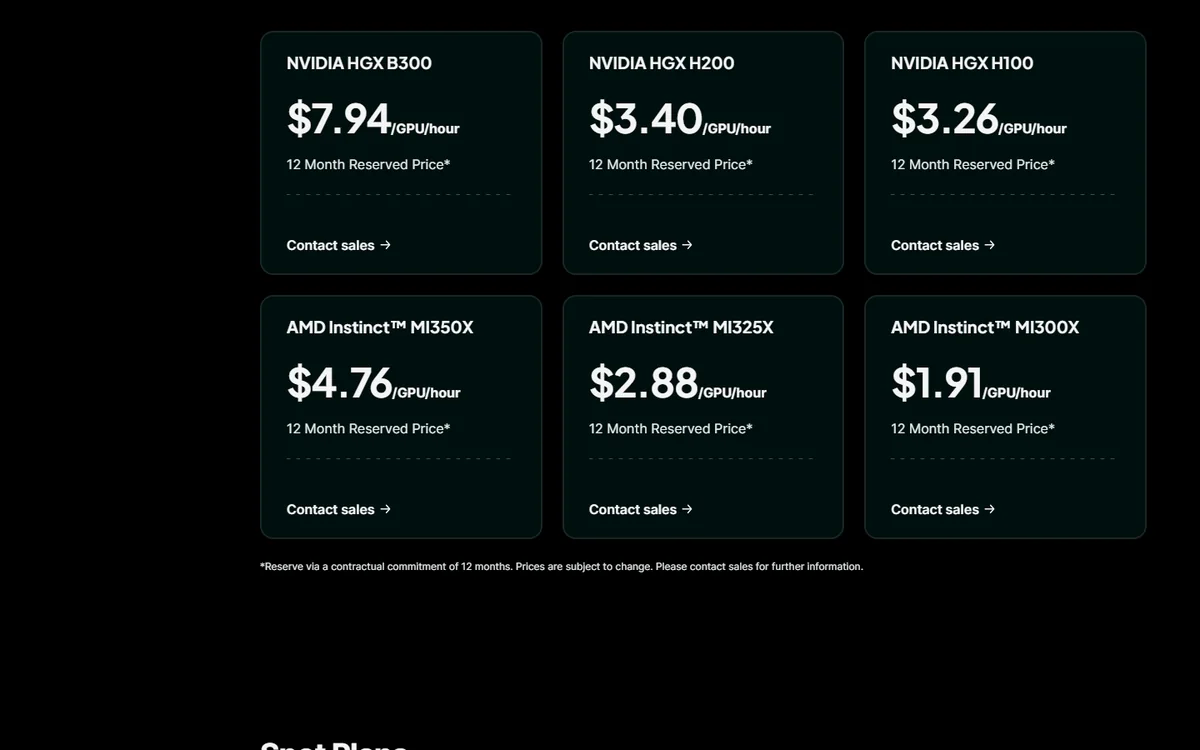
 DigitalOcean
$2.59/hr
Managed cloud · 1 or 8 GPUs
20 vCPU240 GiB RAM720 GiB boot + 5 TiB scratch NVMe15,000 GiB transfer12-month reserved $1.91Billed while powered off
DigitalOcean sells MI300X GPU Droplets with one or eight GPUs at $2.59 per GPU-hour, $20.72 an hour for the eight-GPU size, and its pricing page lists per GPU 20 vCPU, 240 GiB of memory, a 720 GiB NVMe boot disk, a 5 TiB NVMe scratch disk and a 15,000 GiB transfer allowance3. Billing is per second with a 5-minute minimum. A 12-month reservation through sales costs $1.91 per GPU-hour, the cheapest single-GPU yearly contract we found. The trap is the stopped state: a powered-off GPU Droplet bills in full until it is destroyed, and destroying it discards the scratch disk, so bursty work must keep its data on separately priced volumes. For a steady endpoint on a well-known cloud with card billing and support, it is the main alternative to GPUBank in the United States.3
Checked 16 Oct 2026
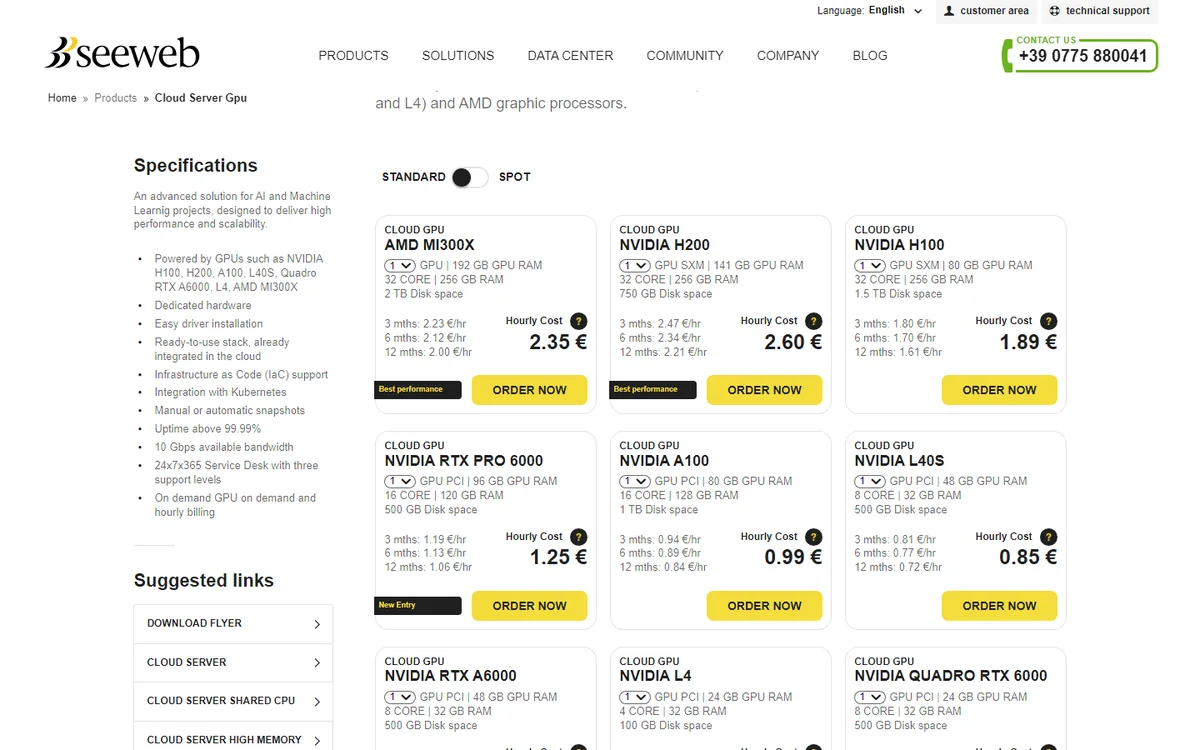
 Seeweb
€2.35/hr (about $2.63)
Managed cloud · 1 to 8 GPUs · Italy
32 cores256 GB RAM2 TB diskFree traffic3 months €2.2312 months €2.00Spot price not shown
Seeweb, an Italian provider, lists the MI300X at 2.35 euros an hour, about $2.63 at the ECB rate of 15 October, for one GPU with 32 cores, 256 GB of RAM and 2 TB of disk, in sizes of 1, 2, 4 or 8 GPUs78. Network traffic and API calls are free, billing starts on activation with no advance payment and you pay for the hours used. Commitments bring the rate to 2.23 euros for three months, 2.12 for six and 2.00 for twelve, about $2.24. A spot tier promises savings of up to 40 percent, but the page shows the same 2.35 euros and terminates spot instances after a two-minute notice. Seeweb is the only provider we found renting single MI300X GPUs from EU data centres, which is the reason to pay about a dollar an hour more than GPUBank's US offer.7
Checked 16 Oct 2026
 Hot Aisle
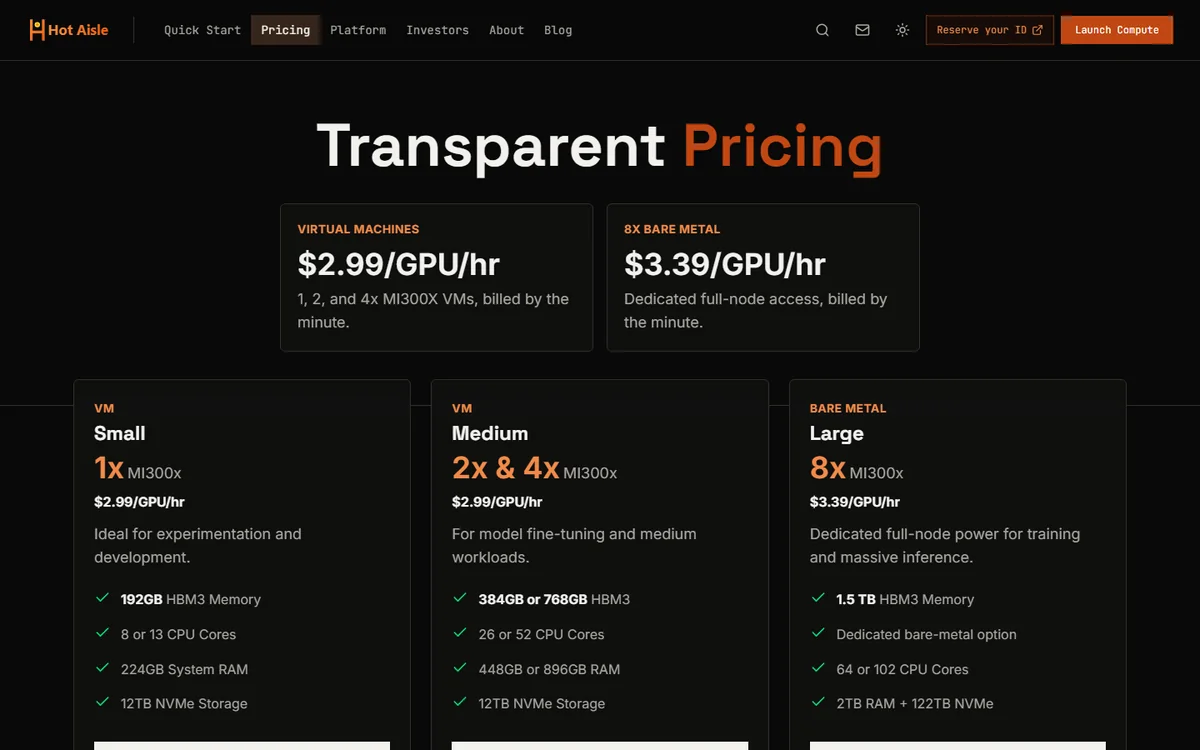
$2.99/hr
AMD-only cloud · 1, 2, 4 or 8 GPUs
8 or 13 CPU cores224 GB RAM12 TB NVMe8x bare metal $3.39Out of stock per GetDeploying
Hot Aisle is an AMD-only cloud that rents MI300X virtual machines with 1, 2 or 4 GPUs at $2.99 per GPU-hour and eight-GPU bare metal at $3.39, both billed by the minute6. The single-GPU VM comes with 8 or 13 CPU cores, 224 GB of system RAM and 12 TB of NVMe, a generous scratch disk, and the bare-metal node has 2 TB of RAM and 122 TB of NVMe. Its pricing page no longer mentions the $1.99 rate that older pages and several aggregators still quote, so trust $2.99. GetDeploying listed every Hot Aisle MI300X size as out of stock on 15 October, and we could not check stock ourselves because launching needs an account11. The page does not say what a stopped VM costs. Hot Aisle suits a team that wants a provider specialised in AMD hardware and per-minute billing on bare metal.6
Checked 16 Oct 2026
 Crusoe
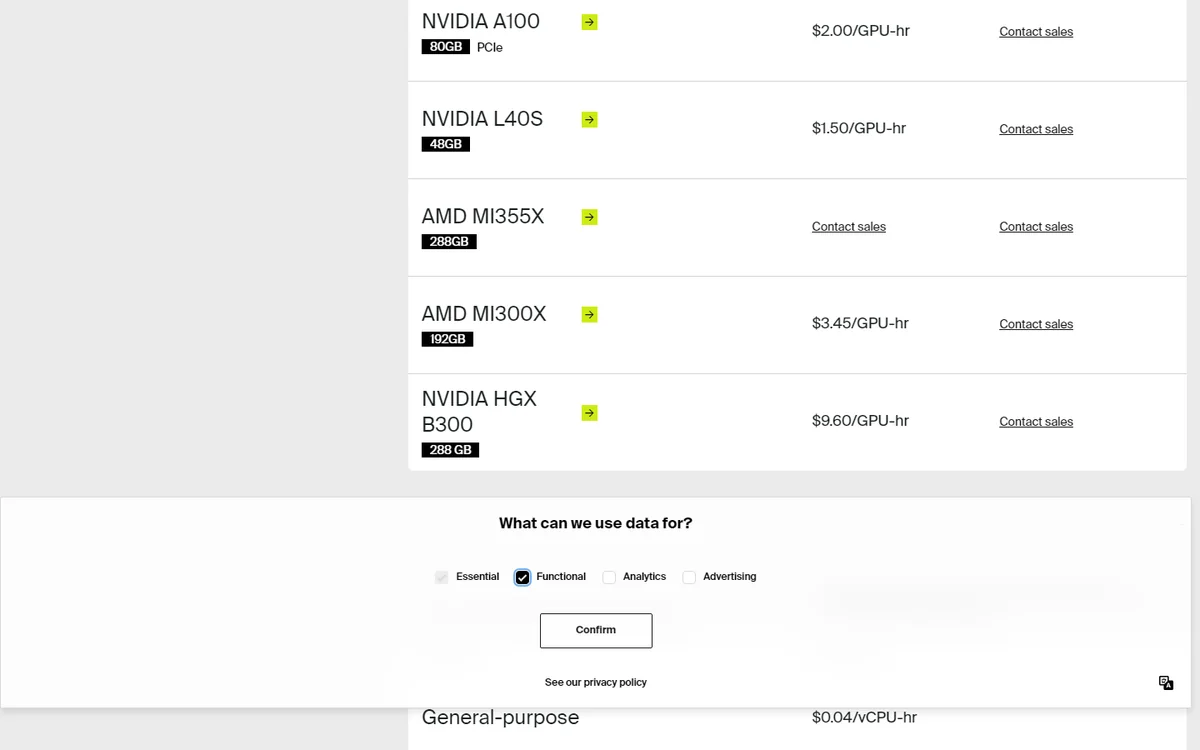
$3.45/hr
Managed cloud · 8-GPU node
240 vCPU2 TB RAMInfiniBandSpot and reserved on requestDisk $0.08/GiB-month
Crusoe lists the MI300X at $3.45 per GPU-hour on demand on its pricing page, with spot and reserved capacity only through sales13. GetDeploying shows the offer as the mi300x-192gb-ib.8x instance, an eight-GPU node with 240 vCPU, 2 TB of RAM and InfiniBand, which makes the smallest bill $27.60 an hour, and it listed the node as out of stock on 15 October11. Persistent disks cost $0.08 per GiB-month and Crusoe says that at this time it does not charge for network ingress or egress13. At more than twice GPUBank's per-GPU rate it is not a price leader for this card; its case is a cluster with InfiniBand on a provider that also runs NVIDIA fleets, for a team that wants both under one contract.13
Checked 16 Oct 2026
 Oracle Cloud
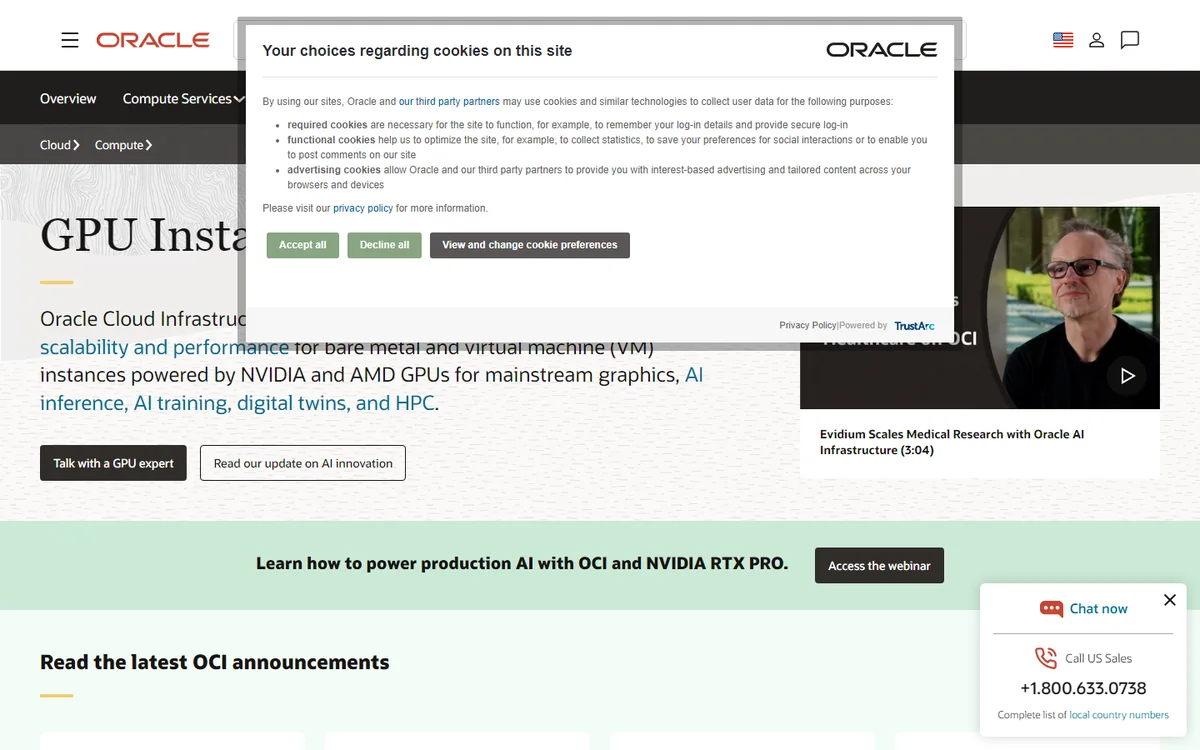
$6.00/hr
Large cloud · 8-GPU bare metal
224 vCPU2 TB RAMBare metal$48.00/hr per nodeNo published spot
Oracle's GPU page gives the MI300X at $6 per GPU-hour, which is $48.00 an hour for the BM.GPU.MI300X.8 bare-metal shape, and GetDeploying lists that node with 224 vCPU and 2 TB of RAM511. It matches Azure's on-demand rate per GPU and is 3.6 times GPUBank's, and Oracle sells only the whole node, so the smallest commitment is $1,152 a day. The page also mentions a try-before-you-buy programme for the MI300X shape. Oracle makes sense for an organisation already on OCI, with its networking, identity and compliance work done there, or for one that needs a large supercluster of MI300X under a single enterprise contract; for one or two cards at a time it is the most expensive way to rent this GPU that we found.5
Checked 16 Oct 2026
Where GPUBank wins, and where it does not
GPUBank wins on the MI300X wherever the buyer wants one card, by the hour, with the machine priced in. Its $1.65 on-demand rate is the cheapest single-GPU MI300X we could confirm on a provider's own page, $0.94 an hour below DigitalOcean and about a dollar below Seeweb and Hot Aisle, and it already covers 24 vCPU, 240 GB of RAM, 2 TB of NVMe, an IPv4 address and all traffic2376. The $0.99 interruptible tier is the cheapest MI300X hour on any provider's own page, and the $1.32 reservation is the only one we found that runs for a week or a month rather than a year. Per-second billing with no minimum, no charge for a stopped machine beyond its disk, and a full credit when a host fails mid-job matter more on this card than on most, because its rivals bill a powered-off Droplet in full or refuse to stop at all2310.
It loses in several places. The card is listed only in Ashburn, so a European data-residency requirement points to Seeweb instead167. A marketplace listing such as Runpod Community at $0.50 is half the price of the interruptible tier when one exists1. Payment is a prepaid balance topped up in crypto from $25, with no card payments for now, which some finance departments cannot accept; the top-up bonus brings the effective on-demand hour to about $1.22 with $100 and $1.03 with $1,0002. Finally, GPUBank's ready-made templates are listed with CUDA builds such as PyTorch 2.8 with CUDA 12.8, so on this card plan to launch your own Docker image, which GPUBank accepts, starting from the official vLLM ROCm image1617.
The rest of the market
Beyond the providers shown as cards, the MI300X is sold by a handful of node sellers and two small marketplaces. Cyfuture AI lists an eight-GPU node with 128 vCPU and 1.5 TB of RAM at $2.79 per GPU-hour on demand and $1.62 on a 12-month term, and Cirrascale's own pricing page asks $17,999 a month for an eight-GPU server on an annual term or $22,499 on a monthly term, which is $3.08 and $3.85 per GPU-hour over a 730-hour month1112. Vultr's MI300X appeared on ComputePrices at $1.75 per GPU on an eight-GPU server on 15 October and on GetDeploying as a $1.85 spot cluster that was sold out; Vultr's own page refused our requests, and Spheron describes the $1.75 as a 24-month prepay, so treat it as a long-commitment rate141110.
TensorWave's often-quoted $1.71 is a starting point for a sales conversation: GetDeploying files it under custom terms with data from 31 August, and TensorWave's site publishes no rate card11. Denvr lists eight-GPU nodes on a waitlist with no price, and GetDeploying shows Runpod's 1x MI300X Secure Cloud at $2.39, out of stock, while Runpod's own pricing page no longer lists the card11. On the marketplace side, ComputePrices shows OpenRelay at $1.99 for a single GPU in community and verified tiers, Aquanode at $2.63 and AtmosCompute at $3.35, none of which we could confirm on the providers' own pages14. The Vast.ai MI300X at $0.49 that a tracker reported in September no longer appeared in the trackers we read on 16 October, which is what a single cheap marketplace listing usually does.
The large clouds, per GPU inside an eight-GPU instance
Azure and Oracle are the only large clouds that rent the MI300X, and both sell only the eight-GPU machine. Azure's Standard_ND96isr_MI300X_v5, with 96 vCPU and 1,850 GiB of RAM, costs $48.00 an hour on Linux in East US 2 according to Azure's own retail price API, which is $6.00 per GPU415. The same API gives $8.8704 an hour for spot, or $1.11 per GPU; $269,107 for a one-year reservation, or $3.84 per GPU-hour; and $553,772 for three years, or $2.63 per GPU-hour4. CloudPrice lists the VM in 17 regions and GetDeploying shows up to $7.86 per GPU outside East US 2, and managed disks and internet egress bill on top at Azure's usual rates1511.
Oracle prices the MI300X at $6 per GPU-hour, or $48.00 an hour for the BM.GPU.MI300X.8 bare-metal node with 224 vCPU and 2 TB of RAM that GetDeploying lists511. AWS and Google Cloud have no MI300X instance in any catalogue or tracker we read. At list price the two large clouds cost 3.6 times GPUBank's on-demand rate ($6.00 against $1.65), so their case rests on things other than price: an existing enterprise agreement, compliance work already done on that cloud, private networking to the rest of your estate, or Azure's spot price, which at $1.11 per GPU is cheap but comes in eight-GPU units with quota to request and short eviction notice.
05 / Every offer
The whole comparison, sorted by kind and price.
| Provider | USD / GPU-hr | Kind | Unit | What the price includes | Billing | Stock | Basis |
|---|---|---|---|---|---|---|---|
| GPUBank | $1.65 | Managed on demand | 1 GPU | 24 vCPU, 240 GB RAM, 2 TB NVMe, IPv4, all traffic | Per second | In stock | Provider page2 |
 Runpod | $2.39 | Managed on demand | 1 GPU | 24 vCPU, 120 GB RAM (tracker); not on Runpod's pricing page | Per second | Sold out | Aggregator11 |
| DigitalOcean | $2.59 | Managed on demand | 1 GPU | 20 vCPU, 240 GiB RAM, 5 TiB scratch, 15,000 GiB transfer | Per second, 5-min minimum | Not stated | Provider page3 |
| Seeweb | $2.63 | Managed on demand | 1 GPU | €2.35; 32 cores, 256 GB RAM, 2 TB disk, free traffic | Hourly | Not stated | Provider page7 |
| AAquanode | $2.63 | Managed on demand | 1 GPU | Not stated on the tracker | Not stated | Not stated | Aggregator14 |
| CCyfuture AI | $2.79 | Managed on demand | 8-GPU node | 128 vCPU, 1.5 TB RAM | Not stated | Not stated | Aggregator11 |
| Hot Aisle | $2.99 | Managed on demand | 1 GPU | 8 or 13 cores, 224 GB RAM, 12 TB NVMe | Per minute | Sold out | Provider page6 |
| AAtmosCompute | $3.35 | Managed on demand | 1 GPU | Not stated on the tracker | Not stated | Not stated | Aggregator14 |
| Hot Aisle | $3.39 | Managed on demand | 8-GPU node | Bare metal, 2 TB RAM, 122 TB NVMe | Per minute | Sold out | Provider page6 |
| Crusoe | $3.45 | Managed on demand | 8-GPU node | 240 vCPU, 2 TB RAM, InfiniBand; no egress fees | Per minute | Sold out | Provider page13 |
 Spheron | $3.59 | Managed on demand | 1 GPU | VM on a ROCm image; cannot be stopped | Per minute, 20-min minimum | Not stated | Provider snapshot10 |
| Runpod Community | $0.50 | Marketplace | 1 GPU | Host's machine; storage extra | Per second | Not stated | Aggregator1 |
| OOpenRelay | $1.99 | Marketplace | 1 GPU | Community and verified tiers; no egress fees | Not stated | Not stated | Aggregator14 |
| GPUBank | $0.99 | Spot and interruptible | 1 GPU | As on demand; 5-min notice, stopped not deleted | Per second | In stock | Provider page2 |
 Microsoft Azure | $1.11 | Spot and interruptible | 8-GPU node | 96 vCPU, 1,850 GiB RAM; disks and egress extra | Pay as you go | Not stated | Provider page4 |
 Vultr | $1.85 | Spot and interruptible | 8-GPU node | 256 vCPU, 2 TB RAM bare metal | Hourly | Sold out | Aggregator11 |
| GPUBank | $1.32 | Reserved | 1 GPU | One week or one month, prepaid | Per term | In stock | Provider page2 |
| CCyfuture AI | $1.62 | Reserved | 8-GPU node | 12 months; 128 vCPU, 1.5 TB RAM | Contract | Not stated | Aggregator11 |
 TensorWave | $1.71 | Reserved | 8-GPU node | Custom terms, quote; data of 31 Aug | Contract | On request | Aggregator11 |
| Vultr | $1.75 | Reserved | 8-GPU node | Long prepay (24 months per Spheron) | Prepaid term | Not stated | Aggregator14 |
| DigitalOcean | $1.91 | Reserved | 1 GPU | 12 months, through sales | Contract | On request | Provider page3 |
| Seeweb | $2.24 | Reserved | 1 GPU | €2.00, 12 months (€2.23 for 3) | Hourly, committed | Not stated | Provider page7 |
| Microsoft Azure | $2.63 | Reserved | 8-GPU node | 3 years, $553,772 per VM | Prepaid or monthly | Not stated | Provider page4 |
| CCirrascale | $3.08 | Reserved | 8-GPU node | Annual term, $17,999 a month | Monthly | Not stated | Provider page12 |
| Microsoft Azure | $3.84 | Reserved | 8-GPU node | 1 year, $269,107 per VM | Prepaid or monthly | Not stated | Provider page4 |
| CCirrascale | $3.85 | Reserved | 8-GPU node | Monthly term, $22,499 a month | Monthly | Not stated | Provider page12 |
| Microsoft Azure | $6.00 | Large clouds | 8-GPU node | ND96isr MI300X v5, 96 vCPU, 1,850 GiB; East US 2 | Pay as you go | Not stated | Provider page4 |
| Oracle Cloud | $6.00 | Large clouds | 8-GPU node | BM.GPU.MI300X.8 bare metal, 2 TB RAM | Per hour | Not stated | Provider page5 |
"Aggregator" rows could not be read on the provider's own page that day; "Provider snapshot" rows come from a page dated by the provider.
06 / The real monthly bill
The real cost beyond the hourly rate
The largest gap between list price and invoice on MI300X offers comes from the hours you are not computing. On GPUBank a stopped machine bills only its persistent disk, so keeping 200 GB of weights between sessions costs $6.00 a month2. On DigitalOcean a powered-off GPU Droplet keeps billing its full rate until it is destroyed, which at $2.59 is $1,890.70 a month whether or not you use it, and destroying it discards the 5 TiB scratch disk3. Spheron's MI300X instances cannot be stopped at all, only destroyed10. Hot Aisle's and Seeweb's pages do not say what a stopped instance costs, and on Azure a deallocated VM stops its compute meter while managed disks keep billing. If you work in bursts and keep large weights around, the stopped state can cost more than the difference between two hourly rates.
Traffic is rarely the problem on this card, because most sellers include it: GPUBank includes all traffic and an IPv4 address, Seeweb and Crusoe say they charge nothing for traffic, and DigitalOcean gives each single-GPU Droplet a 15,000 GiB transfer allowance27133. Billing granularity matters more. A 61-minute job costs 61 minutes on a per-second or per-minute meter and 120 minutes on one that rounds up to the started hour, a 97 percent overcharge; Seeweb bills by the hour and does not say how it rounds. DigitalOcean has a 5-minute minimum, Spheron a 20-minute minimum that turns a 5-minute smoke test into $1.20 at $3.59, and GPUBank none, so a 90-second test costs about $0.043102.
The hourly rate also assumes every hour does useful work. On GPUBank a launch that fails its health check is not billed, a host failure restarts the machine on a healthy host with the same disk and credits the interrupted session in full, and a missed spot notice credits the last 30 minutes2. Seeweb's spot instances are terminated after a two-minute notice, so anything not copied off in that time is gone7. On a marketplace the renter should assume that hours lost to a host that disappears are lost at their own expense, and so is the work since the last checkpoint on Azure spot. The interruptible rows in the scenarios below therefore carry a 5 percent rework allowance, a judgement for a job that checkpoints every 30 minutes rather than a measured rate.

Three workloads, priced for a month
GPUBank reserved
730 h GPU$963.60
Storage$6.00
OtherNone
Month$969.60
One-month reservation, prepaid
All-inGPUBank
730 h GPU$1,204.50
Storage$6.00
OtherNone
Month$1,210.50
On demand, traffic included
All-inDigitalOcean reserved
730 h GPU$1,394.30
Storage$0.00
OtherNone
Month$1,394.30
12-month contract
DigitalOcean
730 h GPU$1,890.70
Storage$0.00
OtherNone
Month$1,890.70
On demand, within transfer allowance
Seeweb
730 h GPU$1,922.73
Storage$0.00
OtherNone
Month$1,922.73
€1,715.50 at 1.1208 USD per euro
Hot Aisle
730 h GPU$2,182.70
Storage$0.00
OtherNone
Month$2,182.70
1-GPU VM, out of stock on the day
A 70B model in 16-bit needs about 141 GB, so this is the job the MI300X is rented for, and marketplace or spot capacity is ruled out because an endpoint that disappears when outbid is not an endpoint. GPUBank on demand costs $1.65 times 730, or $1,204.50, plus 200 GB at $0.03, or $6.00, for $1,210.50; a one-month reservation brings it to $969.60, and funding on-demand use with $1,000 top-ups brings the cash outlay to about $757. DigitalOcean's 12-month reservation at $1.91 costs $1,394.30 and commits you for a year, its on-demand rate $1,890.70, Seeweb about $1,923 and Hot Aisle $2,182.70. GPUBank wins by $184 a month against the cheapest yearly contract and by $680 against DigitalOcean on demand. The answer changes if the endpoint must run in the EU, where Seeweb is the only single-GPU option, or if your company can only pay by card or on invoice.
GPUBank spot
100 h GPU$831.60
Storage$60.00
OtherNone
Month$891.60
105 h with 5% rework, 8 GPUs
All-inAzure spot
100 h GPU$931.39
Storage$0.00
OtherDisks and egress not priced
Month$931.39
105 h at $8.8704, quota needed
GPUBank
100 h GPU$1,320.00
Storage$60.00
OtherNone
Month$1,380.00
On demand, no interruptions
All-inDigitalOcean
100 h GPU$2,072.00
Storage$0.00
OtherVolumes not priced
Month$2,072.00
Destroyed between runs
Crusoe
100 h GPU$2,760.00
Storage$149.01
OtherNone
Month$2,909.01
1,863 GiB at $0.08, node out of stock
Fine-tuning and evaluation runs that checkpoint every 30 minutes can live with reclaims. GPUBank's interruptible tier costs 8 times $0.99, or $7.92 a node-hour, over 105 hours with the rework allowance, so $831.60, plus 2,000 GB at $0.03, or $60, for $891.60. Azure spot costs $8.8704 times 105, or $931.39, before managed disks and egress, which we did not price, and it needs quota for 96-vCPU ND-series VMs. If the job cannot tolerate reclaims, GPUBank on demand costs $13.20 times 100 plus $60, or $1,380, against $2,072 for DigitalOcean's eight-GPU Droplet before volumes and $2,909.01 for Crusoe with its disk. GPUBank spot wins, Azure spot comes within $40 of GPUBank's total before its own disks are counted, and the gap between the two stays small enough that an organisation already on Azure may reasonably stay there.
Runpod Community
40.67 h GPU$20.33
Storage$0.00
OtherHost storage not priced
Month$20.33
$0.50 listing must exist when needed
GPUBank
40.67 h GPU$67.10
Storage$15.00
OtherNone
Month$82.10
Per-second billing, disk kept
All-inDigitalOcean
40.67 h GPU$105.33
Storage$0.00
OtherVolume not priced
Month$105.33
Destroyed after each session
Hot Aisle
40.67 h GPU$121.59
Storage$0.00
OtherStopped state unknown
Month$121.59
Per-minute billing
Spheron
40.67 h GPU$145.99
Storage$0.00
OtherCannot be stopped
Month$145.99
Dated snapshot price
Seeweb
40.67 h GPU$210.71
Storage$0.00
OtherNone
Month$210.71
Each session rounded to 2 hours
Forty sessions of 61 minutes make 2,440 minutes, or 40.67 hours. On GPUBank that is $67.10 of compute plus 500 GB at $0.03, or $15, for $82.10, and about $61 in cash with a $100 top-up at plus 35 percent. DigitalOcean costs $105.33 of compute only if you destroy the Droplet after each session and keep the weights on a volume; keeping it powered off instead bills the full $1,890.70. Hot Aisle bills per minute for $121.59, Spheron $145.99 on a machine it will not let you stop, and Seeweb, if each 61-minute session rounds up to two hours, 188 euros or about $211. A Runpod Community listing at $0.50 would cost $20.33 plus the host's storage, the cheapest by far when such a listing exists and its host stays up; for work with a deadline, GPUBank is the cheapest managed option by at least $23 a month.
07 / Measured speed
Performance: where the MI300X earns its price
The MI300X is the right rental in three cases: serving a model too large for one 80 GB card but small enough for 192 GB, such as a 70B model in 16-bit or a 100B to 140B model in FP8, where one MI300X replaces two H100s and the tensor-parallel traffic between them; memory-bound serving of very large models across a node, such as Llama 3.1 405B or DeepSeek-class mixtures of experts; and long-context serving where the KV cache, not compute, sets the batch size. It stops being the right tool for latency-critical serving at low batch, for prefill-heavy work, for anything built on TensorRT-LLM or custom CUDA kernels, and for small-model fine-tuning, where measured wall-clock times favour the H100. The figures below were published by others with the settings shown; we have not rerun them, and they disagree with each other widely, mostly because AMD's own tests pair its best software with a well-tuned setup while independent testers use stock builds.
The most reproducible comparison is MLPerf Inference v4.1 on Llama 2 70B in FP8: AMD's table of submissions 4.1-0070 and 4.1-0043 puts eight MI300X at 22,021 tokens per second in the server scenario against 21,605 for eight H100, and EE Times reports AMD's single-MI300X entry at 3,062.72 tokens per second offline and 2,520.27 in the server scenario, with the eight-GPU entry at 21,028.21819. On Llama 3.1 in FP8, AMD's January 2025 tests on vLLM 0.6.7 and ROCm 6.3 against TensorRT-LLM 0.16 put the MI300X at 0.94 times the H100 on 70B and 1.31 times on 405B18. Independent work is harsher: SemiAnalysis found that for most scenarios the MI300X is not competitive with the H200 and beats the H100 only on Llama 3 405B and DeepSeek-V3, and arXiv paper 2510.27583 measured 37 to 66 percent of H100 and H200 performance on Llama 70B2021.
Per job at GPUBank's prices the answer depends on whose numbers you trust. On the MLPerf server figures, one MI300X produces about 9.91 million tokens an hour, so at $1.65 a million tokens cost $0.167, against $0.190 on an H100 at $1.85. On AMD's 0.94 ratio the MI300X costs 0.95 times the H100 per token, on the 405B ratio 0.68 times, and on the arXiv range between 1.35 and 2.41 times as much. For fine-tuning, Spheron timed a 375-step LoRA run at about 34 minutes on the MI300X against 18 on the H100, which is $0.94 against $0.56 per run at our prices10. The pattern is consistent: the bigger the model relative to 80 GB, the better the MI300X looks per job.
AMD ROCm blog, 29 January 2025, citing MLCommons v4.1; AMD's other MI300X entry, reported by EE Times, scored 21,028.2 tok/s in the same scenario.18
AMD: vLLM 0.6.7.dev, ROCm 6.3.0, PyTorch 2.6.0a0 against TensorRT-LLM 0.16.0, TP8, January 2025. Independent: arXiv 2510.27583, 37 to 66 percent of H100 and H200, October 202521.18
Spheron, which rents both cards; software versions not published, so treat as indicative.10
ALL-IN ON DEMAND
$1.65
GPUBank, one GPU with CPU, RAM, NVMe and traffic
NEXT SINGLE GPU
$2.59
DigitalOcean on demand, 57% more
LARGE CLOUDS
$6.00
Azure and Oracle, per GPU, eight at a time
08 / Per job, not per hour
MI300X against the other cards, per job
Against the H100 SXM at $1.85, the MI300X wins outright whenever the model needs more than 80 GB: a 70B model in 16-bit runs on one MI300X at $1.65 an hour, while the H100 needs two cards and tensor parallelism at $3.70. When the model fits in 80 GB, for example a 70B model in FP8 or anything up to about 30B in 16-bit, the H100 usually finishes the job for less money despite its higher rate, because its software is more mature and independent benchmarks put it ahead on 70B-class serving2120. Against the H200 SXM at $2.49, with 141 GB at 4.8 TB/s, the MI300X is $0.84 cheaper an hour and holds 51 GB more, but SemiAnalysis found the H200 faster in most scenarios, so the MI300X wins per job only on models or contexts that overflow 141 GB.
The B200 SXM at $4.15, with 180 GB at 8 TB/s and FP4 support, is in a different class for throughput, and for a team serving a large model at high volume its cost per token can undercut the MI300X despite an hourly rate 2.5 times higher; we have no like-for-like measurement to put a number on it. The practical rule is this: pick the MI300X when memory per card is the constraint and your stack is PyTorch, vLLM or SGLang; pick the H100 when the model fits in 80 GB and you depend on CUDA-only tools; pick the H200 when you need more than 80 GB and want CUDA; and pick the B200 when throughput per card matters more than the hourly rate.
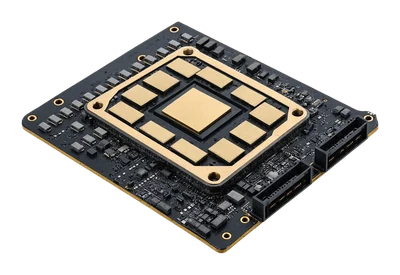
MI300X
192 GB HBM3 · 5.3 TB/s
$1.65/hr
Very large models on a single card, on ROCm
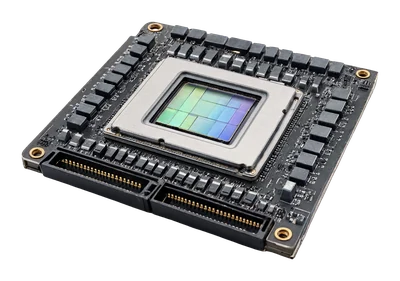
H100 SXM
80 GB HBM3 · 3.35 TB/s
$1.85/hr
AI training, fine-tuning and production LLM inference
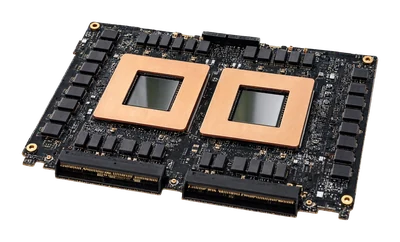
H200 SXM
141 GB HBM3e · 4.8 TB/s
$2.49/hr
Long-context LLM inference and fine-tuning above 70B
B200 SXM
180 GB HBM3e · 8 TB/s
$4.15/hr
Large-scale training and frontier model inference
GPUBank on-demand prices, all-in. Memory bar scaled to 192 GB.
09 / Rent or buy
Rent or buy an MI300X server
The realistic purchase unit is a whole eight-GPU server, because the MI300X exists only as an OAM module on an eight-socket baseboard. On 16 October 2026 Servermall listed a new Supermicro AS-8125GS-TNMR2 with eight MI300X and 6 TB of DDR5 in stock at 278,193 euros before VAT, about $311,800 at the ECB rate of 15 October, with other configurations up to 378,127 euros228. ServerBuyBack's June 2026 index puts used MI300X modules at $12,000 to $20,000 each and calls the market thin and volatile23. Our model assumes $110,000 of resale after two years for the whole server, eight modules near the bottom of that range plus a little for the chassis, plus 8.5 kW under load (6 kW for the GPUs and 2.5 kW for the rest), $0.15 per kWh and $2,000 a month of colocation. The power, electricity and colocation figures are our assumptions, not quotes.
Owning then costs ($311,800 minus $110,000) divided by 24, or $8,408 a month of capital, plus $2,000 of colocation, plus $1.275 of electricity per node-hour. Renting the same eight GPUs from GPUBank costs $13.20 per node-hour on demand, $8.25 at the effective rate of $1,000 top-ups, and $7,708.80 for a reserved 730-hour month. Break-even against on demand would need $10,408 divided by ($13.20 minus $1.275), or about 873 node-hours a month, which is more hours than a month has, so at a new server's price owning never wins. At $200,000 for a used server with the same resale, break-even falls to about 482 hours a month against on demand, but owning still loses to the reservation and to the bonus-funded rate. Buy only if you can source a server well below new price, keep it busy for years and need the hardware on your own premises.
| Hours a month | Rent at $1.65 | Rent at $1.03 effective | Own | Cheaper |
|---|---|---|---|---|
| 100 | $1,320.00 | $825.00 | $10,535.83 | Rent |
| 200 | $2,640.00 | $1,650.00 | $10,663.33 | Rent |
| 400 | $5,280.00 | $3,300.00 | $10,918.33 | Rent |
| 600 | $7,920.00 | $4,950.00 | $11,173.33 | Rent |
| 730 | $9,636.00 | $6,022.50 | $11,339.08 | Rent |
Servermall, new Supermicro AS-8125GS-TNMR2, 278,193 euros before VAT on 16 Oct 2026, at 1.1208 USD per euro (ECB, 15 Oct 2026)
10 / What to choose
The cheapest MI300X depends on the job.

You serve a 70B model in 16-bit or a 100B to 140B model in FP8
One MI300X on demand or reserved
It fits on one card where an H100 needs two, at $1.65 an hour on demand or $1.32 reserved for a month.

You run checkpointed fine-tuning or evaluation on eight GPUs
GPUBank interruptible or Azure spot
At $0.99 or $1.11 per GPU, each GPU-hour costs 40 percent less than GPUBank on demand or 82 percent less than Azure on demand, as long as the job resumes from a checkpoint.

Your stack depends on TensorRT-LLM, Marlin kernels or custom CUDA
An H100 or H200 instead
Porting costs days to weeks of engineering, more than the $0.20 an hour the MI300X saves against an H100.

Your data must stay in the European Union
Seeweb
The only single-GPU MI300X we found in EU data centres, at 2.35 euros an hour with free traffic.
11 / Questions
What people ask before renting one.
The cheapest MI300X hour we could confirm on a provider's own page on 16 October 2026 is GPUBank's interruptible tier at $0.99 per GPU-hour, and the cheapest non-interruptible one is GPUBank on demand at $1.65 with CPU, RAM, NVMe, an IPv4 address and traffic included2. A Runpod Community marketplace listing at $0.50 appeared on the MadeByAgents tracker on 15 October, but we could not open it on Runpod's own pages and a single cheap listing can be gone within the hour1. Per GPU, Azure spot at $1.11 also looks cheap, but it rents only an eight-GPU VM and can be reclaimed4. Among single-GPU on-demand clouds GPUBank is followed by DigitalOcean at $2.59, Seeweb at about $2.63 and Hot Aisle at $2.99376.
An MI300X costs between about $0.50 and $6.00 per GPU-hour in October 2026, and the mode explains most of that range. Marketplace listings sit around $0.50 to $1.99, spot capacity at $0.99 on GPUBank, $1.11 per GPU on Azure and $1.85 on Vultr, and single-GPU on demand from $1.65 on GPUBank to $3.59 on Spheron114241110. Reserved capacity runs from $1.32 on a GPUBank month to $3.85 on a Cirrascale monthly term, and Azure and Oracle on demand cost $6.00 per GPU, sold as $48.00-an-hour eight-GPU machines125. Aggregator medians differ because each samples different offers, so compare the provider rows rather than an average.
You can rent a single MI300X from GPUBank, DigitalOcean, Seeweb, Hot Aisle and Spheron, and marketplace hosts also rent single cards out of larger servers237610. Azure, Oracle, Vultr, Crusoe, TensorWave, Cirrascale, Cyfuture AI and Denvr sell only the eight-GPU server or a contract for one, so their per-GPU price is one eighth of a bill that is eight times larger11. For a single 70B model in 16-bit, one card is enough, since about 141 GB of weights fits in 192 GB with room for the cache. For models above roughly 170B parameters at 8-bit, or for tensor-parallel training, you need several cards in one machine: GPUBank and Seeweb sell 2, 4 or 8, and DigitalOcean sells 8.
Yes, a 70B model fits on one MI300X in 16-bit precision, which is the main reason to rent this card. Llama 3.3 70B has 70.55 billion parameters, which take about 141 GB at two bytes each, leaving roughly 50 GB of the 192 GB for the KV cache and activations, enough for moderate concurrency at typical context lengths379. The same model in 16-bit does not fit on an 80 GB H100 and leaves almost nothing free on a 141 GB H200. In FP8 it takes about 71 GB and fits an H100 too, so the MI300X's advantage shrinks to cache headroom, which still matters for long contexts and many concurrent users. Larger models such as Mixtral 8x22B or Mistral Large 2 fit on one MI300X in FP84140.
The MI300X is about as fast as the H100 in AMD's own 70B benchmarks, slower in several independent tests and faster on very large models. In MLPerf Inference v4.1 on Llama 2 70B, AMD's table puts eight MI300X at 22,021 tokens per second in the server scenario against 21,605 for eight H10018. AMD's January 2025 tests put it at 0.94 times the H100 on Llama 3.1 70B in FP8 and 1.31 times on 405B18. SemiAnalysis found it beats the H100 only on Llama 3 405B and DeepSeek-V3, and arXiv paper 2510.27583 measured 37 to 66 percent of H100 and H200 performance on Llama 70B2021. For a small LoRA run Spheron timed 34 minutes against the H100's 1810. Benchmark your own workload before committing.
No. As of 16 October 2026 we found no MI300X instance on AWS or Google Cloud in any catalogue or tracker we read, and the only large clouds renting the card are Microsoft Azure and Oracle4511. Azure sells it as the Standard_ND96isr_MI300X_v5 virtual machine with eight GPUs, 96 vCPU and 1,850 GiB of RAM at $48.00 an hour in East US 2, $6.00 per GPU, with spot at $8.8704 for the whole VM and reservations of one or three years415. Oracle prices the BM.GPU.MI300X.8 bare-metal shape at $6 per GPU-hour, again only as a whole eight-GPU node5. A team that needs one or two cards rather than eight will find them only on specialised clouds: GPUBank at $1.65, DigitalOcean at $2.59, Seeweb at about $2.63 and Hot Aisle at $2.99, each billed for the card alone2376.
ROCm is ready for production if your stack is PyTorch, vLLM or SGLang, and not yet if you depend on NVIDIA-only libraries. ROCm 10.1.0 shipped on 5 October 2026 with the MI300X listed as supported alongside PyTorch 2.14, vLLM 0.29 and SGLang 0.5.18 builds, and PyTorch publishes official ROCm wheels2426. TensorRT-LLM has no ROCm build, FlashAttention 3 exists on ROCm only as an FP8 Triton path, and SGLang lists Marlin, GGUF and ModelOpt quantisation as not working on AMD293031. Backend choice matters too: vLLM measured its AITER attention up to 3.82 times faster than the older ROCm path on the MI300X35. On GPUBank, which launches any Docker image, start from a ROCm image such as vLLM's official one rather than the CUDA templates1617.
The MI300X spot price is worth the risk for checkpointed batch work and not for endpoints people depend on. GPUBank's interruptible tier saves 40 percent ($0.99 against $1.65), gives five minutes of notice and a checkpoint hook, stops the machine rather than deleting it and credits 30 minutes if the notice is missed2. Azure spot at $1.11 per GPU saves 82 percent against its own $6.00 on-demand price, but comes as an eight-GPU VM with quota to request4. Seeweb's spot terminates the instance after a two-minute notice, and its page shows no spot price below the standard one7. With checkpoints every 30 minutes and a 5 percent rework allowance, 100 eight-GPU hours with 2 TB of disk cost about $892 on GPUBank spot against $1,380 on demand.
The MI300X is cheaper than the H100 on every provider we checked that sells both, because fewer buyers compete for it and its software is less mature, so sellers price it to win customers away from CUDA. On GPUBank it costs $1.65 against $1.85 for the H100 SXM2. On DigitalOcean the gap is wider, $2.59 against $4.41 per GPU for an H100 Droplet, even though the MI300X has 192 GB of memory against 803. SemiAnalysis argued in 2025 that the MI300X needed to cost under $2.10 to $2.40 an hour on one-month contracts to match the H200 on performance per dollar for reasoning workloads, and most specialist clouds now price it below that20. Whether it is cheaper per job depends on the model size, as the performance section shows.
Rent the MI300X unless your model needs between 192 and 256 GB on a single card. The MI325X uses the same CDNA 3 design with 256 GB of HBM3E, so it runs the same ROCm software and adds memory and bandwidth rather than new features3. On DigitalOcean, the main cloud that lists both by the single GPU, the MI325X costs $3.80 an hour on demand against $2.59 for the MI300X, 47 percent more, and $2.88 against $1.91 on a 12-month reservation3. On GPUBank the MI300X costs $1.65 with the whole machine included2. A 70B model in 16-bit, a 100B to 140B model in FP8 or a 235B mixture of experts at 4-bit already fits in 192 GB with room for the cache, so the extra 64 GB pays only for longer contexts, larger batches or models just beyond that line, and for those a machine with two MI300X cards is the other option to price.
A month of one MI300X running continuously costs $1,204.50 on GPUBank on demand ($1.65 times 730 hours), $963.60 on a GPUBank monthly reservation, $1,890.70 on DigitalOcean on demand, $1,394.30 on DigitalOcean's 12-month reservation, about $1,923 on Seeweb and $2,182.70 on Hot Aisle2376. Add storage where it bills separately: on GPUBank, 200 GB of persistent disk adds $6.00. Funding GPUBank through $1,000 top-ups, which carry a 60 percent bonus, brings the cash cost of an on-demand month to about $7532. An eight-GPU month on Azure or Oracle at $48.00 an hour costs $35,040 before disks and egress45.
Whether a stopped MI300X bills depends entirely on the provider, and this is where many invoices go wrong. On GPUBank a stopped machine bills only its persistent disk at $0.03 per GB-month, so compute, the IPv4 address and the local NVMe cost nothing while it is stopped2. On DigitalOcean a powered-off GPU Droplet bills its full rate until it is destroyed, and destroying it discards the scratch disk3. Spheron's MI300X instances cannot be stopped at all, only destroyed10. Seeweb and Hot Aisle do not state the stopped-state charge on the pages we read, and on Azure a deallocated VM stops its compute meter while its managed disks keep billing. If you work in bursts, compare the stopped-state charge before comparing hourly rates.
Per-second billing means a 61-minute job costs 61 minutes, while hourly rounding bills the same job as 120 minutes, 97 percent more. On GPUBank a 61-minute session costs $1.65 times 61 divided by 60, or $1.68, and a 90-second test about $0.04, with no minimum2. DigitalOcean bills per second with a 5-minute minimum, which only affects very short tests3. Hot Aisle bills by the minute6. Spheron's 20-minute minimum makes even a 5-minute test cost $1.20 at $3.5910. Seeweb bills by the hour and does not say how it rounds a partial hour; across 40 development sessions of 61 minutes, minute rounding there would come to about $107 a month and hour rounding to about $2117.
Buying a new MI300X server is not cheaper than renting from GPUBank even at full use, on our assumptions. A new eight-GPU Supermicro server was listed at 278,193 euros before VAT on 16 October 2026, about $311,800228. With $110,000 of resale after two years, 8.5 kW at an assumed $0.15 per kWh and an assumed $2,000 a month of colocation, owning costs about $10,408 a month plus $1.275 per node-hour. Renting eight GPUs from GPUBank costs $13.20 per node-hour on demand, so break-even would need about 873 hours a month, more than a month has, and a reserved month at $7,708.80 is cheaper still2. A used server near $200,000 brings break-even against on demand to about 482 hours, but owning still loses to the reservation.
Seeweb is the only provider we found renting single MI300X GPUs from EU data centres, at 2.35 euros an hour from its Italian sites with traffic free and commitments down to 2.00 euros for twelve months7. GPUBank's European regions, Paris and Frankfurt, do not carry the MI300X; it lists the card only in Ashburn16. Azure lists the ND MI300X v5 in 17 regions according to CloudPrice, at up to $7.86 per GPU outside East US 2 on GetDeploying, and Oracle prices the shape at $6 per GPU-hour, both only as eight-GPU machines15115. For EU data residency on one card, Seeweb is the practical choice, and for a full node the large clouds' European regions are the alternative.
Sources
Sources
- 01MadeByAgents, GPU rental pricesRunpod Community MI300X at $0.50 (aggregator, refreshed 15 Oct 2026) · read 16 Oct 2026
- 02GPUBank pricingMI300X rates, inclusions, billing, spot and reserved terms, top-up bonuses · read 16 Oct 2026
- 03DigitalOcean, GPU Droplets pricingMI300X $2.59 on demand and $1.91 reserved, machine, 5-minute minimum; H100 $4.41; MI325X $3.80 and $2.88 reserved · read 16 Oct 2026
- 04Azure Retail Prices API, Standard_ND96isr_MI300X_v5, East US 2$48.00 on demand, $8.8704 spot, 1-year and 3-year reservations · read 16 Oct 2026
- 05Oracle Cloud Infrastructure, GPU computeMI300X at $6 per GPU-hour · read 16 Oct 2026
- 06Hot Aisle pricing$2.99 VMs, $3.39 bare metal, specs, per-minute billing · read 16 Oct 2026
- 07Seeweb, Cloud Server GPUMI300X at 2.35 euros, commitments, free traffic, spot notice · read 16 Oct 2026
- 08European Central Bank, euro reference rates1.1208 USD per euro on 15 October 2026 · read 16 Oct 2026
- 09AMD Instinct MI300X product pageCompute units, memory, bandwidth, TFLOPS, 750 W, OAM, Infinity Fabric · read 16 Oct 2026
- 10Spheron, AMD MI300X and MI355X pricing 2026Spheron $3.59 snapshot of 17 Sep, billing minimum, Vultr terms, LoRA timing · read 16 Oct 2026
- 11GetDeploying, AMD MI300X rental pricesRunpod, Cyfuture AI, TensorWave, Vultr, Denvr rows and stock status (aggregator, 15 Oct 2026) · read 16 Oct 2026
- 12Cirrascale pricing8x MI300X server at $17,999 annual and $22,499 monthly · read 16 Oct 2026
- 13Crusoe Cloud pricingMI300X $3.45 per GPU-hour, disk prices, no egress fees · read 16 Oct 2026
- 14ComputePrices, MI300XVultr $1.75, OpenRelay, Aquanode, AtmosCompute rows (aggregator, 15 Oct 2026) · read 16 Oct 2026
- 15CloudPrice, Standard_ND96isr_MI300X_v596 vCPU, 1,850 GiB RAM, 17 regions · read 16 Oct 2026
- 16GPUBank, GPU board, regions and templatesMI300X listed in Ashburn only, templates and their CUDA builds, any Docker image, median launch time · read 16 Oct 2026
- 17vLLM documentation, GPU installation (ROCm)MI300 (gfx942) support, ROCm 6.3 or above, official ROCm images · read 16 Oct 2026
- 18AMD ROCm blog, Best practices for competitive inference optimization on MI300X0.94x and 1.31x vs H100, MLPerf v4.1 server table, software versions · read 16 Oct 2026
- 19EE Times, AMD and Untether take on Nvidia in MLPerf benchmarksSingle MI300X 3,062.72 tok/s offline and 2,520.27 server; 8x 21,028.2 server · read 16 Oct 2026
- 20SemiAnalysis, AMD vs NVIDIA Inference Benchmark: Who Wins?MI300X vs H100 and H200, pricing threshold, 23 May 2025 · read 16 Oct 2026
- 21Ambati and Diep, arXiv 2510.2758337 to 66 percent of H100/H200 on Llama 70B, 45 percent of peak FLOPs · read 16 Oct 2026
- 22Servermall, AMD Instinct MI300X GPU serversNew 8x MI300X servers from 278,193 euros before VAT · read 16 Oct 2026
- 23ServerBuyBack, GPU resale value indexUsed MI300X $12,000 to $20,000, June 2026 · read 16 Oct 2026
- 24AMD, ROCm Core SDK 10.1.0 release notesRelease date, gfx942 support, PyTorch, JAX, vLLM and SGLang versions · read 16 Oct 2026
- 25GitHub, ROCm/TheRock releasestherock-10.1 published 5 October 2026 · read 16 Oct 2026
- 26PyTorch wheel indextorch 2.14.1 builds for ROCm 7.2 and 7.14 · read 16 Oct 2026
- 27triton-lang, Triton READMEAMD GPUs on ROCm 6.2+ as supported hardware; v3.8.0 · read 16 Oct 2026
- 28bitsandbytes documentation, installationROCm support, gfx942 in PyPI wheels · read 16 Oct 2026
- 29NVIDIA, TensorRT-LLM READMEInference library for NVIDIA GPUs · read 16 Oct 2026
- 30Dao-AILab, flash-attention READMEROCm CK and Triton backends, MI300 support, FA3 FP8 via Triton · read 16 Oct 2026
- 31SGLang documentation, AMD GPUsMI300X setup, quantisation methods that do not work on AMD · read 16 Oct 2026
- 32Hugging Face, text-generation-inference READMEMaintenance mode, AMD MI210 and MI250 named · read 16 Oct 2026
- 33DeepSpeed READMEhipcc builds, tested on MI100 and MI200; v0.19.7 · read 16 Oct 2026
- 34facebookresearch, xFormers READMEExperimental ROCm wheel; v0.0.35 · read 16 Oct 2026
- 35vLLM blog, Beyond Porting: How vLLM Orchestrates High-Performance Inference on AMD ROCmAITER backends, 3.82x on MI300X, vLLM 0.14.0rc2 on ROCm 7.0 · read 16 Oct 2026
- 36ggml-org, llama.cpp READMEHIP backend for AMD GPUs · read 16 Oct 2026
- 37Hugging Face, meta-llama/Llama-3.3-70B-Instruct70.55 billion parameters · read 16 Oct 2026
- 38Hugging Face, Qwen/Qwen2.5-72B-Instruct72.71 billion parameters · read 16 Oct 2026
- 39Hugging Face, meta-llama/Llama-4-Scout-17B-16E-Instruct108.64 billion parameters · read 16 Oct 2026
- 40Hugging Face, mistralai/Mistral-Large-Instruct-2411122.61 billion parameters · read 16 Oct 2026
- 41Hugging Face, mistralai/Mixtral-8x22B-Instruct-v0.1140.63 billion parameters · read 16 Oct 2026
- 42Hugging Face, Qwen/Qwen3-235B-A22B235.09 billion parameters · read 16 Oct 2026
What we could not confirm
Several rows rest on aggregators because the provider's page could not be read or shows no price: Runpod Community at $0.50 (MadeByAgents), OpenRelay, Aquanode and AtmosCompute (ComputePrices), Cyfuture AI, TensorWave, Runpod Secure Cloud and the Vultr spot cluster (GetDeploying), and Vultr's $1.75, whose term Spheron gives as a 24-month prepay; Vultr's own page refused our requests. Stock status for Hot Aisle, Crusoe, Vultr and Runpod comes from GetDeploying, since launching needs an account. The Vast.ai $0.49 listing and Clore.ai's $1.96 reserved node in our starting data no longer appear anywhere we could read. Seeweb's spot price is not shown below its standard rate, and neither Seeweb nor Hot Aisle states what a stopped instance costs or, for Seeweb, how a partial hour is rounded. Absolute MLPerf v4.1 offline figures for the H100 and H200 could not be read on a primary page, so the chart uses AMD's server table. Spheron's LoRA timing has no published software versions. The resale value, the 2.5 kW beyond the GPUs, the electricity price and the colocation fee in the rent-or-buy model are our assumptions, and no used eight-GPU server price could be read on a seller's page.
MI300X on GPUBank
192 GB on one card, billed by the second.
- 24 vCPU, 240 GB RAM, 2 TB NVMe, IPv4 and traffic in $1.65/hr
- Billed by the second after the health check
- Interruptible $0.99, reserved $1.32
 24 vCPU, 240 GB RAM, 2 TB NVMe, IPv4 and traffic in $1.65/hr
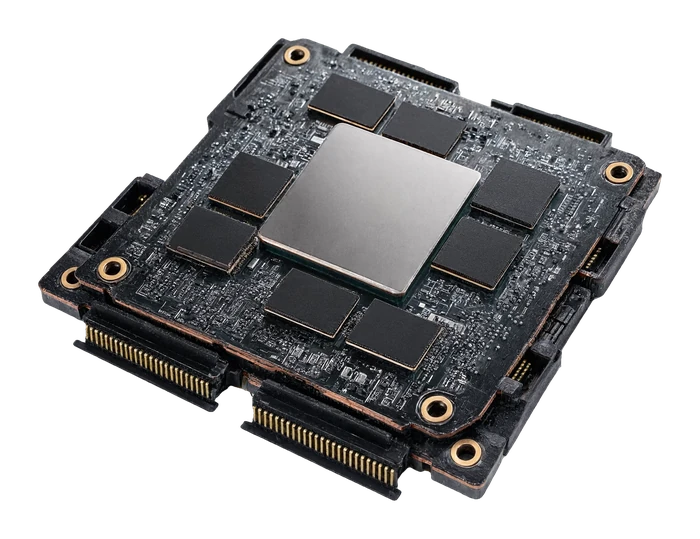
More GPU price guides
Where to rent the other cards at the cheapest price.
B200 SXM180 GB HBM3eFrom $2.49 spot · $4.15 all-inH200 SXM141 GB HBM3eFrom $1.49 spot · $2.49 all-inH100 SXM80 GB HBM3From $1.11 spot · $1.85 all-in H100 PCIe80 GB HBM2eFrom $0.81 spot · $1.35 all-in
 RTX PRO 600096 GB GDDR7 ECCFrom $0.69 spot · $1.15 all-in
 A100 SXM80 GB HBM2eFrom $0.57 spot · $0.95 all-in
 L40S48 GB GDDR6 ECCFrom $0.33 spot · $0.55 all-in
 RTX 509032 GB GDDR7From $0.29 spot · $0.48 all-in
 RTX 409024 GB GDDR6XFrom $0.14 spot · $0.23 all-in