Updated 16 Oct 2026 · 58 offers checked
Where to rent an L40S at the cheapest price
The L40S rents for anything from $0.28 to $3.77 an hour in October 2026, and most of that spread is what each price leaves out. We checked the main offers at source on 16 October, priced three real workloads and worked out where its 48 GB earns a premium.
 SDXL (Juggernaut XL v9) in ComfyUI4.55 s/image26
Whisper large-v3-turbo58.3 x realtime25
FLUX.2 Klein 9B3.31 s/image26
The short answer, 16 Oct 2026
- $0.33/hrCheapest hour you can launch. GPUBank's interruptible L40S costs $0.33 with 16 vCPU, 94 GB of RAM, a 1 TB NVMe disk, an IPv4 address and traffic included, in exchange for five minutes of notice when the card is taken back1. Novita lists spot at $0.28, but every size was out of stock on 15 October2.
- $0.55/hrCheapest whole machine on demand. GPUBank and Novita tie at $0.55 an hour on demand12. GPUBank's price includes the CPU, RAM, NVMe, IPv4 and all traffic with per-second billing, and a $1,000 top-up lowers the effective hour to about $0.341.
- $0.79/hrCheapest marketplace listing. Runpod's Community Cloud, its peer-hosted tier, lists the L40S at $0.79 with 16 vCPU and 94 GB of RAM, and was in stock in 1 and 2-card sizes32. Vast.ai's own page showed no current L40S offers and Lium no longer lists the card45.
The L40S is the card people rent when 24 GB is no longer enough and an H100 is more than the job needs. It carries 48 GB of ECC memory, runs FP8 on its Tensor Cores and is licensed for datacenter use, which is why almost every GPU cloud stocks it as a middle tier for image and video generation, speech transcription, embedding pipelines and the inference of models up to about 30B parameters. GetDeploying tracked 262 L40S price points across 37 providers on 16 October 2026, with a median on-demand price of $1.54 per GPU-hour over 134 configurations2. The cheapest real offers sit near a third of that median, and the gap comes far more from what each price includes, or sells only by the eight-card node, than from any difference in the silicon.
Every price here was first surveyed on 15 October and rechecked on each provider's own pricing page, documentation or console on 16 October 2026, with aggregator figures kept only where the provider's page could not be read and labelled as such in the table. The week had moved several things: Vast.ai's own L40S page showed no current offers, Lium no longer lists the card at all, CloudRift now quotes on-demand capacity only on request, and Runpod's Community Cloud was back in stock4562. GPUBank's figures were read on its own pricing page, updated on 15 October, and it lists the L40S in Paris, Frankfurt, Ashburn and Singapore17.
01 / Cost per output
Where 48 GB pays and where a consumer card wins
The L40S earns its premium over the RTX 4090 and RTX 5090 when memory, not speed, is the constraint. Qwen-Image 2512 in bf16 peaked at 41.4 GB in Runpod's ComfyUI test, so it ran on the L40S in 38.91 seconds while cards under about 46 GB fell back to system memory26; at GPUBank's prices that is about $5.94 per thousand images, cheaper than the A100 SXM's $7.68 even though the A100 is faster, although the RTX PRO 6000 at about $5.76 is cheaper still and twice as quick. Concurrency is the other case. In ComputingForGeeks' vLLM 0.31 test of a 27B model at 4-bit with 32 concurrent requests, the L40S delivered 554 tokens per second with a 3.0 second first token, while the RTX 4090 stalled at 300 because its KV cache held only about 17,000 tokens and never ran more than nine requests at once38. FP8 matters mainly against the A100, which has no FP8 Tensor Cores; the Ada and Blackwell consumer cards run FP8 too, so there the advantage is room, not format.
Where the model is small, the cheaper consumer cards win on cost per output. Whisper turbo needs under 2 GB, and although the L40S is the fastest card in Runpod's test, 1,000 audio hours cost about $9.43 on it at $0.55 against $6.53 on an RTX 4090 at $0.23 and $9.06 on an RTX 5090 at $0.48251. The RTX 5090 also beats the L40S on the 27B test at $0.14 per million tokens against $0.28, and even the throttled RTX 4090 comes out at $0.21, so a team that can keep its context short should rent the consumer card38. The A100 SXM, at $0.95, only matches the L40S per output on batched Llama 3.1 8B in Koyeb's test, about $0.13 per million tokens on both, and loses clearly on images and audio28.

Measured result and cost per output at GPUBank prices
Cheapest per outputFastest measuredNot measured
Measured values as published by each source25263828; the four cards were not all run by the same tester on the same day. Costs use GPUBank's on-demand price per GPU-hour, read on 16 Oct 20261.
- Imagesseconds per image × price ÷ 3,600, shown per 1,000 images
- Tokensprice ÷ (tokens per second × 3,600), shown per million tokens
- Whisperprice ÷ the realtime factor, shown per 1,000 hours of audio
- Marksthe lit cell is the cheapest per output in its row; the bar scales each cost to the row's dearest card
02 / The card
What the L40S is and who rents it
The NVIDIA L40S is an Ada Lovelace datacenter card with 48 GB of GDDR6 with ECC at 864 GB/s, 18,176 CUDA cores and 568 fourth-generation Tensor Cores. NVIDIA rates it at 733 dense TFLOPS in FP8 (1,466 with sparsity), 362 in FP16 and 91.6 in FP32, on a passively cooled dual-slot board that draws up to 350 W through a PCIe Gen4 x16 interface, and it does not support NVLink8. Servers therefore carry four, eight or ten cards that exchange data over PCIe only, which makes the L40S a weak base for multi-node training and a good one for any job that fits on a single card or splits cleanly across two. The L40, without the S, shares the chip family and the 48 GB but has less tensor throughput, rents for less and is a different product, so every figure on this page refers to the L40S alone.
The renters are mostly teams whose work is memory-hungry but not bandwidth-hungry: ComfyUI and video studios running FLUX, Qwen-Image or Wan 2.2 in full precision, transcription and embedding pipelines, and companies serving 7B to 30B models in FP8 to moderate traffic. Because it is a datacenter part, a provider can rent it out without the licence question that follows a GeForce card, whose driver licence excludes datacenter deployment9, and that is why AWS and Oracle stock it next to the specialised clouds. The same reach explains the price range: the card appears as a bare GPU rate on a marketplace, as an all-in instance on a managed cloud, as one eighth of a node at CoreWeave or Gcore, and as a hyperscaler instance priced for customers who already live in that cloud.
03 / The price ladder
How to read the L40S market
Five kinds of offer sell the same card, and a fair comparison keeps them apart. Managed on-demand clouds sell a defined machine at a fixed hourly price, and for the L40S that tier is unusually crowded at the low end: GPUBank and Novita at $0.55, Beam at $0.76, Massed Compute at $0.97 and Runpod's Secure Cloud at $1.09, each with a different amount of CPU, RAM and disk in the price1210113. Peer-to-peer marketplaces, which normally own the lowest headline numbers, were thin this week: Runpod's Community Cloud at $0.79 was the only one in stock, Vast.ai showed no offers on its own page and Clore.ai's only L40S server was already rented in its latest snapshot3412.
Spot and interruptible capacity holds the cheapest hours, from Novita's $0.28 (out of stock on the day) and GPUBank's $0.33 to Nebius preemptible at about $0.75 once its CPU and RAM are counted, while CoreWeave's $0.985 spot rate applies only to a whole eight-card node211314. Reserved capacity lowers the rate as well, though beyond two single-card offers it is usually sold by the server: GPUBank reserves single cards at $0.44 for a week or a month, CloudRift single cards at $0.57 for a month or $0.54 for three, and LeaderGPU rents eight cards for €3,290 a month1615. Serverless offers such as Koyeb at $1.20, Runpod at $1.75 and Modal at about $1.95 for the GPU alone cost two to four times more per hour and only make sense when an endpoint sits idle most of the day16317.
Managed on demandA fixed machine at one hourly price.
MarketplaceHosts set their own price; machines vary.
Spot and interruptibleCheaper hours that can be taken back.
ReservedCommitted for a term, paid either way.
ServerlessBilled by active seconds.
04 / Provider by provider
What each price buys, and what it leaves out.
The captures below were taken on 16 Oct 2026 from each provider's own L40S or pricing page, so every figure can be read next to the conditions printed beside it.
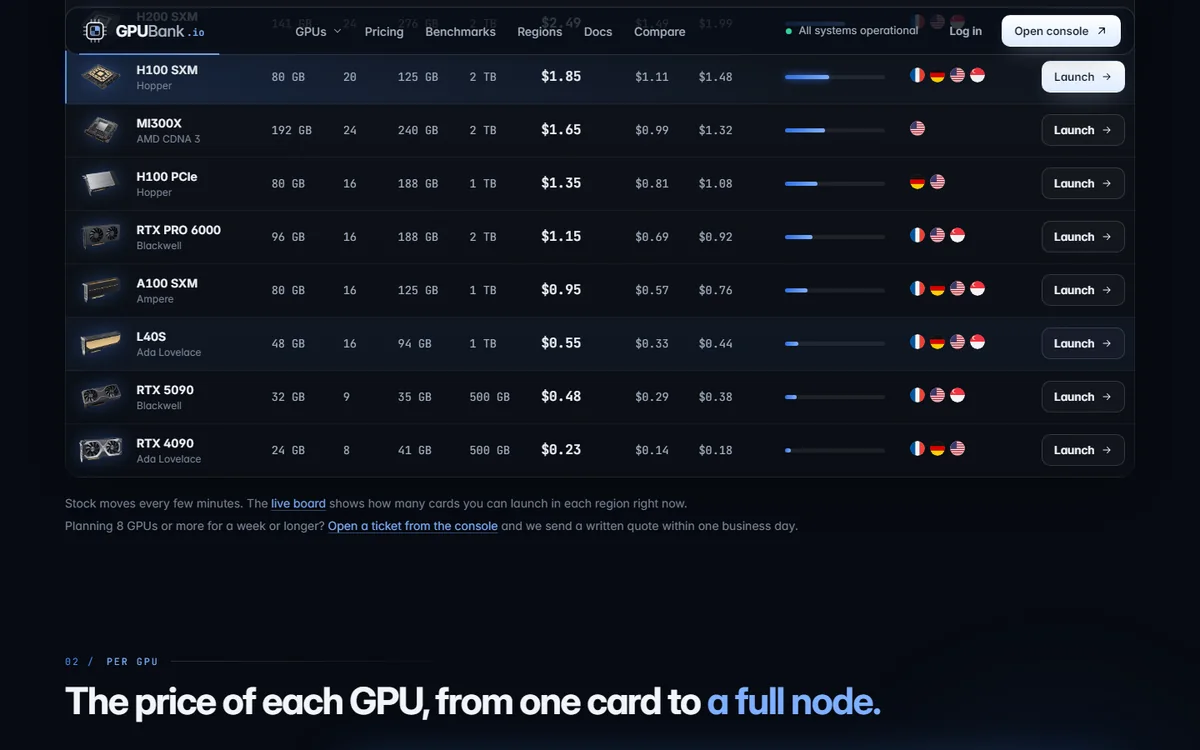
GPUBankAll-in
$0.55/hr
Managed cloud · 1 to 8 GPUs · per second
16 vCPU94 GB RAM1 TB NVMeIPv4 and trafficInterruptible $0.33Reserved $0.44
GPUBank rents the L40S at $0.55 per GPU-hour on demand, $0.000153 a second or $401.50 for a 730-hour month, with 16 vCPU, 94 GB of RAM, a 1 TB local NVMe disk, one public IPv4 address and all inbound and outbound traffic in the price; the only other charge is a persistent disk at $0.03 per GB-month1. Billing starts once the machine passes its health check, a failed launch is not billed, and a host that fails mid-job is replaced with the same disk and the session credited. Interruptible capacity costs $0.33 with five minutes of notice and a stop rather than a deletion, and reservations of a week or a month cost $0.44 on cards set aside, cancellable before they start. Machines come with 1 to 8 cards in Paris, Frankfurt, Ashburn and Singapore, and the median time from launch to a machine that has passed its health check is 48 seconds7. Payment is a prepaid balance topped up in crypto from $25 to $5,000, with bonuses from 20 to 60 percent.1
Checked 16 Oct 2026
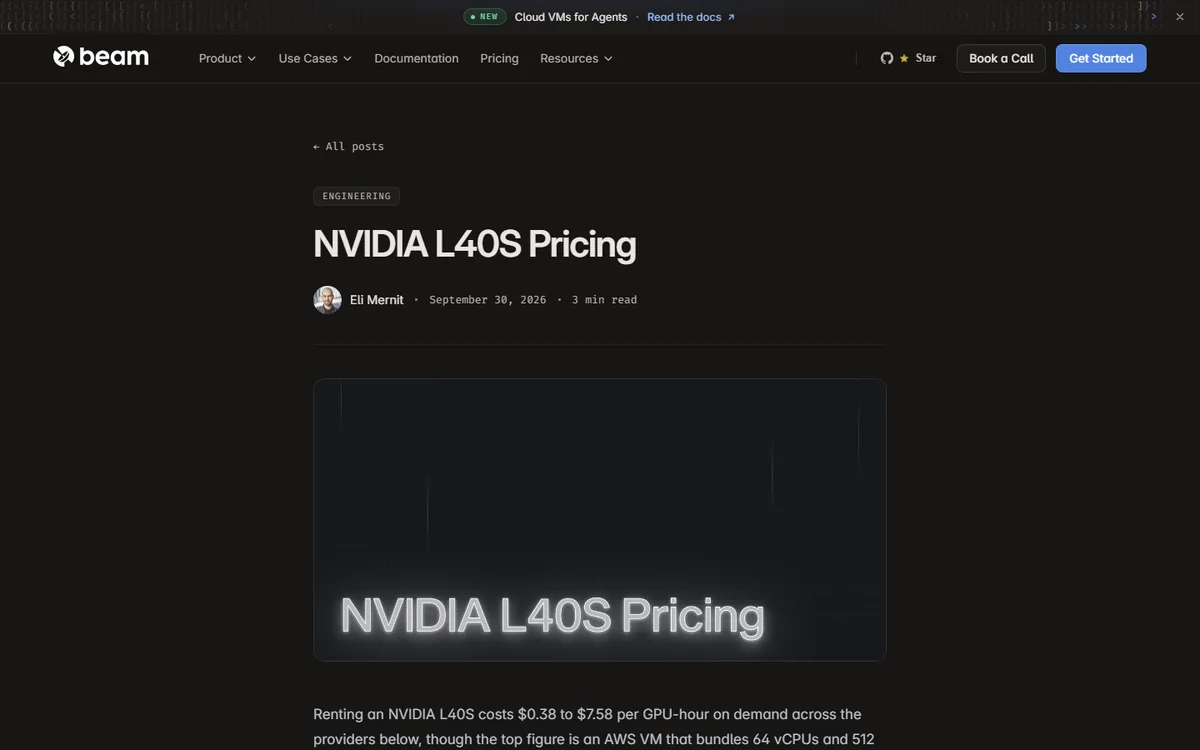
 Beam
$0.76/hr
Managed cloud · on-demand machines
12 vCPU96 GB RAMNVMeStock not published
Beam's own pricing post, published on 29 September 2026, lists its L40S at $0.76 per GPU-hour with vCPU, RAM and NVMe storage included, and GetDeploying shows the configuration as 12 vCPU and 96 GB of RAM per card102. That makes it the cheapest managed offer above the $0.55 pair and one of the few that states a full machine in its price, so it compares with an all-in rate rather than with a marketplace GPU figure. Neither Beam's page nor the aggregator reported whether the card was in stock on the day, so a buyer should check the console before planning a month around it. The price applies to Beam's on-demand machines rather than to its serverless functions, which are billed differently. At $0.76 a full 730-hour month costs $554.80, about $153 more than GPUBank's on-demand rate and $233 more than its reservation, for a machine with less CPU but slightly more RAM.10
Checked 16 Oct 2026
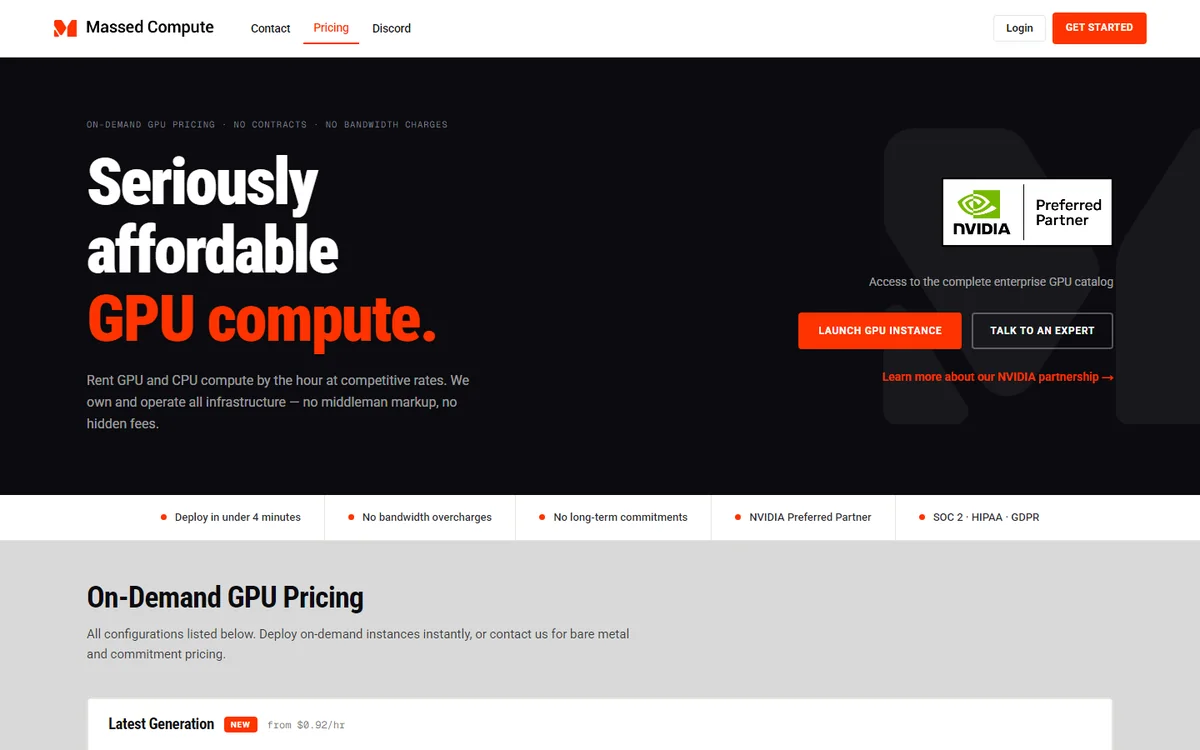
 Massed Compute
$0.97/hr
Managed cloud · 1 to 8 GPUs · US
12 vCPU72 GB RAM625 GB storageIn stock in every size
Massed Compute's own price list shows the L40S at $0.97 an hour for one card with 12 vCPU, 72 GB of RAM and 625 of storage, in gigabytes by implication since the page prints no unit, scaling linearly to $7.76 an hour for eight cards with 94 vCPU and 576 GB of RAM11. GetDeploying showed every size in stock on 15 October, which makes it one of the more dependable sources of L40S capacity in the United States this week2. The same capacity also reaches the market through brokers and marketplaces such as Prime Intellect and Spheron at different prices, so the same machine can appear several times in an aggregator's list. The price is 76 percent above GPUBank's on-demand rate with less CPU and RAM per card, but it is a straightforward per-GPU offer with no node minimum, and for teams that want US-only capacity from a provider that publishes its stock it is a reasonable second source.11
Checked 16 Oct 2026
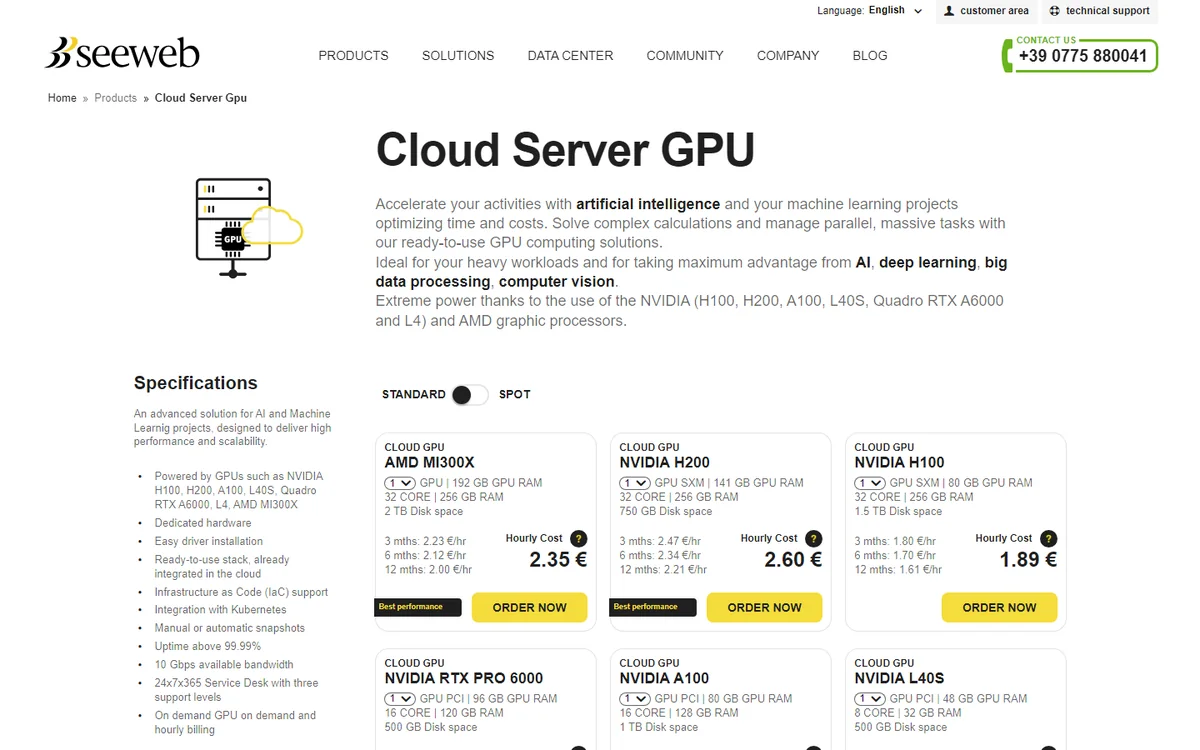
 Seeweb
€0.85/hr
Managed cloud · Italy · hourly
8 cores32 GB RAM500 GB diskFree traffic€0.72 on 12 monthsPrices excl. VAT
Seeweb, an Italian cloud with datacenters in Milan and Frosinone, lists the L40S at €0.85 an hour excluding VAT, about $0.95, with 8 CPU cores, 32 GB of RAM, a 500 GB disk and free network traffic1819. Commitments lower the rate to €0.81 for three months, €0.77 for six and €0.72 for twelve, and its page advertises spot savings of up to 40 percent with a two-minute notice before an interruptible instance is terminated, although no separate spot price was shown when we read it. Billing is by the hour with no advance payment and starts after activation, so it suits sessions measured in hours rather than minutes. The machine around the card is the leanest of the managed offers here, which matters for data loading and preprocessing, but for buyers who need their data and their invoice inside the EU, in euros and from a European company, it is one of the cheaper options on the continent.18
Checked 16 Oct 2026
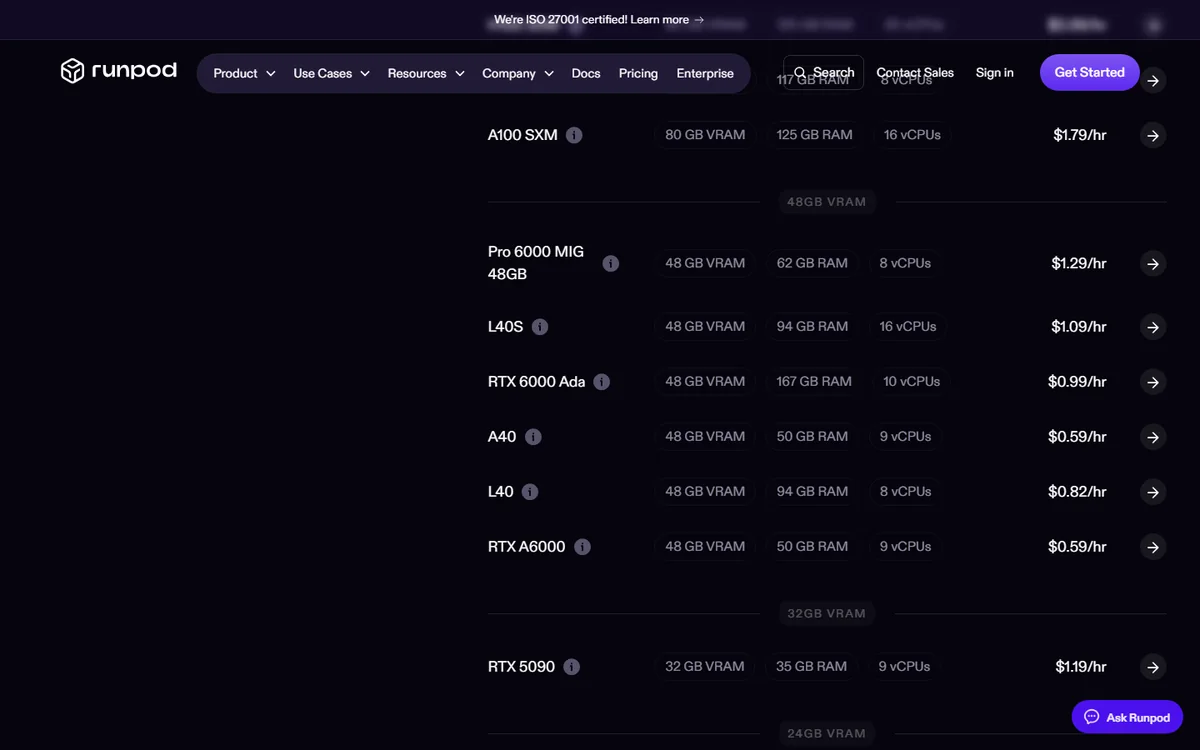
 Runpod
$0.79/hr
Community and Secure Cloud · per second
16 vCPU94 GB RAMSecure Cloud $1.09Volumes extra
Runpod's pricing page lists the L40S at $0.79 an hour on its Community Cloud, where independent hosts supply the machines, and $1.09 on its Secure Cloud in Runpod's partner datacenters, both with 16 vCPU and 94 GB of RAM per card and billed per second3. GetDeploying showed the Community tier in stock in 1 and 2-card sizes and the Secure tier in 1, 2 and 4-card sizes on 15 October, which made Runpod Community the only peer-hosted L40S we could find in stock this week2. Disks are billed separately: $0.07 per GB-month for network storage under 1 TB, $0.10 for a volume disk while running and $0.20 while idle, so a pod kept with its models between sessions costs noticeably more than its hourly rate suggests. Its serverless workers for the 48 GB class are listed at $1.75 an hour, which only pays off for an endpoint that sits idle most of the day.3
Checked 16 Oct 2026
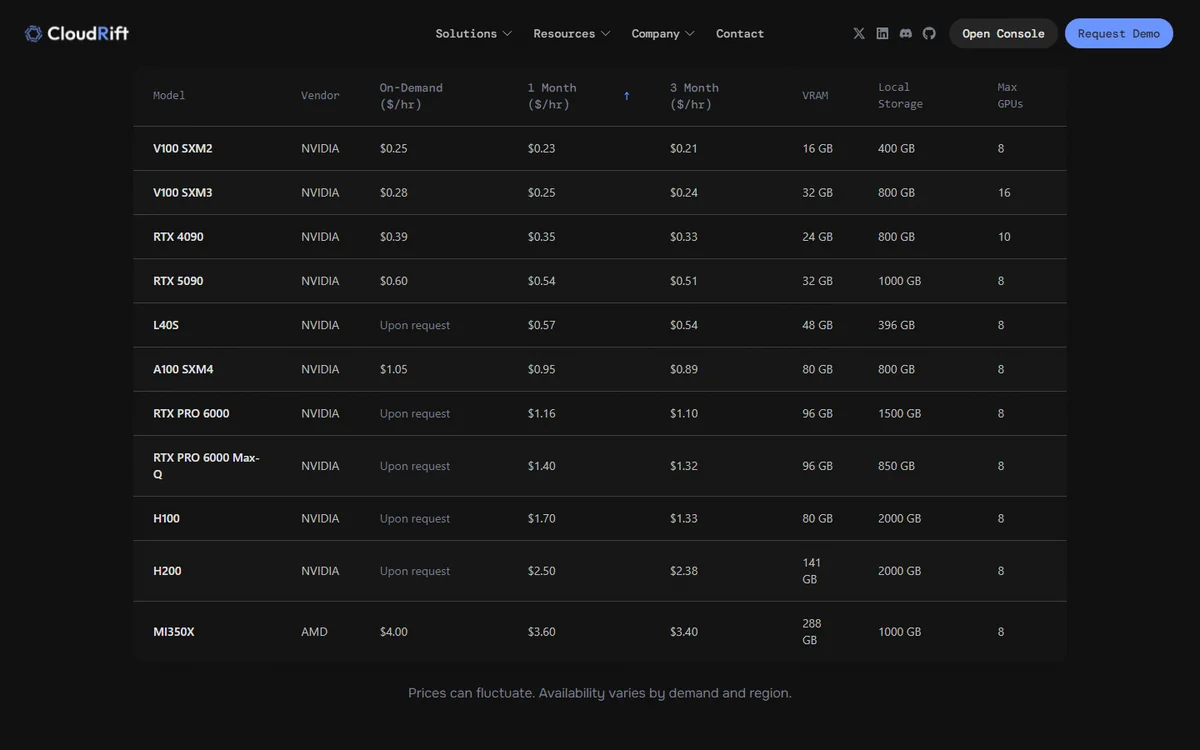
 CloudRift
$0.54/hr
Reserved only · 1 to 8 GPUs
396 GB local storageNetworkingEgressOn demand on request1 week to 3 months
CloudRift has moved the L40S to a reserved-only model since our September survey: its own pricing page now quotes on-demand capacity on request and lists reservations at $0.57 per GPU-hour for one month and $0.54 for three, with up to eight cards per instance and 396 GB of local storage per card6. The hourly price covers compute, the attached storage, networking and standard support, with no separate egress, ingress or API charges, and terms of a week, a month or three months can be chosen in the console, with one-year terms by contact. The page warns that prices fluctuate and availability varies by demand and region. A one-month reservation of a single card costs $416.10, about $95 more than GPUBank's $0.44 monthly reservation; the three-month term comes closer, at $394.20 a month, in exchange for a longer commitment. For buyers who already know they need a card for a quarter, it is the main single-card alternative.6
Checked 16 Oct 2026
Where GPUBank wins, and where it does not
GPUBank wins on the L40S where the comparison is a single card with the whole machine priced in. Its $0.55 on-demand rate ties Novita for the lowest managed price we found, with 16 vCPU, 94 GB of RAM, a 1 TB NVMe disk, an IPv4 address and all traffic included, per-second billing from the moment the health check passes, and no charge for a failed launch1. The $0.33 interruptible tier was the cheapest L40S hour that could actually be launched on 16 October, and the $0.44 weekly or monthly reservation is the lowest single-card reservation we found, below CloudRift's $0.54 three-month term. Top-up bonuses lower the effective on-demand hour to about $0.46 with $25, $0.41 with $100 and $0.34 with $1,000, and the balance never expires1.
It loses in several places. Novita gives more CPU and RAM for the same $0.55 when it has stock, and its $0.28 spot tier beats GPUBank's interruptible price whenever it reappears2. Payment is a prepaid balance topped up in crypto from $25, with no card payments for now, which rules GPUBank out for teams that must pay by invoice or card. Buyers who can fill a whole eight-card server for a month can look at LeaderGPU's dedicated machine, and anyone who needs an RDMA cluster, a hyperscaler's surrounding services or a region outside Paris, Frankfurt, Ashburn and Singapore will be better served elsewhere157. On transcription and on batched LLM serving, GPUBank's own RTX 4090 and RTX 5090 often cost less per output than its L40S, as the comparison further down shows.
The rest of the market
Novita deserves the first mention outside the cards above, because it matches GPUBank's $0.55 on demand with 22 vCPU and 125 GB of RAM per card, and GetDeploying showed it in stock in 1, 2, 4 and 8-card sizes on 16 October, with its $0.28 spot tier sold out in every size2. We could not read Novita's own console without an account, so the figure rests on the aggregator, and a buyer should check stock there before planning around it. Further up the managed tier, GetDeploying listed GPU.ai at $0.79 in stock, Packet.ai at $0.92 on a waitlist, Hostinger at $0.96 with no stock reported and Sesterce at $0.97 in stock with 12 vCPU and 72 GB of RAM2. Seeweb's own page lists the L40S at €0.85 an hour excluding VAT, about $0.95, with 8 cores, 32 GB of RAM, a 500 GB disk and free traffic in Italy, falling to €0.72 on a twelve-month commitment1819.
Between roughly $1.20 and $1.60 sit UpCloud at $1.19 on a two-card server, Civo at $1.29 with every size in stock on its own page, Lyceum at $1.45, Crusoe at $1.50 and Nebius at $1.35 for the GPU alone, which its own documentation prices with $0.012 per vCPU-hour and $0.0032 per GiB-hour on top, about $1.55 for the smallest 8 vCPU and 32 GB preset in eu-north122013. DigitalOcean at $1.57, Scaleway at $1.65 on a two-card server and Vultr at $1.67 come next, the last two out of stock, followed by a band of European and Indian clouds between $1.78 and $2.21: Hikube, EmpirioLabs, Hugging Face and OVHcloud near $1.80, AceCloud at $1.87, Spheron at $2.11, CloudFerro and Elastx at $2.212. Some clouds only sell the whole node: CoreWeave at $18.00 an hour for eight cards ($2.25 each), Gcore at $1.43 and Cyfuture at $1.26 per GPU on eight-card servers142. Every one of these offers appears in the table below with what its price includes.
The large clouds, per GPU inside their instances
AWS sells the L40S in its G6e family. The g6e.xlarge, with one card, 4 vCPU, 32 GiB of RAM and a 250 GiB instance store, costs $1.861 an hour on demand in us-east-1, $1.172 on a one-year reservation and $0.804 on a three-year one, and its spot price stood at $1.829 when we read it, barely below on-demand21. That single-card instance is the cheapest hyperscaler L40S hour, but it buys very little CPU; the g6e.4xlarge, which gives the same card 16 vCPU and 128 GiB, closer to what the specialised clouds include, costs $3.004, and the eight-card g6e.48xlarge costs $30.131, or $3.77 per GPU22. EBS volumes and internet egress are billed on top of all of these.
Oracle rents the L40S as the BM.GPU.L40S.4 bare-metal shape with four cards, 1 TB of RAM and RDMA networking at $14.00 an hour, or $3.50 per GPU, a figure we could read only on trackers because Oracle's price list blocked our fetch232. We found no public L40S virtual machine on Microsoft Azure or Google Cloud; both build their public GPU families on other cards. The large clouds are worth their premium when your data, identity and networking already live there or when you need an RDMA cluster of L40S nodes, but at three to seven times a specialised cloud's per-GPU price they are not where this card is cheap.
05 / Every offer
The whole comparison, sorted by kind and price.
| Provider | USD / GPU-hr | Kind | Unit | What the price includes | Billing | Stock | Basis |
|---|---|---|---|---|---|---|---|
| GPUBank | $0.55 | Managed on demand | 1 GPU | 16 vCPU, 94 GB RAM, 1 TB NVMe, IPv4, traffic | Per second | In stock | Provider page1 |
 Novita AI | $0.55 | Managed on demand | 1 GPU | 22 vCPU, 125 GB RAM | Not stated | In stock | Aggregator2 |
| Beam | $0.76 | Managed on demand | 1 GPU | 12 vCPU, 96 GB RAM, NVMe | Not stated | Not stated | Provider page10 |
| GGPU.ai | $0.79 | Managed on demand | 1 GPU | Machine not listed | Not stated | In stock | Aggregator2 |
| PPacket.ai | $0.92 | Managed on demand | 1 GPU | Machine not listed | Not stated | Waitlist | Aggregator2 |
| Seeweb | $0.95 | Managed on demand | 1 GPU | €0.85 excl. VAT; 8 cores, 32 GB RAM, 500 GB disk, traffic | Hourly | Not stated | Provider page18 |
| HHostinger | $0.96 | Managed on demand | 1 GPU | Machine not listed | Not stated | Not reported | Aggregator2 |
| Massed Compute | $0.97 | Managed on demand | 1 GPU | 12 vCPU, 72 GB RAM, 625 GB storage | Not stated | In stock | Provider page11 |
 Sesterce | $0.97 | Managed on demand | 1 GPU | 12 vCPU, 72 GB RAM | Not stated | In stock | Aggregator2 |
| Runpod Secure Cloud | $1.09 | Managed on demand | 1 GPU | 16 vCPU, 94 GB RAM; disks extra | Per second | In stock | Provider page3 |
 UpCloud | $1.19 | Managed on demand | 2-GPU server | 12 CPU, 128 GB RAM | Not stated | In stock | Aggregator2 |
| CCyfuture AI | $1.26 | Managed on demand | 8-GPU node | 64 vCPU, 1.5 TB RAM | Not stated | Not reported | Aggregator2 |
 Civo | $1.29 | Managed on demand | 1 GPU | Ingress and egress included | Hourly | In stock | Provider page20 |
 Gcore | $1.43 | Managed on demand | 8-GPU node | 192 vCPU, 2 TB RAM, bare metal | Not stated | Not reported | Aggregator2 |
| LLyceum | $1.45 | Managed on demand | 1 GPU | 12 vCPU, 128 GB RAM | Not stated | In stock, 1 or 2 GPUs | Aggregator2 |
 Crusoe | $1.50 | Managed on demand | 1 GPU | 8 vCPU, 147 GB RAM | Not stated | In stock | Aggregator2 |
 Nebius | $1.55 | Managed on demand | 1 GPU | $1.35 GPU plus 8 vCPU and 32 GiB metered | Not stated | Not stated | Provider page13 |
 DigitalOcean | $1.57 | Managed on demand | 1 GPU | 8 vCPU, 64 GB RAM | Not stated | Not reported | Aggregator2 |
 Scaleway | $1.65 | Managed on demand | 2-GPU server | 16 vCPU, 192 GB RAM | Not stated | Sold out | Aggregator2 |
 Vultr | $1.67 | Managed on demand | 1 GPU | 16 vCPU, 180 GB RAM | Not stated | Sold out | Aggregator2 |
| HHikube | $1.78 | Managed on demand | 1 GPU | 8 vCPU, 32 GB RAM | Not stated | Not reported | Aggregator2 |
| EEmpirioLabs | $1.80 | Managed on demand | 1 GPU | 12 vCPU, 72 GB RAM | Not stated | In stock | Aggregator2 |
| HHugging Face | $1.80 | Managed on demand | 1 GPU | 8 vCPU, 62 GB RAM | Not stated | Not reported | Aggregator2 |
 OVHcloud | $1.80 | Managed on demand | 1 GPU | 15 vCPU, 90 GB RAM | Not stated | Not reported | Aggregator2 |
 AceCloud | $1.87 | Managed on demand | 1 GPU | 16 vCPU, 64 GB RAM, Mumbai | Not stated | Not reported | Aggregator2 |
 Spheron | $2.11 | Managed on demand | 1 GPU | 8 vCPU, 32 GB RAM | Not stated | In stock | Aggregator2 |
| CCloudFerro | $2.21 | Managed on demand | 1 GPU | 32 vCPU, 128 GB RAM | Not stated | Not reported | Aggregator2 |
| EElastx | $2.21 | Managed on demand | 1 GPU | 12 vCPU, 180 GB RAM | Not stated | Not reported | Aggregator2 |
 CoreWeave | $2.25 | Managed on demand | 8-GPU node | 128 vCPU, 1,024 GB RAM, 7.68 TB per node | Not stated | Not stated | Provider page14 |
| Runpod Community Cloud | $0.79 | Marketplace | 1 GPU | 16 vCPU, 94 GB RAM; disks extra | Per second | In stock | Provider page3 |
| Novita AI | $0.28 | Spot and interruptible | 1 GPU | 28 vCPU, 125 GB RAM | Not stated | Sold out | Aggregator2 |
| GPUBank | $0.33 | Spot and interruptible | 1 GPU | As on demand; 5 min notice, disk kept | Per second | In stock | Provider page1 |
| Nebius | $0.75 | Spot and interruptible | 1 GPU | $0.65 GPU plus 8 vCPU and 32 GiB metered | Not stated | Not stated | Provider page13 |
| LLyceum | $0.79 | Spot and interruptible | 1 GPU | 12 vCPU, 128 GB RAM | Not stated | Sold out | Aggregator2 |
 Verda | $0.85 | Spot and interruptible | 1 GPU | 20 vCPU, 60 GB RAM | Not stated | Sold out | Aggregator2 |
| UpCloud | $0.89 | Spot and interruptible | 1 GPU | Sold as a 2-GPU server, 12 CPU, 128 GB RAM | Not stated | In stock | Aggregator2 |
| CoreWeave | $0.985 | Spot and interruptible | 8-GPU node | $7.88 per node-hour, North America | Not stated | Not stated | Provider page14 |
| Spheron | $1.05 | Spot and interruptible | 1 GPU | 8 vCPU, 32 GB RAM | Not stated | In stock | Aggregator2 |
| CCloudFerro | $1.11 | Spot and interruptible | 1 GPU | 32 vCPU, 128 GB RAM | Not stated | Not reported | Aggregator2 |
| Vultr | $1.49 | Spot and interruptible | 8-GPU node | 128 vCPU, 2 TB RAM, bare metal | Not stated | Sold out | Aggregator2 |
| GPUBank | $0.44 | Reserved | 1 GPU | As on demand; week or month, prepaid | Per term | In stock | Provider page1 |
| CloudRift | $0.54 | Reserved | 1 GPU | Three months; 396 GB storage, networking | Per term | Not stated | Provider page6 |
| CloudRift | $0.57 | Reserved | 1 GPU | One month; 396 GB storage, networking | Per term | Not stated | Provider page6 |
| CCyfuture AI | $0.61 | Reserved | 8-GPU node | 12 months; 64 vCPU, 1.5 TB RAM | Per term | Not stated | Aggregator2 |
 LeaderGPU | $0.63 | Reserved | 8-GPU node | €3,290 a month excl. VAT; 2 Xeon Gold 6248R, 768 GB RAM | Monthly | Not stated | Provider page15 |
| LLeaseweb | $0.67 | Reserved | 1 GPU | One month; sold as a 2-GPU dedicated server | Monthly | Not stated | Aggregator2 |
| Seeweb | $0.80 | Reserved | 1 GPU | €0.72 on 12 months excl. VAT | Hourly | Not stated | Provider page18 |
| Civo | $0.89 | Reserved | 1 GPU | 36-month commitment | Per term | In stock | Provider page20 |
 Clore.ai | $1.04 | Reserved | 8-GPU node | 360-day contract, bare metal; $1.40 on 30 days | Per term | Not stated | Provider snapshot12 |
| AceCloud | $1.37 | Reserved | 1 GPU | 12 months; 16 vCPU, 64 GB RAM | Per term | Not reported | Aggregator2 |
 AWS g6e.xlarge | $1.86 | Large clouds | 1 GPU | 4 vCPU, 32 GiB, 250 GiB instance store; EBS and egress extra | Per second | Not stated | Aggregator21 |
 Oracle Cloud | $3.50 | Large clouds | 4-GPU node | BM.GPU.L40S.4, 4 GPUs bare metal, RDMA | Not stated | Not stated | Aggregator23 |
| AWS g6e.48xlarge | $3.77 | Large clouds | 8-GPU node | $30.131 per instance-hour; EBS and egress extra | Per second | Not stated | Aggregator22 |
 Koyeb | $1.20 | Serverless | 1 GPU | 15 vCPU, 64 GB RAM, 160 GB disk | Per second | Not stated | Provider page16 |
| Runpod Serverless | $1.75 | Serverless | 1 GPU | 48 GB worker class; storage extra | Per second | Not stated | Provider page3 |
 Modal | $1.95 | Serverless | 1 GPU | GPU only; CPU and memory metered | Per second | Not stated | Provider page17 |
| CCerebrium | $1.95 | Serverless | 1 GPU | Machine not listed | Per second | Not reported | Aggregator2 |
 Replicate | $3.51 | Serverless | 1 GPU | 10 vCPU, 65 GB RAM | Per second | Not reported | Aggregator2 |
"Aggregator" rows could not be read on the provider's own page that day; "Provider snapshot" rows come from a page dated by the provider.
06 / The real monthly bill
What an L40S hour really costs
Storage is the line that most often separates two offers with similar hourly rates. GPUBank bills only a persistent disk at $0.03 per GB-month, prorated by the hour, and nothing else for a stopped machine1. Runpod charges $0.07 per GB-month for network storage under 1 TB, $0.10 for a volume disk while the pod runs and $0.20 once it sits idle3, so 200 GB of ComfyUI checkpoints cost $6.00 a month on GPUBank, $14.00 on a Runpod network volume and $40.00 on an idle Runpod volume disk. Vast.ai bills each host's storage rate every second an instance exists, including while it is stopped, and charges bandwidth at a per-host rate in both directions, which can matter more than the GPU rate when you move large datasets24. AWS adds EBS and egress to every G6e hour21.
Billing granularity matters on short jobs. A 61-minute run on GPUBank costs 61/60 of $0.55, or $0.56, because the meter counts seconds1, while Seeweb bills by the hour, so the same run can be charged as two hours, €1.7018. Prepaid credit is the other hidden term: GPUBank's bonus turns a $100 top-up into $135 of credit, which is a real discount if you would spend the money anyway and a cost if the balance then sits unused1. The last cost is time lost to failure. When a host fails, GPUBank restarts the machine on a healthy host with the same disk and credits the interrupted session in full1; an interruptible machine there gets five minutes of notice and a checkpoint hook, against two minutes on Seeweb's spot18. On a marketplace, a host that drops out or runs slower than advertised is usually the renter's loss, and we found no published automatic credit for it on Vast.ai or Clore.ai.
Three workloads, priced for a month
GPUBank
120 h GPU$66.00
Storage$6.00
OtherNone
Month$72.00
All-in rate; 200 GB persistent disk at $0.03/GB-month
All-inGPUBank, $100 top-ups
120 h GPU$48.89
Storage$4.44
OtherNone
Month$53.33
Same bill paid from a balance credited $135 for every $100
All-inRunpod Community
120 h GPU$94.80
Storage$14.00
OtherNone
Month$108.80
Peer-hosted pod; network volume at $0.07/GB-month
Massed Compute
120 h GPU$116.40
Storage$0.00
OtherStopped-disk terms not stated
Month$116.40
12 vCPU, 72 GB RAM, 625 GB storage included while running
Runpod Secure
120 h GPU$130.80
Storage$14.00
OtherNone
Month$144.80
Network volume at $0.07/GB-month
GPUBank's all-in rate wins this one at $72.00: 120 hours at $0.55 is $66.00 and 200 GB of persistent disk adds $6.00, and paying from a balance built with $100 top-ups brings the cash cost to about $53.33. Runpod's Community Cloud costs $94.80 for the hours and $14.00 for a network volume, $108.80 in all, and its Secure Cloud $144.80. Massed Compute's $116.40 includes 625 GB of storage while the machine runs, but its page does not say what keeping that disk costs between sessions. Novita, at the same $0.55 as GPUBank, would come to about $66 plus whatever its volumes cost, and is the only offer that could beat it if its stock holds. The answer would change only if Vast.ai's L40S listings return near September's $0.47 with cheap storage: under $0.078 per GB-month for the 200 GB.
GPUBank interruptible
171.5 h GPU$56.60
Storage$3.00
OtherCheckpoint per file
Month$59.60
171.5 h at 58.3x realtime; 100 GB disk
All-inGPUBank on demand
171.5 h GPU$94.33
Storage$3.00
OtherNone
Month$97.33
Same job, no interruption
All-inGPUBank RTX 4090 interruptible
171.5 h GPU$39.77
Storage$3.00
OtherCheckpoint per file
Month$42.77
284.1 h at 35.2x realtime on the cheaper card
All-inNebius preemptible
171.5 h GPU$128.49
Storage$0.00
OtherDisk billed separately, not priced
Month$128.49
GPU $0.65 plus 8 vCPU and 32 GiB at preemptible rates, eu-north1
Runpod Community
171.5 h GPU$135.49
Storage$7.00
OtherNone
Month$142.49
Peer-hosted pod; network volume at $0.07/GB-month
Each audio file is a natural checkpoint, so this job belongs on interruptible capacity. At Runpod's measured 58.3 times realtime, 10,000 audio hours take about 171.5 GPU-hours, which cost $56.60 on GPUBank's $0.33 interruptible L40S, $59.60 with a 100 GB disk, against $97.33 on demand. Nebius preemptible comes to about $128.49 before its disk, and Runpod Community to $142.49 with a network volume. The cheaper answer is a different card: the RTX 4090 transcribes at 35.2 times realtime in the same test, so the job takes 284.1 hours, and at GPUBank's $0.14 interruptible rate that is $39.77, or $42.77 with the disk, a quarter less than the L40S. Novita's $0.28 spot L40S would cost about $48 if it were in stock, and batching several streams per card would shorten every line.
GPUBank reserved
730 h GPU$321.20
Storage$3.00
OtherNone
Month$324.20
One month prepaid, cards set aside, traffic included
All-inGPUBank on demand
730 h GPU$401.50
Storage$3.00
OtherNone
Month$404.50
Per second, stoppable at any time
All-inCloudRift 1-month
730 h GPU$416.10
Storage$0.00
OtherNone
Month$416.10
396 GB local storage and networking included
Runpod Secure
730 h GPU$795.70
Storage$7.00
OtherNone
Month$802.70
Network volume at $0.07/GB-month
AWS g6e.xlarge
730 h GPU$1,358.53
Storage$0.00
OtherAbout $36 of egress
Month$1,394.53
4 vCPU, 32 GiB; model on the 250 GiB instance store; 400 GB billed egress at $0.09/GB
For an endpoint that never stops, the reservation is the lever. GPUBank reserved costs 730 times $0.44, or $321.20, plus $3.00 of disk, $324.20 a month with traffic included, against $404.50 on demand. CloudRift's one-month reservation costs $416.10 with 396 GB of storage and egress included, and its three-month term $394.20 a month. Runpod Secure comes to $802.70 with a network volume, and an AWS g6e.xlarge to about $1,394.53 with 400 GB of billed egress, on a machine with only 4 vCPU. LeaderGPU's eight-card server at €3,290 a month works out to €411 per card, about $459, so even a buyer who fills all eight cards pays more per card than GPUBank's reservation. The answer changes only for an endpoint with long idle periods, where serverless billing or stopping the on-demand machine at night beats any reservation.
07 / Measured speed
What the L40S is fast at, measured
Speech is where the L40S surprises. Runpod's faster-whisper test, a single English stream with no batching, measured it at 58.3 times realtime on large-v3-turbo in int8, the fastest of the 23 cards tested, narrowly ahead of the H100 NVL at 57.8 and clearly ahead of the RTX 5090 at 53.0 and the H100 SXM at 52.825. The lead does not hold on the full large-v3 model, where the L40S reached 23.1 times realtime against 25.6 on the RTX PRO 6000 and 24.8 on the RTX 5090, and peak memory stayed under 2.5 GB in int8, so memory plays no part in choosing a Whisper GPU. On images, Runpod's ComfyUI series ran Juggernaut XL v9, an SDXL checkpoint, in 4.55 seconds on the L40S against 7.65 on an A100 SXM and 2.26 on an RTX PRO 6000 Blackwell Server Edition, and under shared load the L40S sustained 694 SDXL images an hour while its typical wait rose from 4.6 to 18.4 seconds at 90 percent of capacity26.
Language models show the card's limit. A 7B model in 16-bit reads about 15 GB of weights for every generated token, and 864 GB/s divided by 15 GB caps a single stream near 57 tokens per second; Runpod measured 48 tokens per second per user on Qwen2.5-7B with vLLM, against 61 on an RTX 4090, 96 on an A100 SXM and 101 on an RTX 509027, and Koyeb's vLLM benchmark gave 46 on Llama 3.1 8B at batch 1 against 86 on an A100 SXM28. Batching hides much of that gap, since Koyeb's L40S reached 1,153 tokens per second at batch 32. With llama.cpp, XiongjieDai's 2024 tables measured 43.42 tokens per second on Llama 3 8B in F16 and 113.6 in Q4_K_M, against 54.56 and 138.31 on an 80 GB A100 PCIe, so quantisation more than doubles single-user speed on this card29. The L40S is therefore the right rental for diffusion, video, transcription, embeddings and serving 7B to 30B models to many users, and the wrong one for single-user chat speed, long-context work on large models or any training that needs NVLink.

Runpod, Best GPU for Whisper, measured on Runpod Secure Cloud pods; page updated 15 October 2026; faster-whisper version not stated.25
Runpod, Best GPU for ComfyUI, runs from 3 July to 10 September 2026; ComfyUI version, resolution and sampler not stated; RTX 4090 and 5090 not tested.26
Runpod, Best GPU for LLM inference, measured 15 September 2026; vLLM version not stated; light load, not saturation throughput.27
INTERRUPTIBLE
$0.33
cheapest L40S hour that could be launched on 16 Oct
ALL-IN ON DEMAND
$0.55
GPUBank and Novita, the lowest managed price
MARKET MEDIAN
$1.54
on demand, 134 configurations, GetDeploying
08 / Per job, not per hour
L40S against the other cards, per job
Memory decides most of these choices before speed does. A 30B model in FP8 needs about 32 GB for weights, which fits on an L40S with room for a KV cache but not on a 24 GB RTX 4090 or comfortably on a 32 GB RTX 5090, and a 70B model at 4-bit fits on one L40S only with a short context: XiongjieDai's llama.cpp tables measured 15.31 tokens per second on Llama 3 70B in Q4_K_M, against 22.11 on an 80 GB A100 PCIe, with the 4090 out of memory29. When a model fits on the cheaper consumer cards, they usually win; when it does not, the L40S is the cheapest card on GPUBank's list that holds it, at $0.55 against $0.95 for the 80 GB A100 SXM and $1.15 for the 96 GB RTX PRO 60001.
The RTX PRO 6000 is the L40S's real rival for image work. In Runpod's ComfyUI test the Blackwell Server Edition rendered SDXL twice as fast, 2.26 seconds against 4.55, so at GPUBank's $1.15 against $0.55 a thousand SDXL images cost about $0.72 on the PRO 6000 and $0.70 on the L40S, nearly the same money with half the wait261. On the newer models the PRO 6000 edges ahead on cost as well: 1.51 seconds against 3.31 on FLUX.2 Klein, about $0.48 per thousand images against $0.51, and 18.03 seconds against 38.91 on Qwen-Image 2512, about $5.76 against $5.94. GPUBank does not state which RTX PRO 6000 variant it rents, so that comparison carries a caveat. The A100 SXM is the better rental for LLM serving, fine-tuning and anything that needs 80 GB or HBM bandwidth; the L40S is the better one for diffusion and audio, where the A100's bandwidth buys little and its price is 73 percent higher.

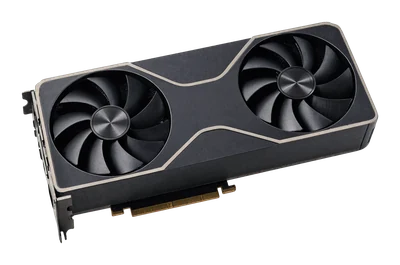
RTX 4090
24 GB GDDR6X · 1.0 TB/s
$0.23/hr
ComfyUI, SDXL and LoRA training on 8B models
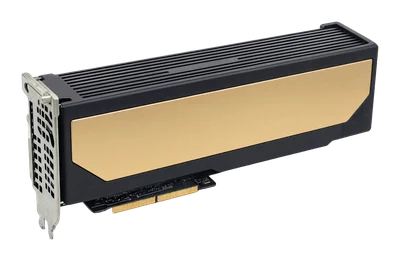
RTX 5090
32 GB GDDR7 · 1.8 TB/s
$0.48/hr
FLUX, SDXL, AI video and small language models
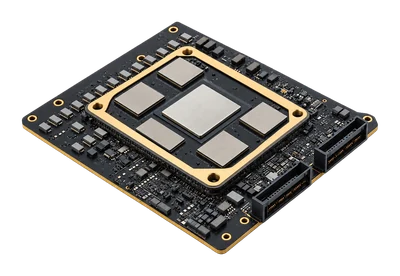
L40S
48 GB GDDR6 ECC · 864 GB/s
$0.55/hr
Stable Diffusion, video, Whisper transcription and embeddings
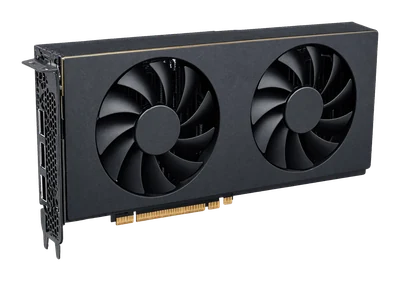
A100 SXM
80 GB HBM2e · 2.0 TB/s
$0.95/hr
LoRA and QLoRA fine-tuning, batch inference
RTX PRO 6000
96 GB GDDR7 ECC · 1.8 TB/s
$1.15/hr
Serving 70B models in 4-bit and AI video generation
GPUBank on-demand prices, all-in. Memory bar scaled to 96 GB.
09 / Rent or buy
Rent or buy one L40S
The realistic purchase is one card in a server, because the L40S is passively cooled and needs a chassis that forces air through it. Sellers disagree by more than $3,000: SabrePC listed the PNY L40S at $9,701.76 in stock on 16 October and Cloud Ninjas at $10,584 with ten in stock, while on 14 October CDW printed $10,497.99, Server Supply $11,000 with a two to three-week lead time and Saitech a $7,709 sale price against a regular $11,500; clustermelt.com put used cards at $6,750 to $8,750 on 1 October303132333435. Taking $9,702 for the card, an assumed $5,000 for a one or two-GPU server around it, and an assumed resale after two years of $6,350 (half the card and 30 percent of the server), the hardware loses $8,352 over 24 months, or $348.00 a month. At an assumed 0.6 kW at the wall under load and 18.19 cents per kWh, every hour of use adds $0.109 of power, before any rack space or cooling.
Against GPUBank's $0.55, owning breaks even at $348.00 divided by ($0.55 minus $0.109), about 789 hours a month, which is more than the 730 hours a month contains, so the card never pays for itself in two years even at full use; at 730 hours owning costs about $427.67 against $401.50 to rent on demand, $321.20 reserved or about $250.94 at the effective price of a $1,000 top-up1. Against the $1.54 market median the same card breaks even at about 243 hours a month2.
Keeping the card four years changes the answer only in part. With an assumed resale of 25 percent of the card and 20 percent of the server, the loss falls to about $234.93 a month; owning then breaks even against GPUBank's $0.55 at about 533 hours a month and costs about $314.50 at full use, a little under the $321.20 reservation but still above the $250.94 effective top-up price, and that is before rack space, cooling or a failed card. A whole eight-card server follows the same logic at a larger scale: Dihuni's configurator starts an eight-card L40S system at $25,500 plus $9,100 per card, about $98,300 if the prices add, and CTOServers in the UK lists a complete one at £69,9953637. Buy if you will run the card around the clock for four years, already pay for rack space and cheap power, or must keep data on your own premises; for everyone else, and for anyone likely to move to a newer card, renting at GPUBank is cheaper.
| Hours a month | Rent at $0.55 | Rent at $0.34 effective | Own | Cheaper |
|---|---|---|---|---|
| 100 | $55.00 | $34.38 | $358.91 | Rent |
| 200 | $110.00 | $68.75 | $369.83 | Rent |
| 400 | $220.00 | $137.50 | $391.66 | Rent |
| 600 | $330.00 | $206.25 | $413.48 | Rent |
| 730 | $401.50 | $250.94 | $427.67 | Rent |
SabrePC, PNY NVL40STCGPU-KIT in stock, read 16 Oct 2026; Cloud Ninjas lists $10,584
10 / What to choose
The cheapest L40S depends on the job.

ComfyUI and image studios
L40S
48 GB holds FLUX and Qwen-Image in bf16 with ControlNets loaded, at about $0.70 per thousand SDXL images on GPUBank; for plain SDXL that fits in 24 GB, an RTX 4090 is enough.

AI video with Wan 2.2
L40S
Video models fill memory long before they run out of compute, and the L40S is the cheapest 48 GB card on GPUBank, with a ready ComfyUI template for Wan 2.2.

Batch transcription
RTX 4090 interruptible
Whisper needs under 5 GB, so the cheaper card wins per audio hour even though the L40S is faster; choose the L40S only when turnaround time matters more than cost.

Chat and API serving
RTX 5090 or A100 SXM
The L40S's 864 GB/s holds single-user token speed to about 48 tokens per second in Runpod's test; take it only when a 30B FP8 model or many concurrent users need its 48 GB.
11 / Questions
What people ask before renting one.
The cheapest L40S hour you could actually launch on 16 October 2026 was GPUBank's interruptible tier at $0.33, which includes 16 vCPU, 94 GB of RAM, a 1 TB NVMe disk, an IPv4 address and all traffic, with five minutes of notice before the card is taken back1. Novita lists spot at $0.28, but it was out of stock in every size2. For capacity that cannot be reclaimed, GPUBank and Novita tie at $0.55 on demand, followed by Beam at $0.76 and Runpod's Community Cloud at $0.79, the only peer-hosted L40S in stock that week103. Vast.ai's own L40S page showed no current offers and Lium no longer lists the card, so the lower marketplace figures quoted in September were not available45. GPUBank's top-up bonus lowers its effective on-demand hour to about $0.34 with a $1,000 top-up1.
An L40S costs between about $0.28 and $3.77 per GPU-hour in October 2026, depending on the mode and on what the price includes. GetDeploying put the median on-demand price at $1.54 across 133 configurations on 15 October, with reserved offers at a median of $1.09 and spot at $1.112. The cheapest whole-machine on-demand price was $0.55 at GPUBank and Novita, Runpod's Secure Cloud costs $1.09, Civo $1.29, Nebius about $1.55 once CPU and RAM are added, and AWS $1.861 for a g6e.xlarge with only 4 vCPU, or $3.77 per GPU on its eight-card instance1320132122. Before comparing two prices, check whether each covers vCPU, RAM, disk, a public IP and egress, and whether the card is sold alone or only as part of an eight-card node.
A full 730-hour month of one L40S costs $401.50 on GPUBank on demand, $321.20 on its monthly reservation and $240.90 on its interruptible tier, plus $0.03 per GB-month for any persistent disk1. Elsewhere the same month costs $394.20 to $416.10 on a CloudRift reservation of three months or one, $576.70 on Runpod's Community Cloud, $795.70 on its Secure Cloud and $1,358.53 on an AWS g6e.xlarge before EBS and egress6321. At GetDeploying's $1.54 median, a month comes to about $1,1242. Whole-server deals only pay off if you fill them: LeaderGPU's eight-card server at €3,290 a month is about €411 per card, more than GPUBank's single-card reservation15. Paying GPUBank's on-demand hours from a balance built with $1,000 top-ups brings the cash cost of a month to about $251.
The L40S is good for serving 7B to 30B models to many users and weak at single-user token speed. Its 864 GB/s of GDDR6 caps generation: Runpod measured 48 tokens per second per user on Qwen2.5-7B with vLLM, against 61 on an RTX 4090, 96 on an A100 SXM and 101 on an RTX 509027, and Koyeb measured 46 on Llama 3.1 8B at batch 128. Batching changes the picture: Koyeb's L40S reached 1,153 tokens per second at batch 32, and in a vLLM test of a 27B model at 4-bit with 32 concurrent requests it delivered 554 tokens per second where the 24 GB RTX 4090 stalled at 300 for lack of KV cache38. Its 48 GB and FP8 support let it hold a 30B model in FP8 with room for context. For a chat product where one user waits on every token, an RTX 5090 or an A100 is faster for the money.
An L40S can run a 70B model at 4-bit, slowly and with a short context. XiongjieDai's llama.cpp tables measured 15.31 tokens per second on Llama 3 70B in Q4_K_M on a single L40S, against 22.11 on an 80 GB A100 PCIe, while the 16-bit version did not fit on either card and the RTX 4090 could not load the 4-bit one29. A 4-bit 70B model takes about 40 GB for its weights, which leaves only a few gigabytes of the 48 GB for the KV cache, so long prompts or several users at once will not fit. Two L40S cards share the weights and leave room for a longer context, but they talk over PCIe without NVLink, so tensor-parallel scaling is imperfect8. For regular 70B serving, a 96 GB RTX PRO 6000 at $1.15 or an 80 GB A100 SXM at $0.95 on GPUBank is simpler1; for occasional experiments one L40S at $0.55 is enough.
Rent the RTX 4090 if your model fits in 24 GB with room to spare, and the L40S if it does not. On GPUBank the 4090 costs $0.23 an hour against $0.55, and in Runpod's tests it generated tokens faster for a single user, 61 per second against 48, while transcribing Whisper turbo at about $6.53 per 1,000 audio hours against $9.43 on the L40S12725. The L40S earns its premium when memory is the limit: Qwen-Image or FLUX in full bf16, large ControlNet stacks, 14B to 30B models in FP8, or batched serving, where a vLLM test showed the 4090 capped at nine concurrent requests by its KV cache while the L40S kept 32 in flight2638. The L40S also has ECC memory and a datacenter licence, whereas NVIDIA's GeForce driver licence excludes datacenter deployment9.
The L40S is better than the A100 for image generation and transcription, and worse for LLM token generation and training. In Runpod's tests it rendered SDXL in 4.55 seconds against 7.65 on an A100 SXM and transcribed Whisper turbo at 58.3 times realtime against 34.02625, which on GPUBank's prices makes about $0.70 per 1,000 SDXL images against $2.021. The A100's 80 GB of HBM2e at about 2 TB/s more than doubles the L40S's bandwidth, which is why it generated 96 tokens per second per user on Qwen2.5-7B against 48 and reached 2,083 tokens per second at batch 32 on Llama 3.1 8B against 1,1532728. It also has NVLink, which the L40S lacks8. Pick the A100 at $0.95 for LLM serving, fine-tuning and anything that needs 80 GB; pick the L40S at $0.55 for diffusion, video, audio and embeddings.
The L40 and the L40S are both Ada Lovelace datacenter cards with 48 GB of GDDR6, but the L40S is the later, AI-oriented version with higher Tensor Core throughput, rated at 733 dense FP8 TFLOPS8, and it is the one providers market for inference and generative work. On bandwidth-bound work the two behave alike: Runpod's vLLM test measured both at 48 tokens per second per user on Qwen2.5-7B27. On compute-bound work the S model pulls ahead: in Runpod's Whisper test the L40 transcribed turbo at 51.7 times realtime against the L40S's 58.325. The L40 usually rents for less, with GetDeploying's cheapest in-stock L40 at $0.78 on 15 October39, and some listings and aggregators mix the two names up, so check the exact model on the provider's page before you compare a price with the figures on this page, which all refer to the L40S.
Interruptible L40S capacity is worth it for any job that checkpoints, such as batch transcription, embedding runs, image batches or training that saves its state, and not for an interactive session or a live endpoint. GPUBank's interruptible tier costs $0.33 against $0.55 on demand, gives five minutes of notice through the metadata endpoint, a webhook and the console, runs a checkpoint hook, stops the machine rather than deleting it and credits the last 30 minutes if the notice is missed1. Nebius preemptible costs about $0.75 with its CPU and RAM, Seeweb's spot gives two minutes of notice, and AWS spot for a g6e.xlarge stood at $1.829, barely below on-demand131821. In our transcription scenario, interruptible capacity cut the bill from $97.33 to $59.60, and a reclaim costs only the work done since the last checkpoint.
An L40S costs $0.79 an hour on Runpod's Community Cloud and $1.09 on its Secure Cloud, both with 16 vCPU and 94 GB of RAM per card and billed per second, and $1.75 an hour as a serverless worker in the 48 GB class3. Community Cloud machines belong to independent hosts and Secure Cloud machines sit in Runpod's partner datacenters; GetDeploying showed the first in stock in 1 and 2-card sizes and the second in 1, 2 and 4-card sizes on 16 October2. Storage is billed on top: $0.07 per GB-month for a network volume under 1 TB, $0.10 for a volume disk while the pod runs and $0.20 once it is stopped, so 200 GB of models kept on an idle pod adds $40.00 a month. A full 730-hour month comes to $576.70 on Community Cloud and $795.70 on Secure Cloud before storage, against $401.50 on GPUBank's on-demand L40S with 16 vCPU, 94 GB of RAM, a 1 TB NVMe disk and traffic included1.
Vast.ai can be a cheap place to rent an L40S when it has listings, but on 16 October 2026 its own L40S page showed no current offers at all4. It is a marketplace: each card belongs to a host who sets the price, the CPU, the disk, the bandwidth rate and the uptime, so availability for a less common card like the L40S comes and goes with a few hosts. Its billing documentation says storage is charged every second an instance exists, including while it is stopped, and bandwidth at each host's rate in both directions24. When listings return, filter for verified datacenter hosts, check the reliability score and the bandwidth price, and keep data you cannot lose on storage you control. We found no published automatic credit for a host that fails mid-job, whereas GPUBank credits the interrupted session in full1.
AWS and Oracle offer the L40S, and we found no public L40S instance on Google Cloud or Microsoft Azure as of 16 October 2026. AWS has sold it since 15 August 2024 in the G6e family, from the g6e.xlarge at $1.861 an hour in us-east-1 with one card, 4 vCPU and 32 GiB, to the g6e.48xlarge with eight cards at $30.131 an hour, or $3.77 per GPU; a three-year reservation brings the g6e.xlarge down to $0.8042122. Oracle sells the BM.GPU.L40S.4 bare-metal shape with four cards at $14.00 per node-hour, $3.50 per GPU, according to the trackers we could read23. These clouds make sense when your data and services already live there or when you need RDMA networking between L40S nodes. On price per GPU-hour they cost three to seven times what a specialised cloud charges for the same card.
A new L40S costs about $9,700 to $11,000 from resellers in October 2026, with occasional sales near $7,700,, and used cards trade at $6,750 to $8,750. SabrePC listed the PNY card at $9,701.76 in stock on 16 October, Cloud Ninjas at $10,584 with ten in stock, CDW at $10,497.99 and Server Supply at $11,000, and clustermelt.com's tracker put the used range at $6,750 to $8,750 on 1 October3031323335. The card is passively cooled and needs a server chassis with forced airflow, so budget for the machine around it as well. With an assumed $5,000 server, two years of use and a resale of $6,350, the hardware costs about $348 a month before power, which means one card does not pay for itself against GPUBank's $0.55 rental even at full-time use1. Buying makes sense for teams that will run it around the clock for four years or more, or that must keep the hardware on their own premises.
The L40S is a strong ComfyUI card, especially when models outgrow 24 GB. In Runpod's ComfyUI tests it rendered Juggernaut XL, an SDXL checkpoint, in 4.55 seconds, FLUX.2 Klein 9B in bf16 in 3.31 seconds, and Qwen-Image 2512 in bf16 in 38.91 seconds while using 41.4 GB, a model that runs from system memory on cards under about 46 GB26. Under shared load it sustained 694 SDXL images an hour. On GPUBank's $0.55 that comes to about $0.70 per 1,000 SDXL images and $0.51 per 1,000 FLUX.2 Klein images1. The RTX PRO 6000 Blackwell Server Edition is about twice as fast at roughly the same cost per image, and for plain SDXL a cheaper 24 GB card is usually enough. GPUBank's ComfyUI templates, including one for Wan 2.2 video, launch on the L40S directly.
Whisper runs at about 58 times realtime on an L40S for a single stream of large-v3-turbo in int8, the fastest of 23 cards in Runpod's 2026 faster-whisper test, narrowly ahead of the H100 NVL at 57.8 and the RTX 5090 at 53.025. One hour of audio takes about 62 seconds. The full large-v3 model in int8 ran at 23.1 times realtime, and peak memory stayed under 2.5 GB in int8 and 4.5 GB in fp16, so Whisper never fills the card. On GPUBank's on-demand price that comes to about $9.43 per 1,000 audio hours for turbo and $23.81 for large-v3, and about 40 percent less on interruptible capacity1. Batching several streams on one card raises throughput well beyond these single-stream figures. If cost per audio hour is all that matters, an RTX 4090 at $0.23 is cheaper, at about $6.53 per 1,000 hours.
Sources
Sources
- 01GPUBank, pricingL40S on-demand, interruptible and reserved rates, inclusions, disk price, top-up bonuses, other cards · read 16 Oct 2026
- 02GetDeploying, Nvidia L40S rental prices262 price points and medians; Novita, GPU.ai, Packet.ai, Hostinger, Sesterce, EmpirioLabs, UpCloud, Lyceum, Crusoe and the other aggregator rows · read 16 Oct 2026
- 03Runpod, GPU cloud pricingCommunity $0.79, Secure $1.09, serverless $1.75, storage rates · read 16 Oct 2026
- 04Vast.ai, Rent L40S GPUsNo current L40S offers · read 16 Oct 2026
- 05GetDeploying, LiumLium no longer lists the L40S · read 16 Oct 2026
- 06CloudRift, GPU rental pricesOn demand on request, $0.57 one month, $0.54 three months · read 16 Oct 2026
- 07GPUBank, GPU board and regionsL40S regions, median launch time · read 16 Oct 2026
- 08NVIDIA L40S product pageMemory, bandwidth, TFLOPS, power, interface, no NVLink · read 16 Oct 2026
- 09NVIDIA GeForce software licenceNo datacenter deployment for GeForce drivers · read 15 Oct 2026
- 10Beam, NVIDIA L40S pricing$0.76 with vCPU, RAM and NVMe included · read 16 Oct 2026
- 11Massed Compute, pricingL40S at $0.97 per card, 1 to 8 cards · read 16 Oct 2026
- 12Clore.ai, Rent NVIDIA L40SSnapshot of 21 Sep 2026: one server, rented; contract rates · read 16 Oct 2026
- 13Nebius documentation, Compute pricing$1.35 GPU, $0.65 preemptible, vCPU and RAM rates, eu-north1 · read 16 Oct 2026
- 14CoreWeave, pricingEight-card L40S node at $18.00 on demand, $7.88 spot · read 16 Oct 2026
- 15LeaderGPU, dedicated GPU serversEight-card L40S server at €3,290 a month excl. VAT · read 16 Oct 2026
- 16Koyeb, pricingServerless L40S at $1.20 with 15 vCPU, 64 GB RAM · read 16 Oct 2026
- 17Modal, pricingL40S at $0.000542 per second, CPU and memory extra · read 16 Oct 2026
- 18Seeweb, Cloud Server GPU€0.85 on demand, commitments, spot notice, hourly billing · read 16 Oct 2026
- 19computeprices.com, Seeweb GPU pricingDollar conversion of Seeweb's euro price · read 14 Oct 2026
- 20Civo, NVIDIA L40S GPU cloud$1.29 on demand, $0.89 on 36 months, in stock · read 16 Oct 2026
- 21Vantage, g6e.xlarge pricingus-east-1 on-demand, spot and reserved prices, specs · read 16 Oct 2026
- 22DevZero, NVIDIA L40S cloud pricingg6e.4xlarge and g6e.48xlarge prices · read 16 Oct 2026
- 23economize.cloud, OCI BM.GPU.L40S.4 pricing$14.00 per node-hour, $3.50 per GPU · read 16 Oct 2026
- 24Vast.ai documentation, BillingStorage billed while stopped, per-host bandwidth · read 15 Oct 2026
- 25Runpod, Best GPU for Whisperfaster-whisper realtime factors on 23 cards, peak memory; updated 15 Oct 2026 · read 16 Oct 2026
- 26Runpod, Best GPU for ComfyUISDXL, FLUX.2 Klein and Qwen-Image timings, peak memory, shared-load throughput · read 16 Oct 2026
- 27Runpod, Best GPU for LLM inferencePer-user decode on Qwen2.5-7B with vLLM · read 16 Oct 2026
- 28Koyeb, GPU benchmarksLlama 3.1 8B throughput by batch size, L40S and A100 · read 16 Oct 2026
- 29XiongjieDai, GPU Benchmarks on LLM Inferencellama.cpp Llama 3 8B and 70B speeds, 2024 snapshot · read 16 Oct 2026
- 30SabrePC, PNY NVIDIA L40S$9,701.76, in stock · read 16 Oct 2026
- 31Cloud Ninjas, NVIDIA L40S 48GB$10,584, ten in stock · read 16 Oct 2026
- 32CDW, PNY NVIDIA L40S 48 GB$10,497.99 · read 14 Oct 2026
- 33Server Supply, NVIDIA L40S 48GB PCIe$11,000, two to three weeks lead time · read 14 Oct 2026
- 34Saitech, PNY NVIDIA L40S 48GB$7,709 sale price, $11,500 regular · read 14 Oct 2026
- 35clustermelt.com, used L40S priceUsed range $6,750 to $8,750, 1 Oct 2026 · read 16 Oct 2026
- 36Dihuni, OptiReady L40S 8-GPU server$25,500 base plus $9,100 per card · read 15 Oct 2026
- 37CTOServers, NVIDIA L40S serversEight-card server at £69,995 · read 15 Oct 2026
- 38ComputingForGeeks, Ollama vs vLLM vs llama.cpp27B 4-bit throughput at 32 concurrent requests on L40S, RTX 4090, RTX 5090 · read 16 Oct 2026
- 39GetDeploying, Nvidia L40 rental pricesCheapest in-stock L40 at $0.78 · read 15 Oct 2026
What we could not confirm
Several figures rest on aggregators because the provider's own page could not be read without an account or blocked our fetch: Novita's $0.55 on demand and $0.28 spot and every row marked Aggregator in the table come from GetDeploying's checks of 16 October, AWS prices from Vantage and DevZero, and Oracle's $3.50 from economize.cloud because Oracle's price list and announcement returned an error. EmpirioLabs, listed at $0.80 in an earlier draft, is $1.80 on GetDeploying and is corrected here. Seeweb's dollar figures use computeprices.com's conversion of its euro prices, and LeaderGPU's $0.63 per GPU-hour is our conversion of €3,290 a month over 730 hours. Vast.ai showed no L40S offers on its own page and Lium no longer lists the card, so the $0.47 and $0.38 seen for them in late September are left out, and Clore.ai published no live hourly rate, only contract rates in a snapshot of 21 September. Runpod's pricing page shows one $1.75 rate for its 48 GB serverless class without separating flex and active workers. We found no public L40S instance on Azure or Google Cloud, but cannot rule out one added after our check. The benchmark sources do not state the faster-whisper, ComfyUI or vLLM versions except ComputingForGeeks (vLLM 0.31.0), and Runpod's ComfyUI test did not include the RTX 4090 or RTX 5090. The server cost, resale values, power draw and electricity price in the rent or buy section are our assumptions, not quotes, and the eight-card Dihuni figure adds its base and per-card prices.
L40S on GPUBank
Images, video and speech on 48 GB, all-in.
- 16 vCPU, 94 GB RAM, 1 TB NVMe, IPv4 and traffic in $0.55/hr
- Billed by the second after the health check
- Interruptible $0.33, reserved $0.44
 16 vCPU, 94 GB RAM, 1 TB NVMe, IPv4 and traffic in $0.55/hr
More GPU price guides
Where to rent the other cards at the cheapest price.
 B200 SXM180 GB HBM3eFrom $2.49 spot · $4.15 all-in
 H200 SXM141 GB HBM3eFrom $1.49 spot · $2.49 all-in
 H100 SXM80 GB HBM3From $1.11 spot · $1.85 all-in
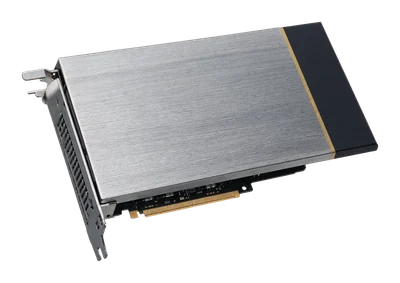 H100 PCIe80 GB HBM2eFrom $0.81 spot · $1.35 all-in
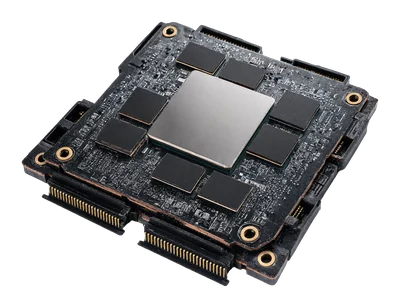 MI300X192 GB HBM3From $0.99 spot · $1.65 all-inRTX PRO 600096 GB GDDR7 ECCFrom $0.69 spot · $1.15 all-inA100 SXM80 GB HBM2eFrom $0.57 spot · $0.95 all-inRTX 509032 GB GDDR7From $0.29 spot · $0.48 all-inRTX 409024 GB GDDR6XFrom $0.14 spot · $0.23 all-in