Updated 16 Oct 2026 · 29 offers checked
Where to rent an RTX 4090 at the cheapest price
We read every RTX 4090 offer we could find on the provider's own page or public API, priced what each hour actually includes, and worked out the monthly bill, the speed per dollar and the point where a used card would cost less than renting one.

The short answer, 16 Oct 2026
- $0.14/hrCheapest hour you can launch and plan on. GPUBank's interruptible RTX 4090 costs $0.14 with the same 8 vCPU, 41 GB of RAM, 500 GB NVMe disk, IPv4 address and traffic as on demand, five minutes of notice before a reclaim and the disk kept1. Clore.ai's own snapshot of 21 September found one free spot server at $0.10, against a $0.365 spot median, and a higher bid can take it mid-run2.
- $0.16/hrCheapest published tier elsewhere. SaladCloud's lowest priority costs $0.16 an hour with vCPU and RAM included, on consumer PCs that can be reclaimed at any time and with no persistent disk3.
- $0.23/hrCheapest whole machine on demand. GPUBank's $0.23 covers 8 vCPU, 41 GB of RAM, a 500 GB NVMe disk, an IPv4 address and all traffic, billed per second, ahead of Runpod Community at $0.34 and Vast.ai's cheapest listing at $0.36 before storage; a top-up bonus brings the hour to about $0.14 to $0.19145.
The RTX 4090 is the card people rent when they need 24 GB of fast memory and refuse to pay datacenter prices, and it is also the card whose price is hardest to compare, because one model number covers several products that only share the silicon. One is a managed machine with its CPU, memory, disk and network folded into a single hourly figure. Another is a listing on a peer-to-peer marketplace where an independent host sets the GPU rate and bills storage and bandwidth on top. A third is a slot on somebody's gaming PC in a distributed network, cheap because it can disappear when the owner sits down to play, and a fourth is a five-card bare-metal block reserved for two weeks. Headline rates for these run from ten cents to almost ninety cents an hour, and most of that spread comes from what each price includes and what it allows the provider to do to your job.
We read each provider's pricing page, documentation or public offer API on 16 October 2026 and recorded what every price covers, after a first survey on 15 October. Several figures from our first survey had moved or were wrong: Vast.ai's advertised floor of $0.14 is no longer in its live offers, where the cheapest single RTX 4090 now costs $0.36 on demand5; Novita AI's own page now shows $0.33 rather than $0.676; packet.ai bills egress at $0.04 per GB7; and the GeForce licence quoted in older articles has been rewritten since 20178.
This page is published by GPUBank, a GPU cloud run by GPU Compute OÜ in Tallinn, Estonia, so read its entry with that in mind. It is measured on the same terms as everyone else, and the text says plainly where a Clore.ai bid, a SaladCloud priority tier or a used card bought for a full-time workload beats it, and what the buyer gives up in each case. The figures come from the providers' own pages unless a row is marked as an aggregator figure or as a provider's dated snapshot, and every price is per GPU-hour in US dollars.
01 / Where cheap hours come from
Why a consumer card rents for ten cents
The cheapest RTX 4090 hours come from consumer machines because the people who own them have already paid for the card. A host on Vast.ai or Clore.ai, or a gamer whose PC runs SaladCloud's agent, bought the 4090 for play or as a side business, pays household electricity and no rent, and is happy with anything above the cost of power, which is how a card that resells for about $2,200 ends up rented for ten to thirty-six cents an hour2625. Because the licence keeps those cards out of the big clouds8, a large share of the supply sits in homes, small server rooms and colocated racks rather than in the facilities a renter would picture. The floors show it: Vast's cheapest on-demand single card was $0.36 and its median $0.53, Clore's spot floor was $0.10 against a $0.375 on-demand median, and Salad's lowest tier was $0.16523.
For the renter that has three consequences. The floor is real but thin: Clore's $0.10 was one free server among 2432, Vast's listings change by the hour, and the cheapest slot is often the one with the fewest CPU cores, the slowest disk or the weakest uplink, so the price that matters is the cost per finished job after a short benchmark on the host you rent. Interruption is part of the deal, since the owner can take the machine back or a higher bid can take it from you, and on most of these networks the renter pays for the lost time. And the hardware is an end-of-life consumer card without ECC that has often run hot for years, which is fine for image generation and experiments and a poor fit for customer data, unreleased weights or anything a user waits on. A managed all-in rate costs a few cents more an hour and buys a known machine, a notice period and somebody who answers for the host.
Marketplace floors and medians, USD per GPU-hourLowest listingMedianGPUBank all-in $0.23
AWS, Google Cloud, Microsoft Azure and Oracle Cloud list no RTX 4090 instance, so the usual exercise of dividing an eight-GPU instance price by eight has nothing to divide for this card. Their Ada-generation offers are the datacenter L4 and L40S, which carry ECC memory, run on datacenter drivers and fit server airflow, and which cost more per hour than any RTX 4090 offer on this page. For a team that must stay inside one of those clouds for compliance or data-gravity reasons, the L40S with 48 GB is the nearest equivalent, and the comparison with the 4090 is then a question of whether the extra memory and the platform are worth the price, which the section on other cards answers per job. For everyone else, the absence of the large clouds, which the licence explains8, is the reason this market exists at all.
NVIDIA GeForce driver licenceCurrent version
2.8You agree that GeForce or Titan SOFTWARE: (i) is licensed for use only on GeForce or Titan hardware products you own, and (ii) is not licensed for datacenter deployment.
02 / The card and its price
The card, and why its price varies so much
The GeForce RTX 4090 is NVIDIA's Ada Lovelace flagship on the AD102 chip, with 16,384 CUDA cores, 512 fourth-generation Tensor Cores, 24 GB of GDDR6X on a 384-bit bus and a 450 W total graphics power that NVIDIA pairs with an 850 W minimum supply9. Its 1,008 GB/s of memory bandwidth is what sets the speed at which it writes tokens in a language model, Clore.ai gives its dense FP16 and BF16 tensor throughput as 165 TFLOPS, noting that the 330 TFLOPS sometimes quoted assumes 2:4 sparsity, and its Tensor Cores run FP8 natively2, the precision at which FLUX.1 dev fits in its memory and runs well. It went on sale on 12 October 2022 at $1,59910, was replaced at the top of the range by the RTX 5090, on sale from 30 January 2025 at $1,999, and is no longer in production, so the supply of new cards has dried up and the used market sets the price of the hardware that hosts rent out. It has no NVLink, so two cards in one machine are two separate 24 GB devices joined over PCIe.
The large clouds do not rent it, and the reason is a licence clause rather than a missing price list. Clause 2.8 of the current NVIDIA driver licence says that GeForce software is licensed only for GeForce hardware you own and is not licensed for datacenter deployment8, a restriction NVIDIA first introduced at the end of 2017 to keep consumer cards out of large enterprise installations11. The supply therefore comes from specialised GPU clouds, peer-to-peer marketplaces and networks of consumer PCs, where the 4090 is one of the most listed cards of all: Clore.ai alone counted 378 of them on 243 servers in its snapshot of 21 September2.
People rent it for ComfyUI, Stable Diffusion WebUI Forge and InvokeAI, where SDXL fits easily and FLUX.1 dev runs at FP8, for LoRA and QLoRA fine-tuning of models up to about 8B to 14B parameters, and for single-card inference of language models up to about 14B at 8-bit or about 32B at 4-bit with a short context; Clore's rule of thumb of half a gigabyte per billion parameters at 4-bit puts a 32B model near 16 GB of weights and a 70B model near 40 GB, beyond one card2. GPUBank positions its RTX 4090 for ComfyUI, SDXL and LoRA training on 8B models1. The price range follows from where the cards sit: a card in a spare room costs its owner little more than electricity, a card in a rack carries the cost of the building, the network and the staff, and the rate reflects which of the two you are renting.
What one RTX 4090 cost to buy, October 2022 to October 2026NewUsed, sold or valuedUsed, asking
- Oct 2022$1,599Launch price, on sale 12 October 202210
- Sep 2023$1,603eBay average sold price, September 202332
- Oct 2023$1,704eBay average over 304 sales before the China export rules32
- Dec 2024$2,500Remaining Amazon stock started near $2,500 as production ended33
- Jan 2026$2,352Used market value, 17 January 202626
- May 2026$2,328Used market value, 30 May 202626
- Sep 2026$3,010Used market value spike, 12 September 202626
- Oct 2026$2,214Used market value, 6 October 202626
- Oct 2026$2,999Median asking price, 54 used listings, 15 October 202628
03 / The price ladder
How to read the RTX 4090 market
The fair way to compare RTX 4090 offers is to group them by what you are actually buying before looking at the number. A managed on-demand offer sells a defined machine at a fixed hourly rate that stays in force until you stop it, and the useful question is what that rate leaves out: GPUBank, CloudRift and Beam include the local disk and charge nothing for traffic11213, while Runpod bills volumes separately and packet.ai bills egress at $0.04 per GB47. A marketplace listing sells a slot on a host whose CPU share, memory, disk speed, PCIe generation and reliability vary from one listing to the next, at a GPU rate the host sets, with storage and bandwidth as separate lines. Putting the two side by side without saying so is how most cheapest-GPU lists end up comparing things that cannot be compared.
The other three kinds of offer each trade something for the price. Spot and priority tiers can be taken back, either by a higher bid on Vast.ai and Clore.ai or by a higher-priority workload on SaladCloud, and they differ less in their discount than in what happens at the moment of interruption: some delete the container, some leave a disk you keep paying for, and only a few give notice. Reserved capacity lowers the rate in exchange for paying for a week, a month or longer whether you use it or not, and for this card it ranges from GPUBank's $0.18 for a single card to Clore.ai's five-GPU and eight-GPU bare-metal blocks at $0.40 to $0.9412. Serverless workers bill only the seconds spent on requests, at an hourly equivalent of $0.69 on Beam for the GPU alone and $1.10 for a Runpod flex worker134, which only pays when traffic is rare and bursty: once a $0.69 worker is busy for a third of the month, a dedicated $0.23 machine already costs the same.
Managed on demandA fixed machine at one hourly price.
MarketplaceHosts set their own price; machines vary.
Spot and interruptibleCheaper hours that can be taken back.
ReservedCommitted for a term, paid either way.
ServerlessBilled by active seconds.
04 / Provider by provider
What each price buys, and what it leaves out.
The captures below were taken on 16 Oct 2026 from each provider's own RTX 4090 or pricing page, so every figure can be read next to the conditions printed beside it.
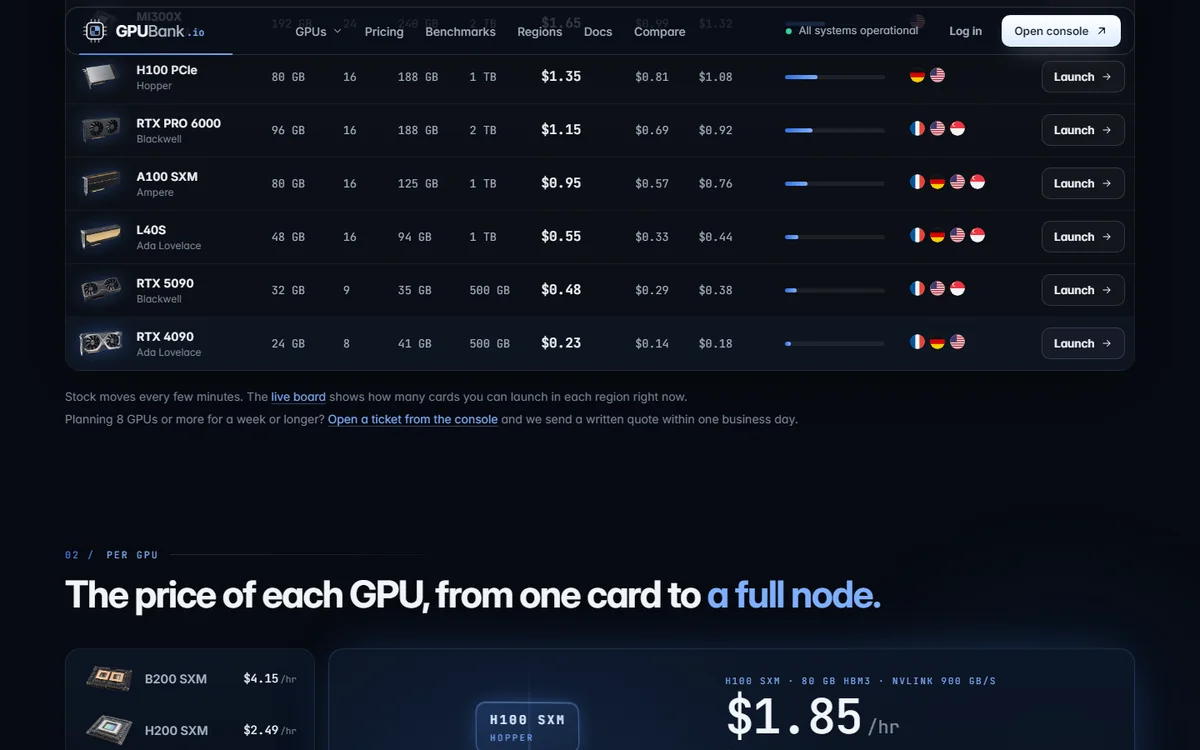
GPUBankAll-in
$0.23/hr
Managed on demand · Frankfurt, Ashburn, Paris queue
8 vCPU41 GB RAM500 GB NVMeIPv4All trafficDisk $0.03/GB-moInterruptible $0.14Reserved $0.18
GPUBank lists the RTX 4090 at $0.23 an hour on demand, $0.000064 a second, and the rate covers the vCPUs, the memory, the local NVMe scratch disk, one public IPv4 address and all traffic, in machines of one to four GPUs. The only other line on the bill is a persistent disk at $0.03 per GB-month. Billing is per second with no minimum and starts only once the machine has passed its health check, a failed launch is not billed, and a host failure during a job restarts the machine on a healthy host with the same disk and credits the session in full. The interruptible tier costs $0.14 with five minutes of notice and a stop rather than a deletion, and a week or a month reserved costs $0.18. Payment is a prepaid balance topped up in crypto from $25, with a bonus that brings the effective hour to between $0.14 and $0.19; cards are not accepted for now1. The card is listed in Frankfurt and Ashburn, with Paris on a waiting queue18.1
Checked 16 Oct 2026
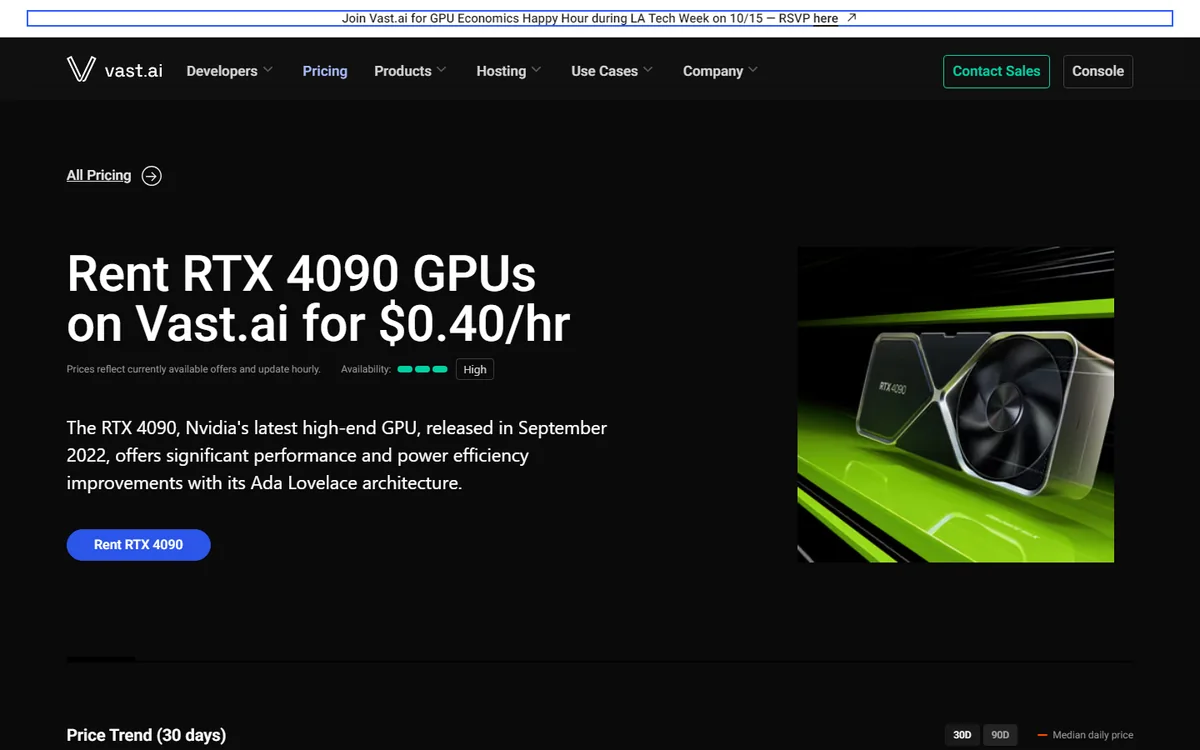
 Vast.ai
from $0.36/hr
Marketplace · host-set price per listing
Host's CPU and RAM shareStorage at host rateBandwidth at host rateBids from $0.27
Vast.ai is the reference RTX 4090 marketplace, and its public offer search, which we queried on 16 October, is where the floor and median below come from. The cheapest single-card on-demand listing was $0.36 for the GPU, on a US host with a 99.6 percent reliability score, the median per-GPU rate across all listings was $0.53, and interruptible bids started at $0.275. The $0.14 floor still quoted on some Vast pages and in older articles was not in the live offers. Each host also sets a storage rate, about $0.20 per GB-month on the cheap listings, billed for as long as the instance exists even while it is stopped, and a bandwidth rate per gigabyte. Listings show the CPU share, the PCIe link and the measured memory bandwidth, and the cheapest hosts are not always the fastest, so a short benchmark before a long job is worth its few cents.5
Checked 16 Oct 2026
 SaladCloud
$0.16 to $0.33/hr
Distributed consumer PCs · four priority tiers
vCPURAMNo persistent diskReclaimable at every tier
SaladCloud runs containers on consumer PCs and sells the RTX 4090 at four priorities: $0.330 an hour at high, $0.273 at medium, $0.217 at low and $0.160 at the lowest batch tier, billed per second while the container runs, with allocation, image download and start-up not charged and vCPU and RAM included3. Those rates have applied since a price change on 12 September 202630. The price is low because the machines belong to people who use them, so a container can be moved off a PC at any time and a higher-priority workload displaces a lower one. There is no persistent disk, so model weights travel in the image or come from object storage you pay for elsewhere, and a production endpoint needs at least two replicas. For a large batch of images that tolerates restarts, the lowest tier is one of the cheapest published 4090 hours anywhere.3
Checked 16 Oct 2026
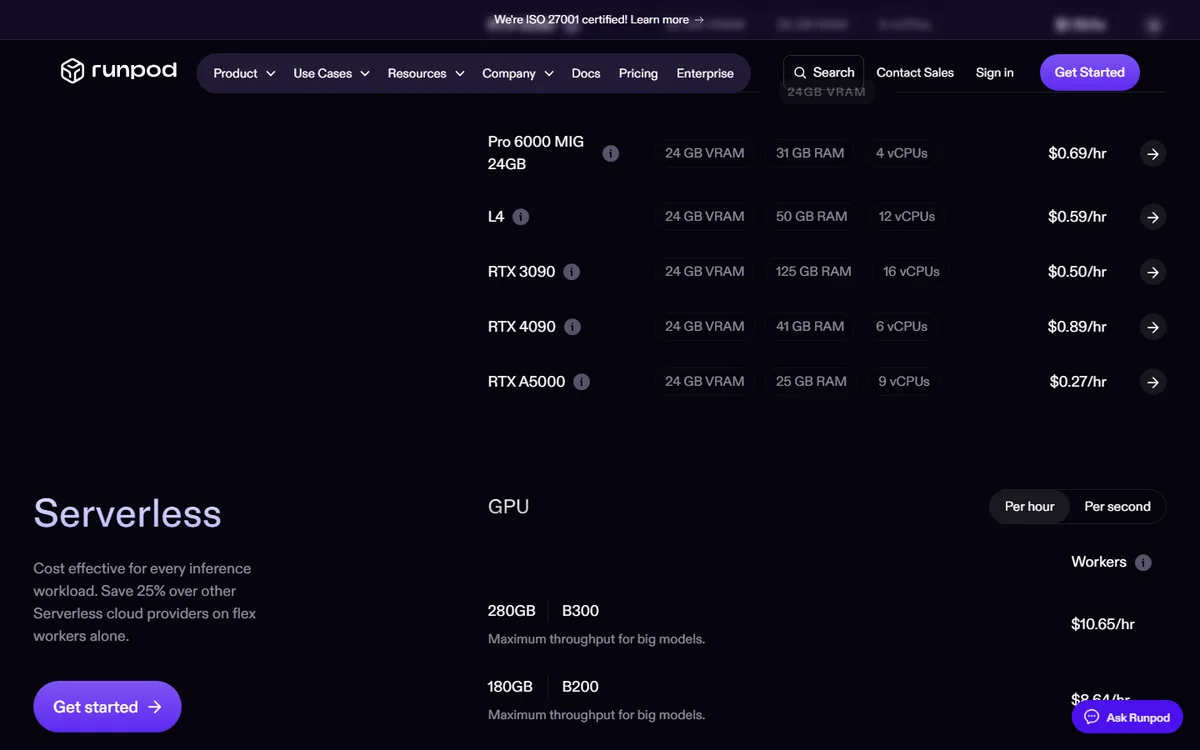
 Runpod
$0.34/hr
Community Cloud · Secure Cloud at $0.89
6 vCPU41 GB RAMVolume $0.10/GB-mo, $0.20 idleNetwork volume $0.07/GB-mo
Runpod's pricing page, updated 8 October 2026, lists the RTX 4090 with 6 vCPU and 41 GB of RAM at $0.89 an hour on Secure Cloud, the tab it shows by default, and its structured data gives $0.34 for Community Cloud, which runs on third-party hosts4. GetDeploying showed the Secure tier in stock in 1, 2 and 4-card sizes and the Community tier out of stock on 16 October14. Billing is per second, and storage is a separate line: a volume disk costs $0.10 per GB-month while the pod runs and $0.20 while it is stopped, and a network volume costs $0.07 per GB-month under 1 TB, which is how a 100 GB model library adds $7 a month. The serverless RTX 4090 worker is $1.10 an hour. Runpod's own guide, updated on 15 October, describes the card as end of life and still selling above its launch price31.4
Checked 16 Oct 2026
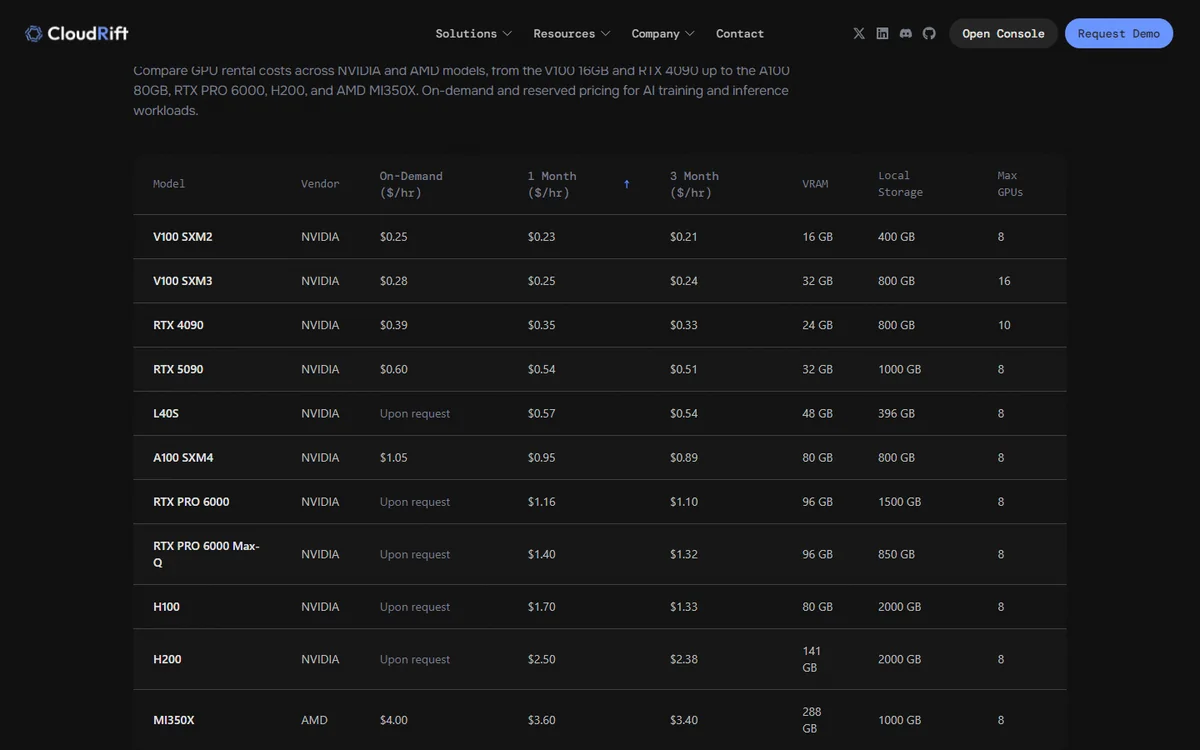
 CloudRift
$0.39/hr
Managed on demand · reservations from $0.33
800 GB local storageNetworkingNo egress fees1 month $0.353 months $0.33
CloudRift lists the RTX 4090 at $0.39 an hour on demand, billed by the second while the instance runs, with up to ten GPUs per instance12. Its FAQ says the rate covers compute, the attached local storage shown in the pricing table, 800 GB per card for this model, networking and standard support, and that there are no egress, ingress or API-call charges. A one-month reservation costs $0.35 and a three-month reservation $0.33, and the page warns that prices fluctuate and availability varies. The pricing table does not state the vCPU and RAM that come with each card, so check the configuration in the console before you launch. CloudRift also publishes its own vLLM benchmarks of the 4090 against the RTX 5090 and the RTX PRO 6000, which we use in the performance section25.12
Checked 16 Oct 2026
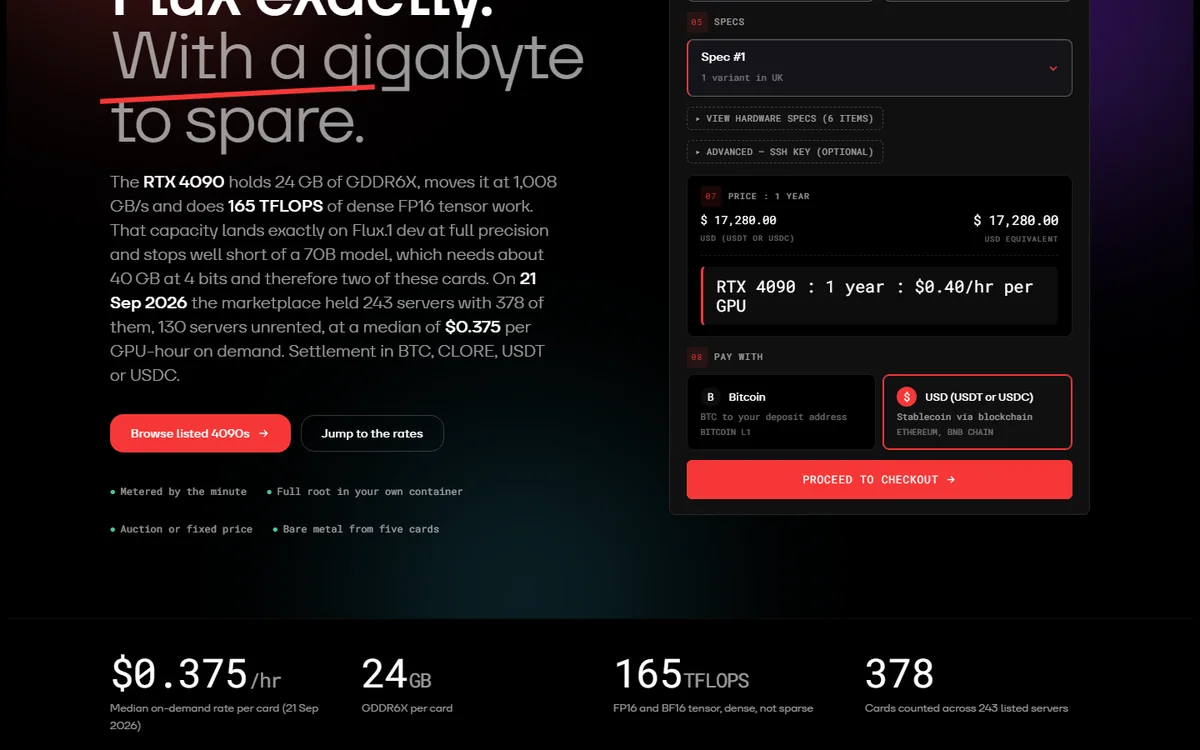
 Clore.ai
spot from $0.10/hr
Marketplace · snapshot of 21 Sep 2026
Host-set CPU, RAM, diskRenter fee 1.25% spot, 5% on demandPer-minute billing
Clore.ai publishes the most useful dated snapshot of any marketplace. On 21 September 2026 it counted 243 servers carrying 378 RTX 4090s, 130 of them unrented; the median on-demand quote was $0.375 per GPU-hour across 230 quotes and the median spot quote $0.365, the cheapest free server on spot was $0.100, and the median of the unrented servers was $0.583, because idle cards tend to be the overpriced ones2. The page title advertised from $0.28 on the day we read it. Clore bills by the minute and takes a 2.5 percent fee on spot and 10 percent on on-demand rentals, split equally between renter and host. Spot rentals are won by bid and a higher bid can take the machine mid-run. Bare-metal blocks of five cards for 14 days in the UK and eight cards for 30 days in Japan and Hong Kong were quoted at $0.40 to $0.94 per GPU-hour.2
Checked 16 Oct 2026
Where GPUBank wins, and where it does not
GPUBank is the cheapest managed on-demand RTX 4090 we found: $0.23 an hour, or $0.000064 a second, for 8 vCPU, 41 GB of RAM, a 500 GB local NVMe disk, one public IPv4 address and all inbound and outbound traffic, in machines of one to four GPUs1. Billing starts only after the machine passes its health check, a failed launch is not billed, a host failure during a job restarts the machine on a healthy host with the same disk and credits the session in full, and a stopped machine costs only its persistent disk at $0.03 per GB-month. The interruptible tier at $0.14 gives five minutes of notice, runs a checkpoint hook and stops the machine instead of deleting it, and a reservation for a week or a month costs $0.181. GPUBank lists the card in Frankfurt and Ashburn, with Paris on a waiting queue, and the median time from launch to a machine that has passed its health check is 48 seconds18.
It loses in three places. A lucky Clore.ai spot bid near $0.10 is cheaper than any GPUBank tier, and SaladCloud's lowest priority at $0.16 is close to its interruptible price for batch work that tolerates reclaims23. A used card bought for a workload that runs around the clock beats GPUBank's list on-demand rate past about 690 hours a month, as the section on buying shows. And payment is a prepaid balance topped up in crypto from $25 to $5,000, with cards not accepted for now; the balance never expires and carries a bonus of 20 to 60 percent, which brings the effective on-demand hour to about $0.19 with a $25 top-up, $0.17 with $100 and $0.14 with $1,000, but the bonus only pays if the credit is actually used1.

The rest of the market
Several managed offers sit just above the providers shown in the cards. Novita AI's own RTX 4090 page lists $0.33 an hour on demand and warns that the price follows the computing power market, while GetDeploying showed its single-card configuration with 16 vCPU and 125 GB of RAM out of stock on 16 October, along with a $0.17 spot rate and a 12-month four-card reservation at $0.27 per GPU, all sold out614. packet.ai rents a dedicated card at $0.39 with hourly billing, local NVMe and $0.04 per GB of egress, and its own page names both US Central and EU West as the region7. Beam's on-demand machine with 8 vCPU, 64 GB of RAM and 500 GB of NVMe starts at $0.44 with no egress fees13. Spheron lists 8 vCPU, 24 GB of RAM and 500 GB of storage at a last known $0.58, billed per minute after a 20-minute minimum, but its page said no RTX 4090 capacity was live when we read it15.
The marketplace tail is thinner than its reputation. Lium's own page shows a reference price of $0.30 with no pod available, while GetDeploying listed one Lium node in stock at $0.621614, and TensorDock's page quotes a typical $0.35 that varies by host, with vCPU at $0.003 an hour, RAM at $0.002 per GB-hour and NVMe at $0.00005 per GB-hour billed on top, on a pricing page last updated in July 202417. Further up, GetDeploying tracked Oblivus at $0.64 on demand and out of stock, a 36-month Oblivus reservation at $0.44, GPUhub at $0.44, SwissGPU at $0.48, Database Mart reservations at $0.51 to $0.76 and Runpod's Secure Cloud at $0.89 in stock, for a median on-demand rate of $0.47 across twelve providers on 16 October14. io.net's explorer, which our first survey quoted at $0.25, would not load for us, so it is left out of the comparison.
05 / Every offer
The whole comparison, sorted by kind and price.
| Provider | USD / GPU-hr | Kind | Unit | What the price includes | Billing | Stock | Basis |
|---|---|---|---|---|---|---|---|
| GPUBank | $0.23 | Managed on demand | 1 GPU | 8 vCPU, 41 GB RAM, 500 GB NVMe, IPv4, traffic | Per second | In stock | Provider page1 |
 Novita AI | $0.33 | Managed on demand | 1 GPU | Price follows the market; 16 vCPU per aggregator | Not stated | Sold out | Provider page6 |
| CloudRift | $0.39 | Managed on demand | 1 GPU | 800 GB local storage, networking, no egress | Per second | Not stated | Provider page12 |
| ppacket.ai | $0.39 | Managed on demand | 1 GPU | Dedicated card, local NVMe; egress $0.04/GB | Hourly | In stock | Provider page7 |
 Beam | $0.44 | Managed on demand | 1 GPU | 8 vCPU, 64 GB RAM, 500 GB NVMe, no egress | Not stated | Not stated | Provider page13 |
 Spheron | $0.58 | Managed on demand | 1 GPU | 8 vCPU, 24 GB RAM, 500 GB NVMe; 20 min minimum | Per minute | Sold out | Provider page15 |
 Oblivus | $0.64 | Managed on demand | 1 GPU | 12 vCPU, 70 GB RAM | Not stated | Sold out | Aggregator14 |
| Runpod Secure Cloud | $0.89 | Managed on demand | 1 GPU | 6 vCPU, 41 GB RAM; disks extra | Per second | In stock | Provider page4 |
| Clore.ai | $0.28 | Marketplace | 1 GPU | Headline 'from' price; host-set machine; 5% renter fee | Per minute | In stock | Provider page2 |
 Lium | $0.30 | Marketplace | 1 GPU | Reference price, varies by node | Per second | Sold out | Provider page16 |
| Runpod Community | $0.34 | Marketplace | 1 GPU | 6 vCPU, 41 GB RAM; volumes extra | Per second | Sold out | Provider page4 |
 TensorDock | $0.35 | Marketplace | 1 GPU | GPU only; vCPU, RAM, NVMe billed on top | Per second | Not stated | Provider page17 |
| Vast.ai | $0.36 | Marketplace | 1 GPU | Host CPU and RAM share; storage, bandwidth extra | Per second | In stock | Provider page5 |
| Clore.ai | $0.10 | Spot and interruptible | 1 GPU | Cheapest free spot server; median $0.365 | Per minute | Not stated | Provider snapshot2 |
| GPUBank | $0.14 | Spot and interruptible | 1 GPU | Same machine, 5 min notice, disk kept | Per second | In stock | Provider page1 |
| SaladCloud | $0.16 | Spot and interruptible | 1 GPU | Lowest priority; vCPU, RAM; no persistent disk | Per second | Not stated | Provider page3 |
| Novita AI | $0.17 | Spot and interruptible | 1 GPU | Spot, 16 vCPU | Not stated | Sold out | Aggregator14 |
| SaladCloud | $0.217 | Spot and interruptible | 1 GPU | Low priority | Per second | Not stated | Provider page3 |
| Vast.ai | $0.27 | Spot and interruptible | 1 GPU | Lowest interruptible bid; storage, bandwidth extra | Per second | In stock | Provider page5 |
| SaladCloud | $0.273 | Spot and interruptible | 1 GPU | Medium priority | Per second | In stock | Provider page3 |
| SaladCloud | $0.33 | Spot and interruptible | 1 GPU | High priority, still on consumer PCs | Per second | In stock | Provider page3 |
| GPUBank | $0.18 | Reserved | 1 GPU | Week or month, prepaid, same machine | Per term | In stock | Provider page1 |
| Novita AI | $0.27 | Reserved | cluster | Four cards for 12 months | Per term | Not stated | Aggregator14 |
| CloudRift | $0.33 | Reserved | 1 GPU | Three months, local storage included | Per term | Not stated | Provider page12 |
| CloudRift | $0.35 | Reserved | 1 GPU | One month, local storage included | Per term | Not stated | Provider page12 |
| Clore.ai | $0.40 | Reserved | cluster | Bare metal, 5 GPUs for 14 days (UK) and up; to $0.94 | Per term | On request | Provider snapshot2 |
| Oblivus | $0.44 | Reserved | 1 GPU | 36 months | Per term | Not stated | Aggregator14 |
| Beam | $0.69 | Serverless | 1 GPU | GPU only; CPU and RAM billed on top | Per millisecond | Not stated | Provider page13 |
| Runpod | $1.10 | Serverless | 1 GPU | Serverless worker; storage separate | Per second | Not stated | Provider page4 |
"Aggregator" rows could not be read on the provider's own page that day; "Provider snapshot" rows come from a page dated by the provider.
06 / The real monthly bill
What an RTX 4090 hour really costs
Storage is the line that most often changes the ranking for this card, because image and video work keeps large model libraries between sessions. On GPUBank the local NVMe is part of the rate and a persistent disk costs $0.03 per GB-month, so 100 GB of checkpoints and LoRAs costs $3 a month1. Runpod charges $0.07 per GB-month for a network volume under 1 TB and $0.20 for an idle volume disk4. Vast.ai bills each host's storage rate for as long as the instance exists, stopped or not, and the cheap listings we queried charged about $0.20 per GB-month, so the same 100 GB costs about $205. SaladCloud has no persistent disk at all, so weights are pulled again whenever the container lands on a new PC3.
Billing granularity and lost time are the other two hidden lines. A 61-minute ComfyUI session at $0.23 costs $0.23 when billed per second, as on GPUBank, Runpod, CloudRift, SaladCloud and Vast.ai, and $0.46 when the meter rounds up to the started hour, while Spheron's 20-minute minimum makes a five-minute test cost twenty minutes15. Lost time matters more on the cheapest offers, because on a marketplace the renter usually pays for it: an outbid spot instance is gone and billed to the minute, a host that runs the card on PCIe 3.0 or gives it two CPU cores makes the job longer at your expense, and the cheapest Vast listing reported a measured memory bandwidth of 876 GB/s for a card rated at 1,0085. Clore's own guide says renters are not charged for the downtime when an instance goes down unexpectedly, but a slow host is still paid in full19. GPUBank does not bill a failed launch and credits a session interrupted by a host failure1, which is why the scenarios below add an explicit allowance for lost time to every marketplace and spot row.
Three workloads, priced for a month
GPUBank
40.67 h GPU$9.35
Storage$3.00
OtherNone
Month$12.35
On demand, per second, traffic and IPv4 included
All-inSaladCloud
40.67 h GPU$13.42
Storage$0.00
OtherModel storage kept elsewhere
Month$13.42
High priority, no persistent disk
CloudRift
40.67 h GPU$15.86
Storage$0.00
OtherPersistent storage not priced
Month$15.86
On demand, per second, local disk only while running
Runpod
40.67 h GPU$13.83
Storage$7.00
OtherNone
Month$20.83
Community Cloud, 100 GB network volume at $0.07
Vast.ai
40.67 h GPU$14.64
Storage$20.00
OtherBandwidth at host rate
Month$34.64
Cheapest on-demand listing; 100 GB at $0.20 kept all month
Forty sessions of 61 minutes are 40.67 billed hours on any per-second meter. On GPUBank that is $9.35 of GPU time plus $3.00 for a 100 GB persistent disk, $12.35 in all, or about $9.15 of real money from a $100 top-up credited as $135. SaladCloud's high tier comes to $13.42 but keeps no disk, so the model library must live elsewhere and download at each start. Runpod Community is $13.83 plus $7.00 of network volume, $20.83. CloudRift is $15.86 with nothing kept between sessions. Vast's cheapest listing costs only $14.64 of GPU time, but keeping 100 GB on the instance all month at $0.20 per GB-month adds $20, for $34.64. GPUBank wins here, and the answer changes only for a user who keeps nothing between sessions and accepts Salad's re-downloads.
GPUBank
313.33 h GPU$43.87
Storage$6.00
Other3% reclaim allowance
Month$51.18
Interruptible, 5 min notice, disk kept
All-inGPUBank
313.33 h GPU$72.07
Storage$6.00
OtherNone
Month$78.07
On demand
All-inClore.ai
313.33 h GPU$31.33
Storage$0.00
Other1.25% fee and 10% lost time
Month$34.86
Spot floor of the 21 Sep snapshot, host disk included
SaladCloud
313.33 h GPU$50.13
Storage$0.00
Other10% lost time; storage elsewhere
Month$55.15
Lowest priority on consumer PCs
Vast.ai
313.33 h GPU$84.60
Storage$40.00
Other10% lost time, bandwidth extra
Month$133.06
Lowest interruptible bid; 200 GB at $0.20
Clore.ai
313.33 h GPU$114.37
Storage$0.00
Other1.25% fee and 10% lost time
Month$127.23
Median spot quote of the 21 Sep snapshot
At the measured 11.28 seconds an image, 100,000 FLUX.1 dev images take 313.33 GPU-hours. GPUBank's interruptible tier costs $43.87 for that time, plus $6.00 of disk and a 3 percent reclaim allowance of $1.32, $51.18 in all, against $78.07 on demand. A Clore.ai server held at the $0.10 spot floor would cost $34.86 with the fee and a 10 percent allowance for lost time, the cheapest result on the page, but at Clore's median spot quote the same work costs $127.23. SaladCloud's lowest tier comes to $55.15 before outside storage. Vast's lowest bid of $0.27 gives $93.06 of GPU time and allowance plus $40 of storage, $133.06. Clore wins only if you find and keep a free server near the floor; GPUBank interruptible is the cheapest price you can plan on.
GPUBank
730 h GPU$131.40
Storage$3.00
OtherNone
Month$134.40
Reserved for the month, prepaid
All-inGPUBank, $1,000 top-up
730 h GPU$104.94
Storage$1.88
OtherNone
Month$106.81
On demand at list $170.90; cash paid from a top-up credited $1,600
All-inRunpod
730 h GPU$248.20
Storage$7.00
OtherNone
Month$255.20
Community Cloud, if stock holds
CloudRift
730 h GPU$255.50
Storage$0.00
OtherNone
Month$255.50
One-month reservation, local storage included
Vast.ai
730 h GPU$262.80
Storage$20.00
OtherBandwidth at host rate
Month$282.80
Cheapest on-demand listing, if it stays listed
SaladCloud
730 h GPU$481.80
Storage$0.00
OtherSecond replica
Month$481.80
High priority, two nodes for an endpoint
A full month is 730 hours. GPUBank reserved for the month costs $131.40 plus $3.00 of disk, $134.40, and the on-demand rate costs $170.90 at list price, or $106.81 of real money if paid from a $1,000 top-up credited as $1,600, which then lasts about nine months at this rate; whether bonus credit can pay for a reservation is not stated. Runpod Community comes to $255.20 with its volume, CloudRift's one-month reservation to $255.50 with storage included, and Vast's cheapest listing to $282.80 with storage, if that host stays listed for the month. SaladCloud's high tier is $240.90 a node, but its nodes can be reclaimed, so an endpoint needs two, $481.80. GPUBank wins by a wide margin, and within GPUBank the reservation beats list on-demand past about 571 hours a month.
07 / Speed per dollar
What it does well, and where it stops
Measured results put the RTX 4090 where its memory says it should be. In ComfyUI's community benchmark of the standard FLUX.1 dev FP8 workflow, a 4090 on PyTorch 2.9.1 and ComfyUI 0.6.0 took 11.28 seconds an image, against 8.78 seconds for an RTX 5090 and 26 seconds for an RTX 309020, so 1,000 images take 3.13 GPU-hours; NVIDIA's own figure is about 10 seconds at FP8 and 15 at FP1621. On SDXL at 1024 by 1024 and 20 steps, Formula Mod reports about 3.2 seconds on the 4090 and 2.2 on the 5090, and Spheron about 2.1 seconds on the 4090 against 2.5 on the L40S, so 1,000 SDXL images cost about $0.20 on GPUBank's 4090 against $0.29 on its 5090 and about $0.38 on its L40S2223. In llama.cpp's CUDA scoreboard, which runs Llama 2 7B at Q4_0 with flash attention, the 4090 generates 188.96 tokens per second against 300.40 for the 5090 and 200.90 for an 80 GB A10024. Batched serving changes the scale: CloudRift measured 2,259 tokens per second on one 4090 serving Qwen3-Coder-30B-A3B in AWQ through vLLM under heavy concurrency25.
The card stops being the right tool in three cases. The first is any model that does not fit in 24 GB: FLUX.1 dev in BF16, which Clore puts at about 24 GB with no headroom and Spheron at 30 to 33 GB with its text encoders loaded, a 70B language model, which needs about 40 GB at 4-bit, or a 32B model served with a long context223. CloudRift's own test needed two 4090s to serve Llama 3.3 70B at 4-bit and reached 467 tokens per second, against 1,031 on a single 96 GB RTX PRO 600025. The second is work that splits one model across cards, because without NVLink every layer pays a PCIe toll under tensor parallelism. The third is unattended production serving where ECC memory, a datacenter driver and a service agreement matter more than the hourly rate, which is the ground of the L40S and the datacenter cards.
ComfyUI GitHub discussion #9002; each result posted by a user, second or later render20
llama.cpp CUDA scoreboard, ggml-org discussion #1501324
CloudRift, RTX 4090 vs 5090 vs PRO 6000 LLM inference benchmark, 9 Oct 202525
CHEAPEST ALL-IN
$0.23
GPUBank on demand, whole machine and traffic
MARKETPLACE MEDIAN
$0.53
Vast.ai per-GPU median across listings, 16 Oct
USED CARD
$2,214
GetPCParts used value, 6 Oct 2026
08 / Against other cards
The RTX 4090 against the other cards, per job
Per job rather than per hour, the RTX 4090 is the cheapest card GPUBank rents for anything that fits in 24 GB. On FLUX.1 dev at FP8, 1,000 images cost $0.72 on the 4090 at 11.28 seconds each and $1.17 on the RTX 5090 at 8.78 seconds and $0.48 an hour20, so the 5090 buys speed rather than savings. For a single user in llama.cpp, a million tokens cost $0.34 on the 4090, $0.44 on the 5090 and $1.31 on an 80 GB A100 at GPUBank's $0.95 A100 rate, because the A100 generates only 6 percent faster here24. Under batched vLLM serving the 4090 and the 5090 converge at about $0.03 per million tokens each, since the 5090's 4,570 tokens per second are almost exactly twice the 4090's 2,259 at a little more than twice the price25.
The other cards earn their price through memory rather than speed. The RTX 5090 at $0.48 adds 8 GB and FP4 support, which is enough for FLUX at higher precision, more LoRAs loaded at once or a 32B model with a usable context. The L40S at $0.55 brings 48 GB of ECC memory, which suits BF16 FLUX, stacked ControlNets and high-resolution upscaling, although we found no measurement on the same tests to price it per job. The A100 SXM at $0.95 has 80 GB of HBM2e at 2.0 TB/s and is the card for models and batches that need it, not a faster 4090: to match the 4090 per job it would have to finish 4.1 times sooner, and on the workloads measured here it is barely faster at all124.
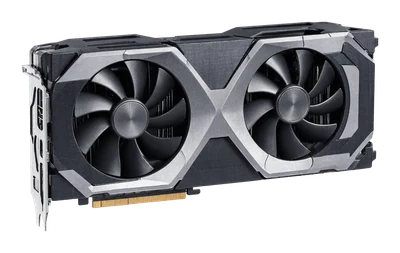
RTX 4090
24 GB GDDR6X · 1.0 TB/s
$0.23/hr
ComfyUI, SDXL and LoRA training on 8B models
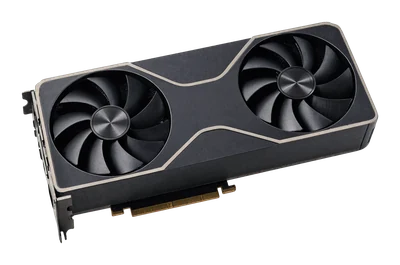
RTX 5090
32 GB GDDR7 · 1.8 TB/s
$0.48/hr
FLUX, SDXL, AI video and small language models
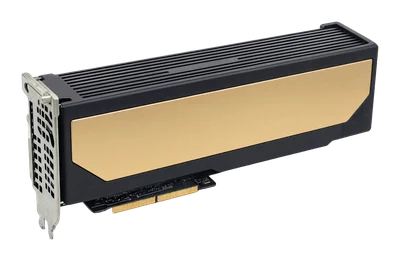
L40S
48 GB GDDR6 ECC · 864 GB/s
$0.55/hr
Stable Diffusion, video, Whisper transcription and embeddings
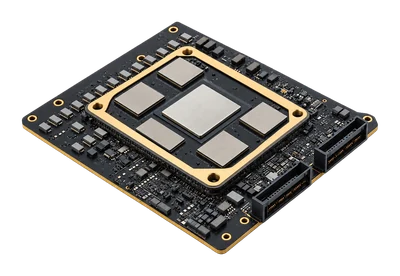
A100 SXM
80 GB HBM2e · 2.0 TB/s
$0.95/hr
LoRA and QLoRA fine-tuning, batch inference
GPUBank on-demand prices, all-in. Memory bar scaled to 80 GB.
09 / Rent or buy
Rent or buy a used RTX 4090
The realistic purchase is one used card in a workstation, because new stock has gone and an eight-card 4090 server is neither sold nor licensed for a datacenter. Trackers disagree on what that card costs. GetPCParts put the used value at $2,214 on 6 October 2026 after a $3,010 spike in September26, PCPrice.watch reported an eBay sold median of €2,185 over 111 sales in 90 days27, and DealHunter's median asking price across 54 used listings was $2,999 on 15 October28. We use $2,200 for the card, $1,200 for the machine around it, $1,400 of combined resale value after 24 months, a draw of 0.6 kW under load and US residential electricity at 18.19 cents per kWh29. Owning then costs $83.33 a month in capital plus $0.11 in power for every hour the card works.
Against GPUBank's $0.23 list rate, each rented hour costs $0.12 more than the electricity of an owned card, so the $83.33 of monthly capital is recovered after about 690 hours, which is a card that works 23 hours a day. At a full 730 hours owning costs $163.01 against $167.90 on demand, a narrow win for the buyer, but a month reserved at $0.18 costs $131.40 and the on-demand rate paid from a $100 top-up works out at $124.37, and the owned card never beats either, because the margin they leave above its electricity is too small to recover the capital in a 730-hour month. Buy if the card will run almost continuously, if your data must stay on your premises, if you already own one or if it also serves as your desktop card. Rent for anything less, for bursty work, and to try the RTX 5090 or the L40S when a job needs more memory.

| Hours a month | Rent at $0.23 | Rent at $0.14 effective | Own | Cheaper |
|---|---|---|---|---|
| 50 | $11.50 | $7.19 | $88.79 | Rent |
| 100 | $23.00 | $14.38 | $94.25 | Rent |
| 200 | $46.00 | $28.75 | $105.16 | Rent |
| 400 | $92.00 | $57.50 | $126.99 | Rent |
| 730 | $167.90 | $104.94 | $163.01 | Rent |
Used value $2,214 on 6 Oct 2026 (GetPCParts); eBay sold median €2,185 (PCPrice.watch, 15 Oct); asking median $2,999 (DealHunter, 15 Oct)
10 / What to choose
The cheapest RTX 4090 depends on the job.

Creators running ComfyUI, SDXL or FLUX
GPUBank RTX 4090 on demand
Per-second billing, a cheap persistent disk for the model library and included traffic make short sessions cheapest at $0.23 an hour.

Large batch jobs that checkpoint
GPUBank interruptible, or a Clore.ai or SaladCloud floor
At $0.14 with notice and the disk kept, or $0.10 to $0.16 if you accept reclaims without notice and re-downloads.

LoRA fine-tuning up to 8B
RTX 4090, interruptible for long runs
QLoRA on 8B fits in 24 GB, and a trainer that checkpoints loses minutes, not hours, when the card is reclaimed.

Models above 24 GB or long contexts
RTX 5090, L40S or RTX PRO 6000
A 70B model needs about 40 GB at 4-bit; paying for memory beats splitting a model across cards with no NVLink.
11 / Questions
What people ask before renting one.
The cheapest RTX 4090 hours are on capacity that can be taken back, and which one is cheapest depends on how much risk you accept. Clore.ai's snapshot of 21 September 2026 found a free spot server at $0.10 per GPU-hour, but that was one server among 243 and a higher bid can take it2. GPUBank's interruptible tier is $0.14 with five minutes of notice and the disk kept, and SaladCloud's lowest priority is $0.16 on consumer PCs with no persistent disk13. For capacity that cannot be interrupted, GPUBank's $0.23 is the lowest all-in price we found, ahead of Novita AI at $0.33, Runpod Community at $0.34 and Vast.ai's cheapest listing at $0.36 before storage and bandwidth645.
An RTX 4090 costs between $0.10 and $0.89 an hour to rent in October 2026, and most offers that include a usable machine fall between $0.23 and $0.45. The low end is spot and priority capacity: Clore.ai at $0.10 in its September snapshot, GPUBank interruptible at $0.14 and SaladCloud from $0.16213. On demand, GPUBank charges $0.23, Novita AI $0.33, Runpod Community $0.34, Vast.ai from $0.36, CloudRift and packet.ai $0.39 and Beam $0.4451213. Datacenter-style fixed offers cost more, with Runpod Secure Cloud at $0.894. GetDeploying's median on-demand rate across twelve providers was $0.47 on 16 October14. Compare what each price includes before you compare the numbers.
The large clouds do not rent the RTX 4090 because NVIDIA's driver licence says that GeForce software is not licensed for datacenter deployment. The clause is 2.8 in the current licence, dated 25 February 2025, and it also limits GeForce software to GeForce hardware you own8. NVIDIA first added the restriction at the end of 2017 and said at the time that it wanted to keep GeForce cards out of demanding, large-scale enterprise environments11. AWS, Google Cloud, Azure and Oracle therefore offer the datacenter L4 and L40S instead. The 4090 comes only from specialised GPU clouds, peer-to-peer marketplaces and networks of consumer PCs, so read each provider's terms, reliability record and data policy more carefully than you would a hyperscaler's.
Vast.ai's cheapest RTX 4090 listing is close to Runpod Community Cloud's price, but its typical listing costs more. On 16 October Vast's public offer search showed the cheapest single card at $0.36 on demand, a median of $0.53 across its listings and interruptible bids from $0.275, while Runpod listed $0.34 on Community Cloud, out of stock on GetDeploying that day, and $0.89 on Secure Cloud414. Vast's rate covers the GPU and the host's CPU and RAM share, and storage and bandwidth come on top at each host's rate, with storage billed even while the instance is stopped. Runpod charges no egress but bills volumes at $0.10 per GB-month running and $0.20 idle. With a large model library kept all month, the storage line usually decides the comparison rather than the GPU rate.
SaladCloud's RTX 4090 is cheap because it runs on consumer PCs that their owners use, so a container can be moved off a machine at any time and no tier behaves like dedicated on-demand capacity. The prices are $0.330 at high priority, $0.273 at medium, $0.217 at low and $0.160 at the lowest batch tier, billed per second with vCPU and RAM included3, unchanged since 12 September 202630. A higher-priority workload displaces a lower one, and there is no persistent disk, so model weights are pulled again on every new node. For batch image generation or transcription that retries failed items, it is one of the cheapest published hours. For a production endpoint, plan on at least two replicas, which doubles the bill to about $482 a month at high priority.
A marketplace RTX 4090 at about $0.10 an hour is a spot slot on one host, and what comes with it is whatever that host offers. Clore.ai's snapshot of 21 September 2026 showed the cheapest free spot server at $0.100 against a spot median of $0.365, with a 1.25 percent renter fee on spot and per-minute billing2. Spot rentals are won by bid, so a higher bid can take the machine during a job, and the cheapest servers tend to give the card few CPU cores and little RAM. On Vast.ai the GPU rate excludes storage and bandwidth, which each host prices separately and bills while the instance exists5. Benchmark the host for a few minutes and price the job, not the hour, before you commit a long run to it.
An on-demand RTX 4090 stays yours until you stop it, while a spot or interruptible one can be taken back by the provider or by a higher bid. The discounts are large: GPUBank's interruptible tier costs $0.14 against $0.23 on demand, about 40 percent less, Novita lists spot at $0.17 against $0.33, and SaladCloud's lowest tier is about half its high tier1143. The terms of the interruption differ far more than the discounts. GPUBank gives five minutes of notice, runs your checkpoint hook, stops the machine rather than deleting it and credits the last 30 minutes if the notice is missed1. On Vast.ai and Clore.ai a higher bid takes the machine, and SaladCloud treats every tier, including its high priority, as interruptible523. Use interruptible capacity for batch jobs that checkpoint often, and on-demand or reserved capacity for anything a user is waiting on.
A single RTX 4090 cannot run a 70B model properly, because the weights alone need about 40 GB at 4-bit precision and the card has 24 GB. Offloading most of the model to system RAM produces output, but the GPU then spends its time waiting on the PCIe bus. Two cards work: CloudRift served Llama 3.3 70B at 4-bit AWQ across two RTX 4090s with vLLM at 467 tokens per second under load, against 1,230 on two RTX 5090s and 1,031 on one 96 GB RTX PRO 600025. The 4090 has no NVLink, so the split pays a PCIe cost on every request. For a 70B model, a single card with enough memory is usually simpler and cheaper per token than a pair of 4090s. One 4090 is comfortable up to about 14B at 8-bit or 32B at 4-bit with a short context.
A rented RTX 4090 handles SDXL easily and runs FLUX.1 dev well at FP8, which is the precision most ComfyUI workflows use on 24 GB. In ComfyUI's community benchmark of the standard FLUX dev FP8 template, a 4090 took 11.28 seconds an image, against 8.78 seconds on an RTX 5090 and 26 seconds on an RTX 309020. At GPUBank's $0.23 an hour, 1,000 FLUX images cost $0.72 on the 4090 and $1.17 on the 5090 at $0.48, so the older card is the cheaper one per image and the newer one the faster1. The 4090's limit is memory: FLUX.1 dev in BF16, several ControlNets at once or large upscales can exceed 24 GB, and that is when a 32 GB or 48 GB card earns its higher price.
Rent the RTX 4090 when the model fits in 24 GB and cost per result matters, and the RTX 5090 when you need its extra 8 GB, lower latency or FP4. On GPUBank the 4090 costs $0.23 and the 5090 $0.48, so the 5090 must be 2.1 times faster to match the 4090 per job1. It is not on FLUX.1 dev at FP8, where it takes 8.78 seconds against 11.28, so 1,000 images cost $1.17 against $0.7220. In llama.cpp single-user generation it reaches 300.40 tokens per second against 188.96, so a million tokens cost $0.44 against $0.3424. In batched vLLM serving it doubles the throughput, 4,570 against 2,259 tokens per second, and the cost per token ends up about equal25.
A full 730-hour month of one RTX 4090 costs about $105 to $650 depending on the provider and the terms. On GPUBank it costs $167.90 at the on-demand rate, $131.40 reserved for the month, or about $104.94 of real money when paid from a $1,000 top-up credited as $1,600, with a persistent disk adding $0.03 per GB-month1. CloudRift's one-month reservation comes to $255.50 with local storage included, Runpod Community at $0.34 to $248.20 plus volume storage, and Vast.ai's cheapest $0.36 listing to $262.80 before host storage and bandwidth1245. SaladCloud's high tier is $240.90 a node, but an always-on service needs a second replica because its nodes can be reclaimed3. Fixed datacenter-style offers cost far more: Oblivus at $0.64 comes to $467.20 and Runpod Secure Cloud at $0.89 to $649.70144.
Buying a used RTX 4090 is cheaper than renting only if the card works almost around the clock. Used cards were valued at $2,214 on 6 October 2026 by GetPCParts, sold for a median of €2,185 on eBay according to PCPrice.watch, and were listed at a median asking price of $2,999 on DealHunter262728. With $2,200 for the card, $1,200 for the machine, $1,400 of resale value after two years, a 0.6 kW draw and US power at 18.19 cents per kWh29, owning costs $83.33 a month plus $0.11 per hour of use. That beats GPUBank's $0.23 list rate only past about 690 hours a month, and never beats the $0.18 reservation or the $0.17 effective rate from a $100 top-up1.
On most providers a stopped RTX 4090 instance keeps billing its storage. On GPUBank a stopped machine costs only its persistent disk at $0.03 per GB-month; compute, the IPv4 address and the local NVMe cost nothing until you start it again1. Runpod bills an idle volume disk at $0.20 per GB-month and a network volume at $0.07 under 1 TB4. On Vast.ai the host's storage rate runs for as long as the instance exists, whether it is running or not, at about $0.20 per GB-month on the cheap listings we saw5. SaladCloud has no persistent disk, so nothing is billed, but nothing is kept either. Read the stop and delete terms before you leave an instance parked for a week.
Yes, LoRA and QLoRA fine-tuning of an 8B model fits on one RTX 4090, and QLoRA reaches models of about 14B parameters within 24 GB. GPUBank positions its RTX 4090 for LoRA training on 8B models and provides Unsloth, Axolotl and Kohya templates as well as PyTorch 2.8 with CUDA 12.81. A full 16-bit fine-tune of an 8B model does not fit, because the weights, gradients and optimiser state together need several times the card's memory. Training across several 4090s works for data-parallel runs where each card holds the whole model, but it is slowed by the lack of NVLink once the model has to be split. For long runs, the interruptible tier at $0.14 is attractive if the trainer saves checkpoints regularly, since a reclaim then costs minutes.
Community-cloud RTX 4090s run on machines owned by people you do not know, so treat them as unsuitable for regulated or confidential data. On Vast.ai, Clore.ai, Runpod Community Cloud and SaladCloud, independent hosts operate the hardware, and container isolation protects you from other tenants but not from the owner of the machine523. Runpod sells its Secure Cloud, at $0.89 for this card, as the option in vetted datacenters4. For public models, open datasets and creative work, community hosts are usually fine, and their low price is the point. For customer data, unreleased weights or work under contract, a managed offer whose operator runs its own regions is the cheaper choice once the risk is counted, even at a few cents more an hour.
Sources
Sources
- 01GPUBank pricingRTX 4090 rates, inclusions, billing, top-up bonuses, other cards · read 16 Oct 2026
- 02Clore.ai, Rent RTX 409021 Sep 2026 snapshot, fees, billing, bare-metal quotes · read 16 Oct 2026
- 03SaladCloud pricingRTX 4090 at four priorities, inclusions, billing · read 16 Oct 2026
- 04Runpod pricing (updated 8 October 2026)Secure and Community rates, storage, serverless · read 16 Oct 2026
- 05Vast.ai public offer search, RTX 4090Cheapest listing, median rate, bids, host storage rates, measured bandwidth · read 16 Oct 2026
- 06Novita AI, RTX 4090 GPU instanceOn-demand rate · read 16 Oct 2026
- 07packet.ai, Rent RTX 4090Dedicated rate, billing, egress · read 16 Oct 2026
- 08NVIDIA Driver License Agreement (v. 25 February 2025)Clause 2.8, no datacenter deployment · read 16 Oct 2026
- 09NVIDIA GeForce RTX 4090 product pageCUDA cores, memory, bus, power · read 16 Oct 2026
- 10Engadget, NVIDIA's $1,599 GeForce RTX 4090 arrives on October 12thLaunch date and price · read 16 Oct 2026
- 11The Register, Nvidia: Using cheap GeForce, Titan GPUs in servers? Haha, nope!Origin of the clause and NVIDIA's statement · read 15 Oct 2026
- 12CloudRift pricingOn-demand and reserved rates, inclusions, no egress · read 16 Oct 2026
- 13Beam pricingOn-demand machine, serverless rate, no egress · read 16 Oct 2026
- 14GetDeploying, RTX 4090 rental pricesAggregator rates and stock, $0.47 median across twelve providers on 16 Oct · read 16 Oct 2026
- 15Spheron, RTX 4090 rentalLast known rate, minimum runtime, no capacity · read 16 Oct 2026
- 16Lium, RTX 4090Reference price, no pod available · read 16 Oct 2026
- 17TensorDock cloud GPUsTypical rate and per-resource prices · read 16 Oct 2026
- 18GPUBank, GPU board and regionsRTX 4090 regions, median launch time · read 16 Oct 2026
- 19Clore.ai blog, How to rent a GPU: complete beginner's guideNo charge for unexpected instance downtime · read 15 Oct 2026
- 20ComfyUI discussion #9002, FLUX dev FP8 benchmarkSeconds per image on RTX 3090, 4090, 5090 · read 16 Oct 2026
- 21NVIDIA blog, GeForce RTX 50 Series launch: FLUX.1 dev timingsFLUX.1 dev on the RTX 4090, about 15 s at FP16 and 10 s at FP8 · read 15 Oct 2026
- 22Formula Mod, Best GPU for Stable Diffusion and Flux in 2026SDXL 1024 px, 20 steps: about 3.2 s on RTX 4090, 2.2 s on RTX 5090 · read 15 Oct 2026
- 23Spheron, Best GPU for AI image generation 2026SDXL 1024 px, 20 steps: about 2.1 s on RTX 4090, 2.5 s on L40S · read 15 Oct 2026
- 24llama.cpp discussion #15013, performance on NVIDIA CUDATokens per second, Llama 2 7B Q4_0 · read 16 Oct 2026
- 25CloudRift, RTX 4090 vs 5090 vs PRO 6000: LLM inference benchmarkvLLM throughput, settings · read 16 Oct 2026
- 26GetPCParts, used RTX 4090 market priceUsed values January to October 2026 · read 16 Oct 2026
- 27PCPrice.watch, RTX 4090 used priceeBay sold median over 90 days · read 16 Oct 2026
- 28DealHunter, used RTX 4090 priceMedian asking price, 15 Oct 2026 · read 16 Oct 2026
- 29EIA, Electric Power Monthly, table 5.3US residential electricity price · read 15 Oct 2026
- 30SaladCloud blog, price changes of 12 September 2026Date of the current rates · read 15 Oct 2026
- 31Runpod, Is the RTX 4090 still worth it for AI in 2026?End of life, street prices in 2026 · read 16 Oct 2026
- 32Tom's Hardware, eBay historical GPU prices 2023eBay average sold prices, September and October 2023 · read 16 Oct 2026
- 33Wccftech, RTX 4090 sees massive price hike prior to RTX 5090 launch (8 Dec 2024)Retail prices in December 2024 · read 16 Oct 2026
What we could not confirm
Several figures could not be confirmed at source on 16 October 2026. Clore.ai's $0.10 spot floor, its $0.365 and $0.375 medians and its $0.40 to $0.94 bare-metal quotes come from Clore's own snapshot of 21 September, not from live listings. Vast.ai's figures come from its public offer search at one moment and move by the hour; its pricing page itself rendered no figure for us, and the $0.14 floor in our first survey and on Vast's CLI page was not in the live offers. Runpod's $0.34 Community rate is in the pricing page's structured data, while the visible card showed only the $0.89 Secure rate. Novita AI's stock, its spot and reserved rates, all Oblivus figures and Runpod Community's stock come from GetDeploying, which on 16 October also listed a Lium node at $0.62 that Lium's own page did not show. TensorDock's typical $0.35 sits on a page last updated in July 2024. io.net's explorer would not load, so its $0.25 rate was dropped, as were Hostinger, Shadeform, Sesterce, Akash and LeaderGPU, which we could not reread. packet.ai's page names two different regions. Whether GPUBank's bonus credit can pay for reservations is not stated. We found no checkable L40S result on the three benchmarks used here. Our first survey quoted the 2017 licence wording with a blockchain exception as current; the current clause 2.8 has none. The rent-or-buy arithmetic rests on stated assumptions for the machine cost, resale and power draw. The SDXL timings from Formula Mod and Spheron were read on 15 October and are vendor blog figures without full settings; Formula Mod's site did not answer on 16 October, so we could not reread it.
RTX 4090 on GPUBank
The cheapest whole machine with a 4090 inside.
- 8 vCPU, 41 GB RAM, 500 GB NVMe, IPv4 and traffic in $0.23/hr
- Billed by the second after the health check
- Interruptible $0.14, reserved $0.18
 8 vCPU, 41 GB RAM, 500 GB NVMe, IPv4 and traffic in $0.23/hr
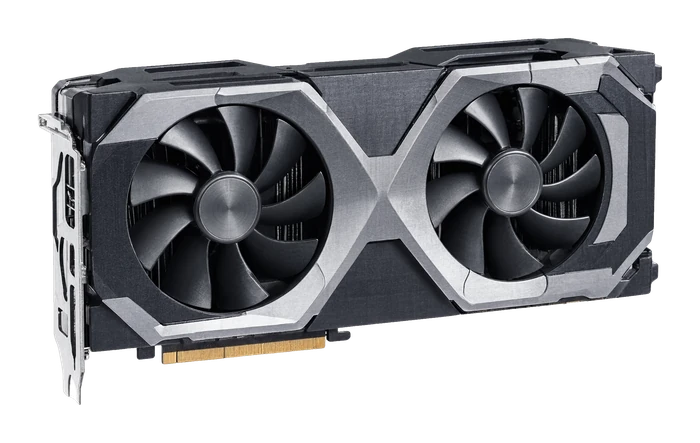
More GPU price guides
Where to rent the other cards at the cheapest price.
 B200 SXM180 GB HBM3eFrom $2.49 spot · $4.15 all-in
 H200 SXM141 GB HBM3eFrom $1.49 spot · $2.49 all-in
 H100 SXM80 GB HBM3From $1.11 spot · $1.85 all-in
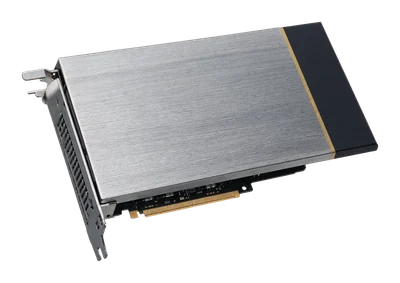 H100 PCIe80 GB HBM2eFrom $0.81 spot · $1.35 all-in
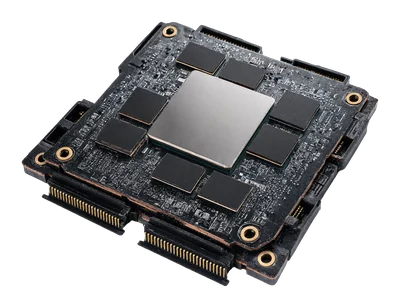 MI300X192 GB HBM3From $0.99 spot · $1.65 all-in
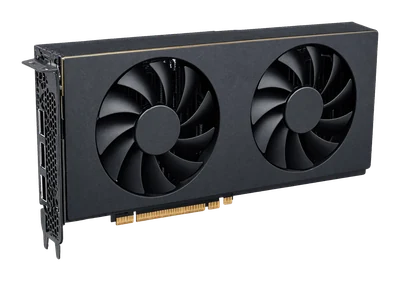 RTX PRO 600096 GB GDDR7 ECCFrom $0.69 spot · $1.15 all-inA100 SXM80 GB HBM2eFrom $0.57 spot · $0.95 all-inL40S48 GB GDDR6 ECCFrom $0.33 spot · $0.55 all-inRTX 509032 GB GDDR7From $0.29 spot · $0.48 all-in